Laos Metal & Metallurgy Machinery Market: Top 5 Importing Countries and Market Competition (HHI) Analysis
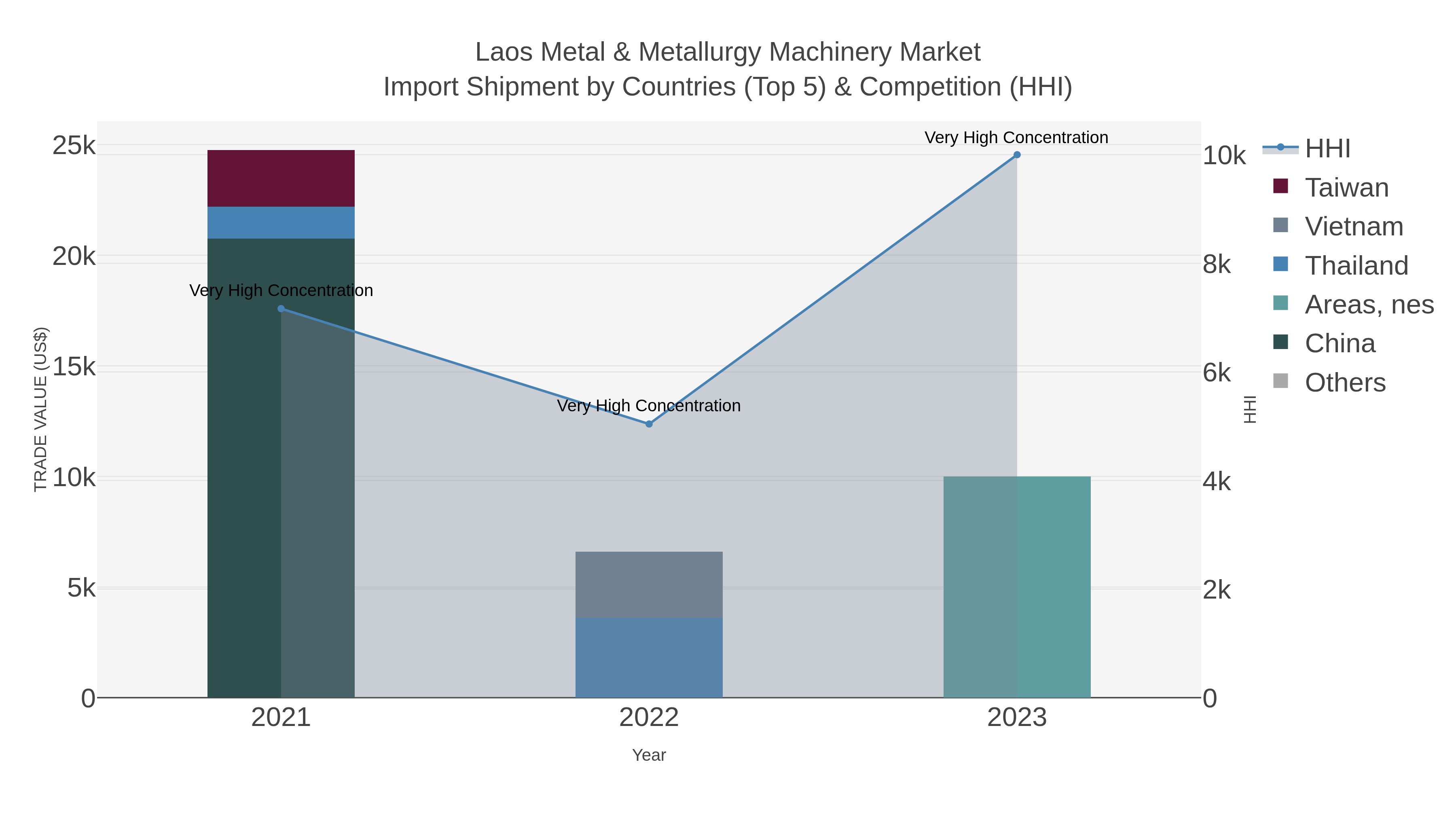
In 2023, Laos saw significant imports of metal and metallurgy machinery primarily from top exporters such as Areas (unspecified location), China, Taiwan, Thailand, and Vietnam. Despite high concentration with a very high Herfindahl-Hirschman Index (HHI) in 2023, the industry experienced a sharp decline with a compound annual growth rate (CAGR) of -36.44%. However, there is a silver lining as the growth rate surged to an impressive 51.68%, indicating potential opportunities for market expansion and development in the coming years.
Key Highlights of the Report:
- Laos Metal & Metallurgy Machinery Market Outlook
- Market Size of Laos Metal & Metallurgy Machinery Market, 2025
- Forecast of Laos Metal & Metallurgy Machinery Market, 2032
- Historical Data and Forecast of Laos Metal & Metallurgy Machinery Revenues & Volume for the Period 2022 - 2032F
- Laos Metal & Metallurgy Machinery Market Trend Evolution
- Laos Metal & Metallurgy Machinery Market Drivers and Challenges
- Laos Metal & Metallurgy Machinery Price Trends
- Laos Metal & Metallurgy Machinery Porter`s Five Forces
- Laos Metal & Metallurgy Machinery Industry Life Cycle
- Historical Data and Forecast of Laos Metal & Metallurgy Machinery Market Revenues & Volume By Product Types for the Period 2022 - 2032F
- Historical Data and Forecast of Laos Metal & Metallurgy Machinery Market Revenues & Volume By Metal Rolling Machinery for the Period 2022 - 2032F
- Historical Data and Forecast of Laos Metal & Metallurgy Machinery Market Revenues & Volume By Steelmaking Equipment for the Period 2022 - 2032F
- Historical Data and Forecast of Laos Metal & Metallurgy Machinery Market Revenues & Volume By Ironmaking Equipment for the Period 2022 - 2032F
- Historical Data and Forecast of Laos Metal & Metallurgy Machinery Market Revenues & Volume By Applications for the Period 2022 - 2032F
- Historical Data and Forecast of Laos Metal & Metallurgy Machinery Market Revenues & Volume By Cutting for the Period 2022 - 2032F
- Historical Data and Forecast of Laos Metal & Metallurgy Machinery Market Revenues & Volume By Welding for the Period 2022 - 2032F
- Historical Data and Forecast of Laos Metal & Metallurgy Machinery Market Revenues & Volume By Non-Metal Processing for the Period 2022 - 2032F
- Historical Data and Forecast of Laos Metal & Metallurgy Machinery Market Revenues & Volume By Additive Manufacturing for the Period 2022 - 2032F
- Historical Data and Forecast of Laos Metal & Metallurgy Machinery Market Revenues & Volume By Others for the Period 2022 - 2032F
- Laos Metal & Metallurgy Machinery Import Export Trade Statistics
- Market Opportunity Assessment By Product Types
- Market Opportunity Assessment By Applications
- Laos Metal & Metallurgy Machinery Top Companies Market Share
- Laos Metal & Metallurgy Machinery Competitive Benchmarking By Technical and Operational Parameters
- Laos Metal & Metallurgy Machinery Company Profiles
- Laos Metal & Metallurgy Machinery Key Strategic Recommendations






































