Latin America Aerostructures Market (2026-2032) | Revenue, Trends, Companies, Value, Growth, Outlook, Forecast, COVID-19 IMPACT, Analysis, Size, Share & Industry

Market Forecast by Component (fuselage, empennage, flight control surfaces, wings, nose, nacelle & pylon and others), by Material (composites, alloys and metals), by End use (OEMs and aftermarkets), by Platform (fixed wing aircrafts (general, military, unmanned aerial vehicles (UAVs), commercial and others), rotary wing aircrafts (commercial, military and unmanned aerial vehicles (UAVs)), by Countries (Mexico, Brazil, Argentina and rest of Latin America)and competitive landscape

Product Code: ETC054326 Publication Date: Mar 2021 Product Type: Report
Publisher: 6Wresearch Author: Ravi Bhandari No. of Pages: 200 No. of Figures: 90 No. of Tables: 30

Latin America Aerostructures Market Size, Share & Growth Rate

The Latin America Aerostructures Market was estimated at USD 195 Million in 2025 and is projected to reach USD 259 Million by 2032, growing at a CAGR of 4.1% from 2026 to 2032. This growth trajectory is driven by the increasing integration of mobility control and cruise control technologies, enhancing the operational efficiency of aircraft. Moreover, the market is witnessing a shift towards decentralized electric power systems, which, despite their challenges, are expected to catalyze growth opportunities as manufacturers strive for centralized production.

Latin America Aerostructures Market Growth Rate Analysis (2021-2032)

The Latin America Aerostructures market is experiencing stable growth, projecting a 5.0% increase in 2021, followed by a slight dip to 4.7% in 2022, likely influenced by supply chain disruptions and economic uncertainties. However, by 2023, the market regained momentum with a return to 5.0% growth, buoyed by rising investments in aerospace infrastructure and a renewed focus on energy transition technologies. The following years show a steady improvement, with rates peaking at 5.2% in 2024, driven by increasing consumer demand and supportive government policies aimed at fostering technological advancements. While growth softens to around 4.5% by 2031, the long-term outlook remains positive as industries adapt and innovate.

Latin America Aerostructures Market Year-wise Growth Rate and Key Drivers

This graph highlights how the Latin America Aerostructures Market has steadily grown over the past five years, supported by major growth factors.
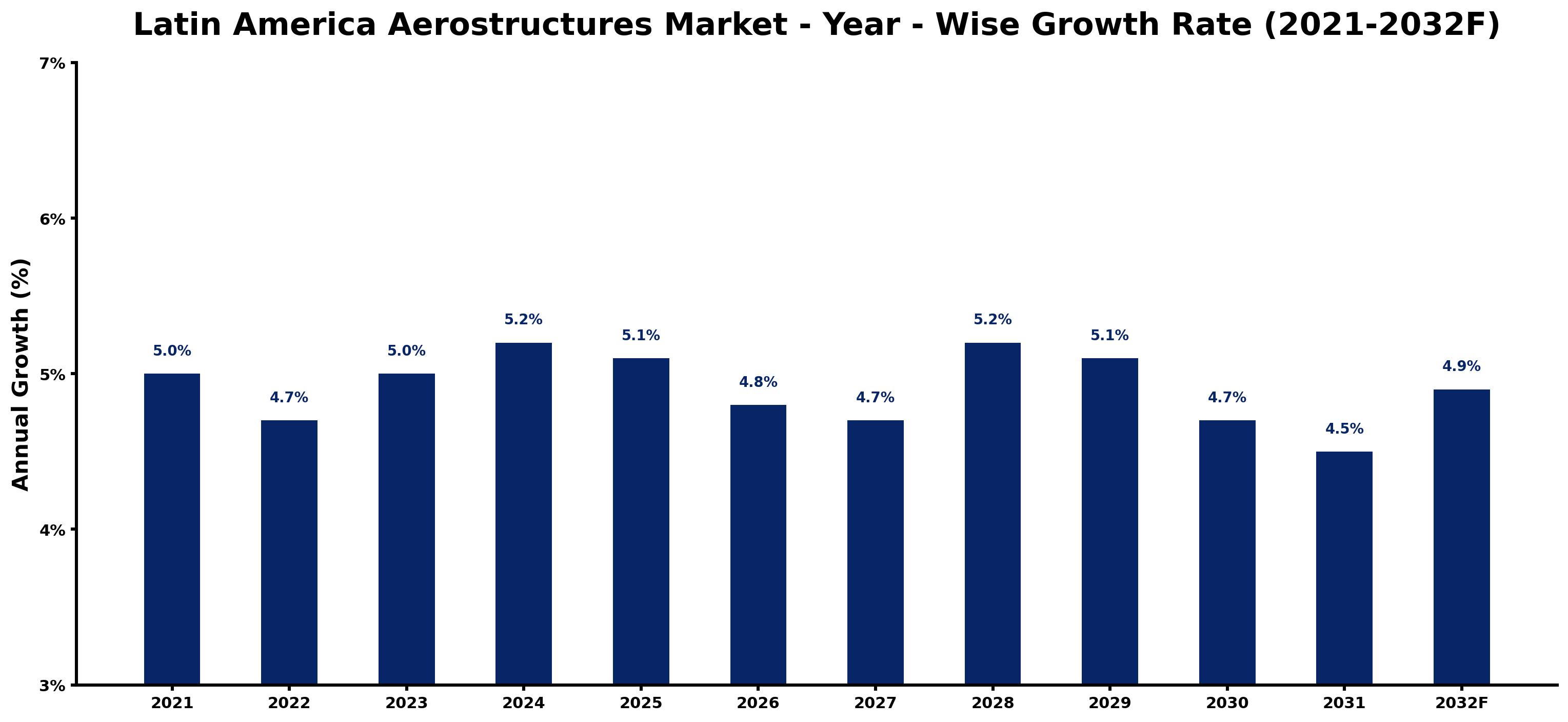
Latin America Aerostructures Market Year-wise Growth Rate and Key Drivers

The table below presents the year‑wise growth rates along with the key drivers influencing the market

YearGrowth RateMajor Drivers
20215.0%Rapid growth in telecom and data center sectors
20224.7%Expansion of commercial construction activities
20235.0%Expansion of commercial construction activities
20245.2%Growing urbanization and commercial development
20255.1%Expansion of commercial construction activities
20264.8%Rising electricity demand across industries
20274.7%Expansion of transportation and logistics networks
20285.2%Increasing smart city development projects
20295.1%Government infrastructure modernization initiatives
20304.7%Increasing industrial automation investments
20314.5%Expansion of transportation and logistics networks
20324.9%Rising electricity demand across industries

Note - Market size estimations and growth projections presented in this report are based on 6Wresearch’s advanced forecasting approach, validated with industry datasets as of June 2026.

Latin America Aerostructures Market Synopsis

The Latin America Aerostructures Market is undergoing a significant transformation as regional stakeholders align with global trends in electrification and automation. This shift is becoming a crucial component for the future of aviation, particularly as the automotive sector invests heavily in these technological advancements.

As the aircraft industry rebounds from the disruptions caused by the COVID-19 pandemic, there is an escalating demand for innovative electric systems. This renewed focus highlights the importance of adaptability among manufacturers and indicates a period of substantial investment and development opportunities within the market.

Latin America Aerostructures Market Key Takeaways

  • The market is anticipated to grow, with substantial contributions from the rising electrification of aircraft systems.
  • Decentralized electric power systems present both challenges and opportunities for increased market penetration.
  • OEMs are poised to create lucrative avenues for growth, driven by expanding manufacturing processes.
  • A fragmented competitive landscape among private players is stimulating innovation and collaboration.
  • Investment in centralized production by electrical control unit manufacturers is expected to propel market advancements.

Evaluation of Restraints in Latin America Aerostructures Market

Despite promising growth indicators, the Latin America Aerostructures Market faces notable restraints. The fragmented landscape of suppliers can complicate the supply chain, often leading to inefficiencies. Additionally, challenges associated with the integration of decentralized electric power systems into traditional aerostructure designs may slow adoption rates. Stakeholders must also navigate regulatory complexities that could impact investment and operational flexibility. These factors underscore the need for strategic planning and agile responses to market dynamics.

Latin America Aerostructures Market Trends

Current trends in the Latin America Aerostructures Market reveal a shift towards enhanced automation and increased use of lightweight materials to improve aircraft performance. The adoption of electric automated systems is becoming more prevalent, prompting manufacturers to innovate their product lines continuously. Moreover, as sustainability becomes a pivotal focus within the industry, advancements in aerostructure designs are aligning with environmentally friendly practices, ensuring compliance with international regulations.

Latin America Aerostructures Market Opportunities

The market offers significant growth and investment opportunities, particularly in the realm of electric power systems. As manufacturers pivot towards centralization and streamlined production methods, the demand for innovative aerostructures will likely increase. Furthermore, partnerships between OEMs and emerging technology firms can accelerate product development, thereby creating a wealth of possibilities for expansion in this evolving sector.

Government Initiatives in the Latin America Aerostructures Market

Governments across Latin America are increasingly recognizing the strategic importance of the aviation sector, leading to supportive policies and public investments. Initiatives aimed at fostering innovation, enhancing regional capabilities, and promoting collaboration among industry stakeholders are gaining traction. These efforts are not only focused on economic revitalization post-pandemic but also emphasize sustainability and technological advancements within aerostructures.

Future Insights of the Latin America Aerostructures Market

Looking ahead to 2026-2032, the Latin America Aerostructures Market is positioned for promising growth. With a renewed focus on electrification and automated systems, the landscape is expected to evolve rapidly. As major players adapt to changing consumer demands and technological advancements, the integration of advanced materials and innovative designs will become critical to maintaining competitive advantages. This dynamic environment is set to attract investors and drive continued expansion across the region.

Latin America Aerostructures Market Latest Developments (May 2025 - June 2026)

Recent industry developments indicate a strong push towards electrification within the aerostructures segment. Companies are increasingly collaborating to enhance their technological capabilities, reflecting a broader trend of consolidation in the market. Additionally, investment in research and development has surged, as firms seek to innovate and streamline their operations to respond to evolving market demands.

Latin America Aerostructures Market - Key Attractiveness of the Report

  • 10 Years of Market Numbers
  • Historical Data Starting from 2022 to 2025
  • Base Year: 2025
  • Forecast Data until 2032
  • Key Performance Indicators Impacting the Market
  • Major Upcoming Developments and Projects

Key Highlights of the Report:

  • Latin America Aerostructures Market Overview
  • Latin America Aerostructures Market Outlook
  • Latin America Aerostructures Market Forecast
  • Historical Market Data for the period 2022-2032F and Market Size & Forecast until 2032F of Latin America Aerostructures Market Revenues
  • Historical Market Data for the period 2022-2032F and Market Size & Forecast until 2032F, by Component
  • Historical Market Data for the period 2022-2032F and Market Size & Forecast until 2032F, by Material
  • Historical Market Data for the period 2022-2032F and Market Size & Forecast until 2032F, by Platform
  • Historical Market Data for the period 2022-2032F and Market Size & Forecast until 2032F, by End use
  • Historical Market Data for the period 2022-2032F and Market Size & Forecast until 2032F, by Countries
  • Historical Market Data for the period 2022-2032F and Market Size & Forecast until 2032F of Brazil Aerostructures Market
  • Historical Market Data for the period 2022-2032F and Market Size & Forecast until 2032F of Argentina Aerostructures Market
  • Historical Market Data for the period 2022-2032F and Market Size & Forecast until 2032F of Mexico Aerostructures Market
  • Historical Market Data for the period 2022-2032F and Market Size & Forecast until 2032F of Rest of Latin America
  • Market Drivers and Restraints
  • Latin America Aerostructures Market Trends
  • Industry Life Cycle
  • Porter’s Five Force Analysis
  • Market Opportunity Assessment
  • Latin America Aerostructures Market Share, By Players
  • Competitive Benchmarking

Markets Covered

The report provides a detailed analysis of the following market segments:

  • By Platform:
    • Fixed Wing Aircrafts
      • Commercial
      • Military
      • General
      • Unmanned Aerial Vehicles (UAVs)
      • Others
    • Rotary Wing Aircrafts
      • Military
      • Commercial
      • Unmanned Aerial Vehicles (UAVs)
  • By Component:
    • Fuselage
    • Empennage
    • Wings
    • Nose
    • Nacelle and Pylon
    • Flight Control Services
    • Others
  • By Material:
    • Metals
    • Alloys
    • Composites
  • By End use:
    • OEMs
    • Aftermarkets
  • By Countries:
    • Mexico
    • Brazil
    • Argentina
    • Rest of Latin America

Latin America Aerostructures Market - Frequently Asked Questions

The growth is predominantly driven by the integration of electric systems into aircraft designs, as well as the demand for enhanced automation and efficiency in operations.
The pandemic posed substantial challenges, leading to production delays and disruptions in supply chains. However, as recovery progresses, the market is expected to rebound, especially in sectors focused on electrification.
The Latin America Aerostructures Market was estimated at USD 195 Million in 2025 and is projected to reach USD 259 Million by 2032, growing at a CAGR of 4.1% from 2026 to 2032.
Countries such as Mexico, Brazil, and Argentina are poised to lead the market, driven by increasing investments in aviation infrastructure and technology.
Governments are focusing on supportive policies and public investments that aim to foster innovation and technological advancement, thereby strengthening the aviation industry in the region.
6Wresearch actively monitors the Latin America Aerostructures Market and publishes its comprehensive annual report, highlighting emerging trends, growth drivers, revenue analysis, and forecast outlook. Our insights help businesses to make data-backed strategic decisions with ongoing market dynamics. Our analysts track relevent industries related to the Latin America Aerostructures Market, allowing our clients with actionable intelligence and reliable forecasts tailored to emerging regional needs.
Yes, we provide customisation as per your requirements. To learn more, feel free to contact us on sales@6wresearch.com

1. Executive Summary

2. Introduction

2.1. Report Description

2.2. Key Highlights

2.3. Market Scope & Segmentation

2.4. Research Methodology

2.5. Assumptions

3. Latin America Aerostructures Market Overview

3.1. Latin America Aerostructures Market Revenues, 2022-2032F

3.2. Latin America Aerostructures Market Revenues, By Platform, 2022 & 2032F

3.3. Latin America Aerostructures Market Revenues, By End use, 2022 & 2032F

3.4. Latin America Aerostructures Market Revenues, By Material, 2022 & 2032F

3.5. Latin America Aerostructures Market Revenues, By Component, 2022 & 2032F

3.6. Latin America Aerostructures Market Revenues, By Countries, 2022 & 2032F

3.8. Latin America Aerostructures Market Industry Life Cycle

3.9. Latin America Aerostructures Market- Porter’s Five Forces

4. Latin America Aerostructures Market Dynamics

4.1. Impact Analysis

4.2. Market Drivers

4.3. Market Restraints

5. Latin America Aerostructures Market Trends

6. Latin America Aerostructures Market Overview, By Platform

6.1. Latin America Aerostructures Market Revenues, By Fixed Wing Aircraft, 2022-2032F

6.1.1. Latin America Aerostructures Market Revenues, By Commercial, 2022-2032F

6.1.2. Latin America Aerostructures Market Revenues, By Unmanned Aerial Vehicle (UAVs), 2022-2032F

6.1.3. Latin America Aerostructures Market Revenues, By Military, 2022-2032F

6.1.4. Latin America Aerostructures Market Revenues, By General, 2022-2032F

6.1.5. Latin America Aerostructures Market Revenues, By Others, 2022-2032F

6.2. Latin America Aerostructures Market Revenues, By Rotary Wing Aircraft, 2022-2032F

6.2.1. Latin America Aerostructures Market Revenues, By Commercial, 2022-2032F

6.2.2. Latin America Aerostructures Market Revenues, By Military, 2022-2032F

6.2.3. Latin America Aerostructures Market Revenues, By Unmanned Aerial Vehicles (UAVs), 2022-2032F

7. Latin America Aerostructures Market Overview, By End use

7.1. Latin America Aerostructures Market Revenues, By OEMs, 2022-2032F

7.2. Latin America Aerostructures Market Revenues, By Aftermarkets, 2022-2032F

8. Latin America Aerostructures Market Overview, By Material

8.1. Latin America Aerostructures Market Revenues, By Composites, 2022-2032F

8.2. Latin America Aerostructures Market Revenues, By Alloys, 2022-2032F

8.3. Latin America Aerostructures Market Revenues, By Metals, 2022-2032F

9. Latin America Aerostructures Market Overview, By Component

9.1. Latin America Aerostructures Market Revenues, By Fuselage, 2022-2032F

9.2. Latin America Aerostructures Market Revenues, By Empennage, 2022-2032F

9.3. Latin America Aerostructures Market Revenues, By Flight Control Surfaces, 2022-2032F

9.4. Latin America Aerostructures Market Revenues, By Wings, 2022-2032F

9.5. Latin America Aerostructures Market Revenues, By Nose, 2022-2032F

9.6. Latin America Aerostructures Market Revenues, By Nacelle and Pylon, 2022-2032F

9.7. Latin America Aerostructures Market Revenues, By Others, 2022-2032F

10. Mexico Aerostructures Market Overview

10.1. Mexico Aerostructures Market Revenues, 2022-2032F

10.2. Mexico Aerostructures Market Revenues, By Platform, 2022 & 2032F

10.3. Mexico Aerostructures Market Revenues, By End use, 2022 & 2032F

10.4. Mexico Aerostructures Market Revenues, By Material, 2022 & 2032F

10.5. Mexico Aerostructures Market Revenues, By Component, 2022 & 2032F

10.6. Mexico Aerostructures Market Revenues, By Regions, 2022 & 2032F

11. Brazil Aerostructures Market Overview

11.1. Brazil Aerostructures Market Revenues, 2022-2032F

11.2. Brazil Aerostructures Market Revenues, By Platform, 2022 & 2032F

11.3. Brazil Aerostructures Market Revenues, By End use, 2022 & 2032F

11.4. Brazil Aerostructures Market Revenues, By Material, 2022 & 2032F

11.5. Brazil Aerostructures Market Revenues, By Component, 2022 & 2032F

11.6. Brazil Aerostructures Market Revenues, By Regions, 2022 & 2032F

12. Argentina Aerostructures Market Overview

12.1. Argentina Aerostructures Market Revenues, 2022-2032F

12.2. Argentina Aerostructures Market Revenues, By Platform, 2022 & 2032F

12.3. Argentina Aerostructures Market Revenues, By End use, 2022 & 2032F

12.4. Argentina Aerostructures Market Revenues, By Material, 2022 & 2032F

12.5. Argentina Aerostructures Market Revenues, By Component, 2022 & 2032F

12.6. Argentina Aerostructures Market Revenues, By Regions, 2022 & 2032F

13. Rest of Latin America Aerostructures Market Overview

13.1. Rest of Latin America Aerostructures Market Revenues, 2022-2032F

14. Latin America Aerostructures Market Competitive Landscape

14.1. Latin America Aerostructures Market, By Companies, 2025

14.2. Mexico Aerostructures Market, By Companies, 2025

14.3. Brazil Aerostructures Market, By Companies, 2025

14.4. Argentina Aerostructures Market, By Companies, 2025

14.5. Rest of Latin America Aerostructures Market, By Companies, 2025

15. Company Profiles

16. Key Strategic Recommendations

Global Go To Market Strategy - 2030

Export potential enables firms to identify high-growth global markets with greater confidence by combining advanced trade intelligence with a structured quantitative methodology. The framework analyzes emerging demand trends and country-level import patterns while integrating macroeconomic and trade datasets such as GDP and population forecasts, bilateral import–export flows, tariff structures, elasticity differentials between developed and developing economies, geographic distance, and import demand projections. Using weighted trade values from 2020–2024 as the base period to project country-to-country export potential for 2030, these inputs are operationalized through calculated drivers such as gravity model parameters, tariff impact factors, and projected GDP per-capita growth. Through an analysis of hidden potentials, demand hotspots, and market conditions that are most favorable to success, this method enables firms to focus on target countries, maximize returns, and global expansion with data, backed by accuracy.

By factoring in the projected importer demand gap that is currently unmet and could be potential opportunity, it identifies the potential for the Exporter (Country) among 190 countries, against the general trade analysis, which identifies the biggest importer or exporter.

To discover high-growth global markets and optimize your business strategy:

Click Here
Pricing
  • Single User License
    $ 4,560
  • Department License
    $ 5,055
  • Site License
    $ 5,595
  • Global License
    $ 6,000
6Wresearch Support

Any Query

Call: +91-11-4302-4305
Email us: sales@6wresearch.com
Any Query? Click Here

Leadership Perspectives from Industry Events

Thought Leadership and Analyst Meet

Our Clients

Airtel
Canon
Contec
HoneyWell
Kriloskar
Pwc Logo
Samsung
Tata Teleservices

Industry Events and Analyst Meet

Whitepaper

Read All






























