Latin America Frozen Fruit & Vegetables Market (2026-2032) | Companies, Size, Trends, Analysis, Value, Forecast, Growth, Revenue, Share, Industry, Outlook & COVID-19 IMPACT

Market Forecast by Application (Fruits, Vegetables), by Distribution Channel (Hypermarkets/Supermarkets, E-commerce, Convenience Stores), by Product Type (Frozen Fruits and Frozen Vegetables), By countries (Mexico, Brazil, Argentina, Chile, and the Rest of Latin America) and Competitive Landscape

Product Code: ETC054624 Publication Date: Apr 2021 Product Type: Report
Publisher: 6Wresearch Author: Ravi Bhandari No. of Pages: 200 No. of Figures: 90 No. of Tables: 30

Latin America Frozen Fruit & Vegetables Market Size, Share & Growth Rate

The Latin America Frozen Fruit & Vegetables Market was estimated at USD 431 Million in 2025 and is projected to reach USD 567 Million by 2032, growing at a CAGR of 4.0% from 2026 to 2032. This steady growth trajectory is largely attributed to the increasingly hectic lifestyles of consumers across the region. As urbanization accelerates and the number of working women rises, the convenience and nutritional value of frozen fruits and vegetables are becoming more essential in daily diets.

Latin America Frozen Fruit & Vegetables Market Year-wise Growth Rate and Key Drivers

This graph highlights how the Latin America Frozen Fruit & Vegetables Market has steadily grown over the years, supported by major growth factors.
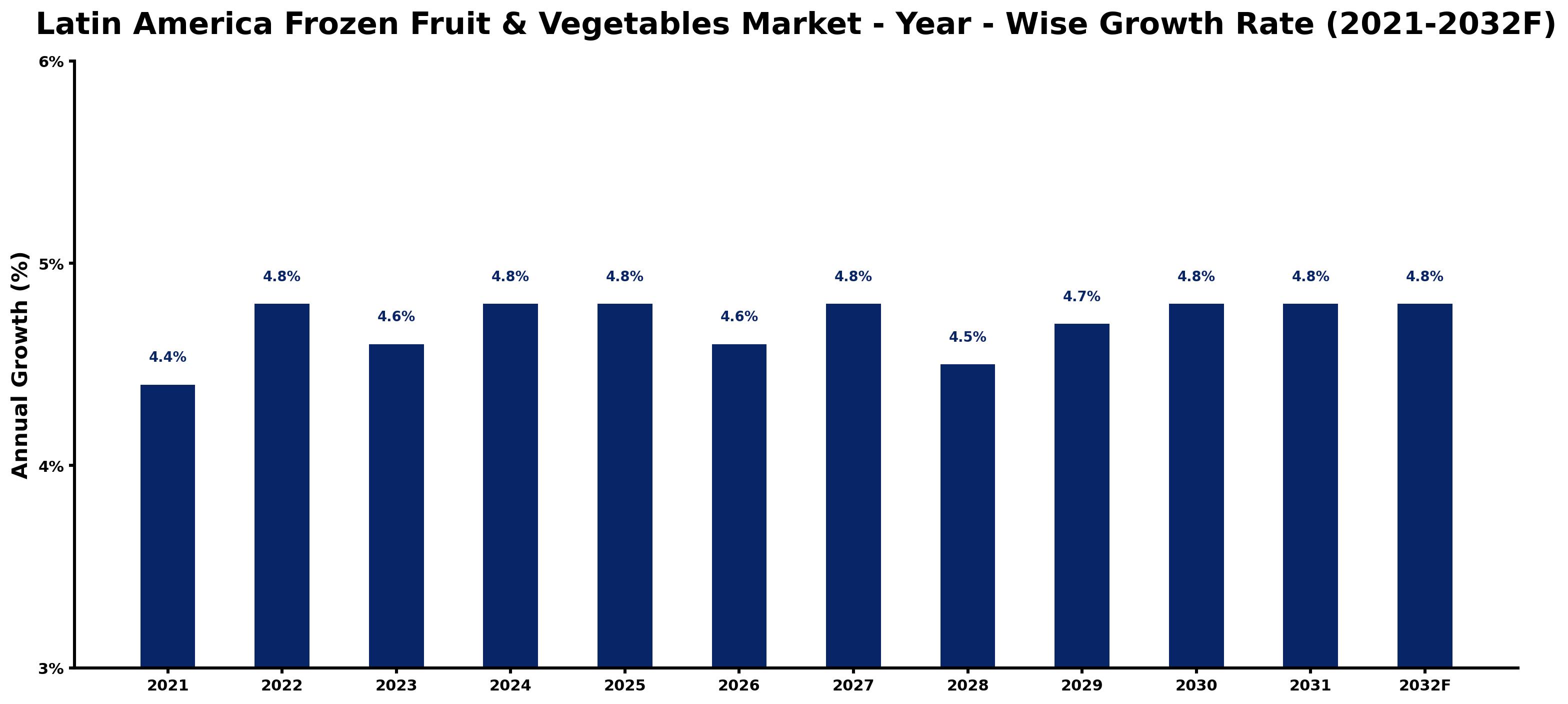
Latin America Frozen Fruit & Vegetables Market Year-wise Growth Rate and Key Drivers

The table below presents the year‑wise growth rates along with the key drivers influencing the market

YearGrowth RateMajor Drivers
20214.4%Expansion of commercial construction activities
20224.8%Expansion of commercial construction activities
20234.6%Expansion of commercial construction activities
20244.8%Increasing smart city development projects
20254.8%Increasing industrial automation investments
20264.6%Increasing industrial infrastructure investments
20274.8%Expansion of commercial construction activities
20284.5%Expansion of commercial construction activities
20294.7%Increasing industrial automation investments
20304.8%Increasing industrial infrastructure investments
20314.8%Rising electricity demand across industries
20324.8%Expansion of manufacturing activities

Note - Market size estimations and growth projections presented in this report are based on 6Wresearch’s advanced forecasting approach, validated with industry datasets as of June 2026.

Latin America Frozen Fruit & Vegetables Market Synopsis

The Latin America Frozen Fruit & Vegetables Market is experiencing a transformation, driven by the demand for quick, nutritious meal solutions. With the growing focus on hygiene and food safety, consumers are leaning towards packaged frozen options, which offer both convenience and quality.

Key players in the market are responding to these shifting consumer preferences with innovations like ready-to-cook meals and smaller, portable packages. As e-commerce channels expand, the accessibility of frozen products will continue to enhance market growth.

Latin America Frozen Fruit & Vegetables Market Key Takeaways

  • The market is anticipated to grow due to urbanization and rising health consciousness among consumers.
  • Ready-to-cook meals and convenient packaging options are key trends shaping market dynamics.
  • Brazil leads the market, with Argentina and Chile following closely behind in revenue generation.
  • The COVID-19 pandemic has temporarily impacted growth, but recovery is on the horizon.
  • Technological advancements in food preservation are facilitating market expansion.

Evaluation of Restraints in Latin America Frozen Fruit & Vegetables Market

While the Latin America Frozen Fruit & Vegetables Market is poised for growth, there are notable restraints that could hamper its expansion. One of the primary challenges is the complexity involved in manufacturing processes, which can lead to inconsistencies in product quality. Additionally, fluctuations in raw material availability and costs may further complicate production logistics. These factors necessitate that manufacturers innovate in operational efficiency to maintain competitive pricing and product availability in an evolving market.

Latin America Frozen Fruit & Vegetables Market Trends

Several trends are currently influencing the Latin America Frozen Fruit & Vegetables Market. Increasing demand for ready-to-cook meal options has led to a rise in the availability of single-serve packages, which cater to busy professionals and families alike. Additionally, the surge in e-commerce has transformed how consumers purchase frozen foods, allowing for greater convenience and accessibility. The health-conscious consumer is also driving demand for organic and all-natural frozen fruits and vegetables, with manufacturers responding by expanding their product lines accordingly.

Latin America Frozen Fruit & Vegetables Market Opportunities

The market presents numerous growth opportunities, particularly in the realm of online retailing, where a growing number of consumers are turning to e-commerce platforms for their grocery needs. Moreover, the demand for sustainable packaging solutions is creating avenues for innovation. As consumers become increasingly environmentally conscious, companies that invest in eco-friendly packaging and sourcing may gain a competitive edge. There is also potential for product diversification, with opportunities to introduce exotic and value-added frozen fruit and vegetable options.

Government Initiatives in the Latin America Frozen Fruit & Vegetables Market

Government policies across Latin America are increasingly focusing on food safety standards and promoting healthy eating initiatives. Various countries are implementing regulations to enhance food quality and safety, which bodes well for the frozen fruit and vegetable sector. Additionally, public spending on nutrition programs is expected to support the growth of healthy food segments, further creating favorable conditions for market expansion.

Future Insights of the Latin America Frozen Fruit & Vegetables Market

Looking ahead to 2026-2032, the Latin America Frozen Fruit & Vegetables Market is set to undergo significant evolution. The increase in dual-income households and the preference for convenience foods will drive continued demand for frozen options. Innovations in preservation technology will likely enhance product quality and shelf life, making frozen fruits and vegetables an increasingly attractive choice for consumers. As the market adapts to shifting consumer preferences, stakeholders will need to align their strategies to leverage these emerging opportunities.

Latin America Frozen Fruit & Vegetables Market Latest Developments (May 2025 - June 2026)

Recent developments in the Latin America Frozen Fruit & Vegetables Market indicate a shift towards enhanced digital marketing strategies as companies adapt to the growing online shopping trends. Additionally, innovations in packaging that maintain freshness and reduce waste are gaining traction, while collaborations between food manufacturers and e-commerce platforms are expected to facilitate smoother distribution channels.

Latin America Frozen Fruit & Vegetables Market - Key Attractiveness of the Report

  • 10 Years of Market Numbers
  • Historical Data Starting from 2022 to 2025
  • Base Year: 2025
  • Forecast Data until 2032
  • Key Performance Indicators Impacting the Market
  • Major Upcoming Developments and Projects

Latin America Frozen Fruit & Vegetables Market - Frequently Asked Questions

The Latin America Frozen Fruit & Vegetables Market was estimated at USD 431 Million in 2025 and is projected to reach USD 567 Million by 2032, growing at a CAGR of 4.0% from 2026 to 2032.
Key trends include the demand for convenience with ready-to-cook meals, smaller packaging, and increasing health awareness among consumers seeking nutritious, safe food options.
The pandemic initially caused a decline in growth due to supply chain disruptions; however, it has also spurred long-term shifts in consumer habits towards frozen foods as safe, convenient options.


Brazil, Argentina, and Chile are the key players in this market, with Brazil being the largest revenue contributor.
Innovations include sustainable packaging solutions that cater to environmentally conscious consumers while maintaining product freshness and reducing waste.
6Wresearch actively monitors the Latin America Frozen Fruit & Vegetables Market and publishes its comprehensive annual report, highlighting emerging trends, growth drivers, revenue analysis, and forecast outlook. Our insights help businesses to make data-backed strategic decisions with ongoing market dynamics. Our analysts track relevent industries related to the Latin America Frozen Fruit & Vegetables Market, allowing our clients with actionable intelligence and reliable forecasts tailored to emerging regional needs.
Yes, we provide customisation as per your requirements. To learn more, feel free to contact us on sales@6wresearch.com
1. Executive Summary
2. Introduction
2.1. Key Highlights of the Report
2.2. Report Description
2.3. Market Scope & Segmentation
2.4. Research Methodology
2.5. Assumptions
3. Latin America Frozen Fruit & Vegetables Market Overview
3.1. Latin America Frozen Fruit & Vegetables Market Revenues, 2022 & 2032F
3.2. Latin America Frozen Fruit & Vegetables Market - Industry Life Cycle
3.3. Latin America Frozen Fruit & Vegetables Market - Porter's Five Forces
3.4. Latin America Frozen Fruit & Vegetables Market Revenue Share, By Distribution Channel, 2022 & 2032F
3.5. Latin America Frozen Fruit & Vegetables Market Revenue Share, By Application, 2022 & 2032F
3.6. Latin America Frozen Fruit & Vegetables Market Revenue Share, By Product Type, 2022 & 2032F
3.7. Latin America Frozen Fruit & Vegetables Market Revenue Share, By Countries, 2022 & 2032F
4. Latin America Frozen Fruit & Vegetables Market Dynamics
4.1. Impact Analysis
4.2. Market Drivers
4.3. Market Restraints
5. Latin America Frozen Fruit & Vegetables Market Trends
6. Latin America Frozen Fruit & Vegetables Market, By Distribution Channel
6.1. Latin America Frozen Fruit & Vegetables Market, By Distribution Channel
6.1.1. Overview and Analysis
6.1.2. Latin America Frozen Fruit & Vegetables Market Revenues, By Hypermarkets/Supermarkets, 2022-2032F
6.1.3. Latin America Frozen Fruit & Vegetables Market Revenues, By E-commerce, 2022-2032F
6.1.4. Latin America Frozen Fruit & Vegetables Market Revenues, By Convinience Stores, 2022-2032F
7. Latin America Frozen Fruit & Vegetables Market, By Application
7.1. Latin America Frozen Fruit & Vegetables Market, By Application
7.1.1. Overview and Analysis
7.1.2. Latin America Frozen Fruit & Vegetables Market Revenues, By Fruits, 2022-2032F
7.1.3. Latin America Frozen Fruit & Vegetables Market Revenues, By Vegetables, 2022-2032F
8. Latin America Frozen Fruit & Vegetables Market, By Product Type
8.1. Latin America Frozen Fruit & Vegetables Market, By Product Type
8.1.1. Overview and Analysis
8.1.2. Latin America Frozen Fruit & Vegetables Market Revenues, By Frozen Fruits, 2022-2032F
8.1.3. Latin America Frozen Fruit & Vegetables Market Revenues, By Frozen Vegetables, 2022-2032F
9. Chile Frozen Fruit & Vegetables Market
9.1. Chile Frozen Fruit & Vegetable Market, By Distribution Channel
9.2. Chile Frozen Fruit & Vegetable Market, By Application
9.3. Chile Frozen Fruit & Vegetable Market, By Product Type
9.4. Chile Frozen Fruit & Vegetable Market, By Countries
10. Argentina Frozen Fruit & Vegetables Market
10.1. Argentina Frozen Fruit & Vegetables Market, By Distribution Channel
10.2. Argentina Frozen Fruit & Vegetables Market, By Application
10.3. Argentina Frozen Fruit & Vegetables Market, By Product Type
10.4. Argentina Frozen Fruit & Vegetables Market, By Countries
11. Brazil Frozen Fruit & Vegetables Market
11.1. Brazil Frozen Fruit & Vegetables Market, By Distribution Channel
11.2. Brazil Frozen Fruit & Vegetables Market, By Application
11.3. Brazil Frozen Fruit & Vegetables Market, By Product Type
11.4. Brazil Frozen Fruit & Vegetables Market, By Countries
12. Mexico Frozen Fruit & Vegetables Market
12.1. Mexico Frozen Fruit & Vegetables Market, By Distribution Channel
12.2. Mexico Frozen Fruit & Vegetables Market, By Application
12.3. Mexico Frozen Fruit & Vegetables Market, By Product Type
12.4. Mexico Frozen Fruit & Vegetables Market, By Countries
13. Rest of Latin America Frozen Fruit & Vegetables Market
13.1. Rest of Latin America Frozen Fruit & Vegetables Market Overview
14. Latin America Frozen Fruit & Vegetables Market Import-Export Trade Statistics
14.1. Latin America Frozen Fruit & Vegetables Market Export to Major Countries
14.2. Latin America Frozen Fruit & Vegetables Market Imports from Major Countries
16. Latin America Frozen Fruit & Vegetables Market Key Performance Indicators
17. Latin America Frozen Fruit & Vegetables Market - Opportunity Assessment
17.1. Latin America Frozen Fruit & Vegetables Market Opportunity Assessment, By Application, 2022 & 2032F
17.2. Latin America Frozen Fruit & Vegetables Market Opportunity Assessment, By Distribution Channel, 2022 & 2032F
18. Latin America Frozen Fruit & Vegetables Market - Competitive Landscape
18.1. Latin America Frozen Fruit & Vegetables Market Revenue Share, By Companies, 2025
18.2. Latin America Frozen Fruit & Vegetables Market Competitive Benchmarking, By Operating and Technical Parameters
19. Company Profiles
20. Recommendations
21. Disclaimer

Global Go To Market Strategy - 2030

Export potential enables firms to identify high-growth global markets with greater confidence by combining advanced trade intelligence with a structured quantitative methodology. The framework analyzes emerging demand trends and country-level import patterns while integrating macroeconomic and trade datasets such as GDP and population forecasts, bilateral import–export flows, tariff structures, elasticity differentials between developed and developing economies, geographic distance, and import demand projections. Using weighted trade values from 2020–2024 as the base period to project country-to-country export potential for 2030, these inputs are operationalized through calculated drivers such as gravity model parameters, tariff impact factors, and projected GDP per-capita growth. Through an analysis of hidden potentials, demand hotspots, and market conditions that are most favorable to success, this method enables firms to focus on target countries, maximize returns, and global expansion with data, backed by accuracy.

By factoring in the projected importer demand gap that is currently unmet and could be potential opportunity, it identifies the potential for the Exporter (Country) among 190 countries, against the general trade analysis, which identifies the biggest importer or exporter.

To discover high-growth global markets and optimize your business strategy:

Click Here
Pricing
  • Single User License
    $ 4,560
  • Department License
    $ 5,055
  • Site License
    $ 5,595
  • Global License
    $ 6,000
6Wresearch Support

Any Query

Call: +91-11-4302-4305
Email us: sales@6wresearch.com
Any Query? Click Here

Leadership Perspectives from Industry Events

Thought Leadership and Analyst Meet

Our Clients

Airtel
Canon
Contec
HoneyWell
Kriloskar
Pwc Logo
Samsung
Tata Teleservices

Industry Events and Analyst Meet

Whitepaper

Read All































