Latin America Hand Tool Market (2026-2032) | Trends, Revenue, Share, Growth, Analysis, Outlook, COVID-19 IMPACT, Forecast, Size, Industry, Companies & Value

Market Forecast by Type (Wrench, Plier, Screw Driver, Hammer, Cable Cutter and others), by End Users (Professional, DIY, Industrial), by Distribution Channel (Online, Offline), By Countries (Mexico, Brazil, Argentina, Chile and rest of Latin America) and Competitive Landscape

Product Code: ETC054451 Publication Date: Apr 2021 Product Type: Report
Publisher: 6Wresearch Author: Ravi Bhandari No. of Pages: 200 No. of Figures: 90 No. of Tables: 30

Latin America Hand Tool Market Size, Share & Growth Rate

The Latin America Hand Tool Market was estimated at USD 381 Million in 2025 and is projected to reach USD 512 Million by 2032, growing at a CAGR of 4.3% from 2026 to 2032. This growth trajectory is significantly driven by the expanding aerospace sector and a surge in automotive maintenance, alongside increased developmental projects across the region. Additionally, the rising trend of do-it-yourself (DIY) activities among consumers is reinforcing the demand for hand tools, especially in household maintenance.

Latin America Hand Tool Market Growth Rate Analysis (2021-2032)

The Latin America hand tool market has exhibited a stable growth pattern, with annual increases ranging between 4.8% and 5.4% from 2021 through 2032. Following a robust 5.3% rise in 2021, the market saw a slight dip to 4.9% in 2022, influenced by supply chain disruptions and inflationary pressures. However, a rebound occurred in 2023, achieving 5.4% growth, driven by revitalized consumer demand and increased investments in infrastructure projects across the region. This momentum appears to continue, as projections indicate sustained expansion around the 5% mark, reflecting ongoing digitalization trends and a focus on energy transition initiatives that bolster hand tool applications in various industries.

Latin America Hand Tool Market Year-wise Growth Rate and Key Drivers

This graph highlights how the Latin America Hand Tool Market has steadily grown over the past five years, supported by major growth factors.
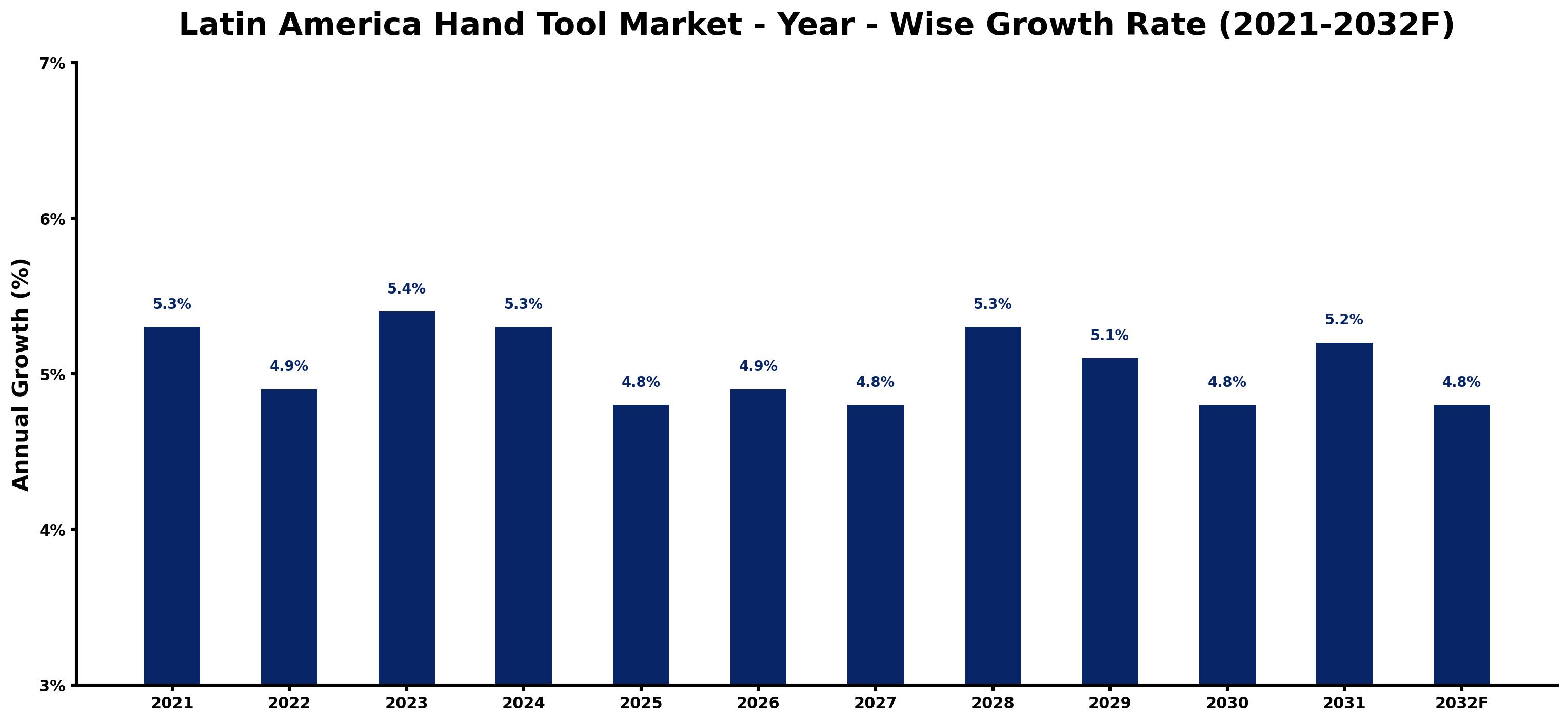
Latin America Hand Tool Market Year-wise Growth Rate and Key Drivers

The table below presents the year‑wise growth rates along with the key drivers influencing the market

YearGrowth RateMajor Drivers
20215.3%Increasing industrial infrastructure investments
20224.9%Increasing industrial infrastructure investments
20235.4%Expansion of manufacturing activities
20245.3%Government infrastructure modernization initiatives
20254.8%Expansion of commercial construction activities
20264.9%Expansion of manufacturing activities
20274.8%Increasing industrial automation investments
20285.3%Expansion of manufacturing activities
20295.1%Growing renewable energy integration projects
20304.8%Growing renewable energy integration projects
20315.2%Rising electricity demand across industries
20324.8%Expansion of transportation and logistics networks

Note - Market size estimations and growth projections presented in this report are based on 6Wresearch’s advanced forecasting approach, validated with industry datasets as of June 2026.

Latin America Hand Tool Market Synopsis

Currently, the burgeoning aerospace industry is the strongest force shaping the Latin America Hand Tool Market. As nations invest in aerospace advancements and infrastructure development, the demand for specialized hand tools is expected to rise significantly.

In parallel, the rapid urbanization in key markets like Mexico and Brazil is catalyzing the demand for hand tools among households and professionals alike. This urban growth fosters an environment where maintenance work becomes increasingly common, further stimulating market demand.

Latin America Hand Tool Market Key Takeaways

  • The market is poised for substantial growth, driven by factors such as industrial expansion and urbanization.
  • DIY activities are increasingly popular, contributing to a surge in consumer demand for hand tools.
  • Mexico and Brazil are highlighted as the most lucrative markets due to economic and urban development.
  • The popularity of power tools presents a competitive challenge to traditional hand tools.
  • Recent trends indicate a rising preference for versatile, user-friendly hand tools that cater to both professional and household applications.

Evaluation of Restraints in Latin America Hand Tool Market

Despite the promising growth projections, several restraints hinder the overall development of the Latin America Hand Tool Market. A notable challenge is the shortage of skilled labor, which limits the effective deployment of hand tools in various sectors. Furthermore, acute competition results in low-profit margins, making it difficult for manufacturers to sustain profitability. Additionally, the increasing adoption of power tools could divert attention from traditional hand tools, impacting market demand negatively.

Latin America Hand Tool Market Trends

Emerging trends in the Latin America Hand Tool Market reflect a shift towards multifunctional tools designed for efficiency and ease of use. This trend aligns with the growing consumer preference for DIY projects and home improvement. Advances in technology have enabled manufacturers to innovate hand tools that cater to diverse applications, thereby enhancing their appeal. Moreover, the emphasis on sustainability is encouraging companies to explore eco-friendly materials and production processes.

Latin America Hand Tool Market Opportunities

There are significant growth and investment opportunities in the Latin America Hand Tool Market, particularly as urbanization continues to accelerate. Companies can capitalize on the burgeoning DIY segment, targeting individual consumers who are increasingly seeking cost-effective, easy-to-use tools for home maintenance. Additionally, public-private partnerships in infrastructure projects present a promising avenue for growth, as they often require a vast array of hand tools for execution and maintenance.

Government Initiatives in the Latin America Hand Tool Market

Government policies across Latin America increasingly support industrial growth, which, in turn, benefits the hand tool market. Initiatives promoting local manufacturing, combined with investment in infrastructure and aerospace industries, create a favorable business environment for tool manufacturers. Additionally, public spending on urban development projects acts as a catalyst for the demand for hand tools, as these projects require various tools for implementation and upkeep.

Future Insights of the Latin America Hand Tool Market

Looking ahead to 2026-2032, the Latin America Hand Tool Market is expected to continue its upward trajectory. Key drivers such as increased urbanization, a growing emphasis on DIY home improvement, and advancements in technology will further propel market growth. Furthermore, as industries evolve, the integration of smart tools equipped with technology for enhanced performance may pave the way for new opportunities, ensuring that hand tools remain indispensable in various sectors.

Latin America Hand Tool Market Latest Developments (May 2025 - June 2026)

Recent developments in the Latin America Hand Tool Market indicate a shift towards integrating digital platforms for sales and customer engagement. Companies are increasingly investing in e-commerce strategies to adapt to changing consumer behaviors, especially post-pandemic. Additionally, the trend towards sustainable practices is influencing production methods, with a growing number of manufacturers exploring eco-friendly options in their product lines.

Latin America Hand Tool Market - Key Attractiveness of the Report

  • 10 Years of Market Numbers
  • Historical Data Starting from 2022 to 2025
  • Base Year: 2025
  • Forecast Data until 2032
  • Key Performance Indicators Impacting the Market
  • Major Upcoming Developments and Projects

Latin America Hand Tool Market - Frequently Asked Questions

The Latin America Hand Tool Market was estimated at USD 381 Million in 2025 and is projected to reach USD 512 Million by 2032, growing at a CAGR of 4.3% from 2026 to 2032.
Key drivers include the expanding aerospace industry, the rapid rise in automotive maintenance needs, and a notable increase in urbanization, particularly in Mexico and Brazil.
Urbanization leads to increased household ownership and an uptick in DIY activities, thus creating a stronger demand for hand tools for both maintenance and personal projects.
The market is contending with low-profit margins due to intense competition, alongside a shortage of skilled professionals, which limits effective deployment and maintenance of tools.

Technological advancements are pushing manufacturers towards developing multifunctional tools that cater to a diverse range of applications, enhancing convenience and usability for consumers.

6Wresearch actively monitors the Latin America Hand Tool Market and publishes its comprehensive annual report, highlighting emerging trends, growth drivers, revenue analysis, and forecast outlook. Our insights help businesses to make data-backed strategic decisions with ongoing market dynamics. Our analysts track relevent industries related to the Latin America Hand Tool Market, allowing our clients with actionable intelligence and reliable forecasts tailored to emerging regional needs.
Yes, we provide customisation as per your requirements. To learn more, feel free to contact us on sales@6wresearch.com

1. Executive Summary

2. Introduction

2.1. Key Highlights of the Report

2.2. Report Description

2.3. Market Scope & Segmentation

2.4. Research Methodology

2.5. Assumptions

3. Latin America Hand Tool Market Overview

3.1. Latin America Country Macro Economic Indicators

3.2. Latin America Hand Tool Market Revenue, 2022 & 2032F

3.3. Latin America Hand Tool Market - Industry Life Cycle

3.4. Latin America Hand Tool Market - Porter's Five Forces

3.5. Latin America Hand Tool Market Revenue Share, By Type, 2022 & 2032F

3.6. Latin America Hand Tool Market Revenue Share, By Distribution Channel, 2022 & 2032F

3.7. Latin America Hand Tool Market Revenue Share, By End User, 2022 & 2032F

3.8. Latin America Hand Tool Market Revenue Share, By Regions, 2022 & 2032F

4. Latin America Hand Tool Market Dynamics

4.1. Impact Analysis

4.2. Market Drivers

4.3. Market Restraints

5. Latin America Hand Tool Market Trends

6. Latin America Hand Tool Market, By Type

6.1. Latin America Hand Tool Market, By Type

6.1.1. Overview and Analysis

6.1.2. Latin America Hand Tool Market Revenue, By Wrench, 2022-2032F

6.1.3. Latin America Hand Tool Market Revenue, By Plier, 2022-2032F

6.1.4. Latin America Hand Tool Market Revenue, By Screw Driver, 2022-2032F

6.1.5. Latin America Hand Tool Market Revenue, By Hammer, 2022-2032F

6.1.6. Latin America Hand Tool Market Revenue, By Cable Cutter, 2022-2032F

6.1.7. Latin America Hand Tool Market Revenue, By Others, 2022-2032F

7. Latin America Hand Tool Market, By Distribution Channel

7.1. Latin America Hand Tool Market, By Distribution Channel

7.1.1. Overview and Analysis

7.1.2. Latin America Hand Tool Market Revenue, By Industrial, 2022-2032F

7.1.3. Latin America Hand Tool Market Revenue, By DIY, 2022-2032F

7.1.4. Latin America Hand Tool Market Revenue, By Professional, 2022-2032F

8. Latin America Hand Tool Market, By Distribution Channel

8.1. Latin America Hand Tool Market, By Distribution Channel

8.1.1. Overview and Analysis

8.1.2. Latin America Hand Tool Market Revenue, By Online, 2022-2032F

8.1.3. Latin America Hand Tool Market Revenue, By Offline, 2022-2032F

9. Brazil Hand Tool Market

9.1. Brazil Hand Tool Market, By Type

9.2. Brazil Hand Tool Market, By Distribution Channel

9.3. Brazil Hand Tool Market, By End User

9.4. Brazil Hand Tool Market, By Regions

10. Chile Hand Tool Market

10.1. Chile Hand Tool Market, By Type

10.2. Chile Hand Tool Market, By Distribution Channel

10.3. Chile Hand Tool Market, By End User

10.4. Chile Hand Tool Market, By Regions

11. Mexico Hand Tool Market

11.1. Mexico Hand Tool Market, By Type

11.2. Mexico Hand Tool Market, By Distribution Channel

11.3. Mexico Hand Tool Market, By End User

11.4. Mexico Hand Tool Market, By Regions

12. Argentina Hand Tool Market

12.1. Argentina Hand Tool Market, By Type

12.2. Argentina Hand Tool Market, By Distribution Channel

12.3. Argentina Hand Tool Market, By End User

12.4. Argentina Hand Tool Market, By Regions

13. Rest of Latin America Hand Tool Market

13.1. Rest of Latin America Hand Tool Market Overview

14. Latin America Hand Tool Market Import-Export Trade Statistics

14.1. Latin America Hand Tool Market Export to Major Regions

14.2. Latin America Hand Tool Market Imports from Major Regions

15. Latin America Hand Tool Market Key Performance Indicators

16. Latin America Hand Tool Market - Opportunity Assessment

16.1. Latin America Hand Tool Market Opportunity Assessment, By Type, 2022 & 2032F

16.2. Latin America Hand Tool Market Opportunity Assessment, By Distribution Channel, 2022 & 2032F

17. Latin America Hand Tool Market - Competitive Landscape

17.1. Latin America Hand Tool Market Revenue Share, By Companies, 2025

17.2. Latin America Hand Tool Market Competitive Benchmarking, By Operating and Technical Parameters

18. Company Profiles

19. Recommendations

20. Disclaimer

Global Go To Market Strategy - 2030

Export potential enables firms to identify high-growth global markets with greater confidence by combining advanced trade intelligence with a structured quantitative methodology. The framework analyzes emerging demand trends and country-level import patterns while integrating macroeconomic and trade datasets such as GDP and population forecasts, bilateral import–export flows, tariff structures, elasticity differentials between developed and developing economies, geographic distance, and import demand projections. Using weighted trade values from 2020–2024 as the base period to project country-to-country export potential for 2030, these inputs are operationalized through calculated drivers such as gravity model parameters, tariff impact factors, and projected GDP per-capita growth. Through an analysis of hidden potentials, demand hotspots, and market conditions that are most favorable to success, this method enables firms to focus on target countries, maximize returns, and global expansion with data, backed by accuracy.

By factoring in the projected importer demand gap that is currently unmet and could be potential opportunity, it identifies the potential for the Exporter (Country) among 190 countries, against the general trade analysis, which identifies the biggest importer or exporter.

To discover high-growth global markets and optimize your business strategy:

Click Here
Pricing
  • Single User License
    $ 4,560
  • Department License
    $ 5,055
  • Site License
    $ 5,595
  • Global License
    $ 6,000
6Wresearch Support

Any Query

Call: +91-11-4302-4305
Email us: sales@6wresearch.com
Any Query? Click Here

Leadership Perspectives from Industry Events

Thought Leadership and Analyst Meet

Our Clients

Airtel
Canon
Contec
HoneyWell
Kriloskar
Pwc Logo
Samsung
Tata Teleservices

Industry Events and Analyst Meet

Whitepaper

Read All































