Latin America Mobile Crane Market Size, Share & Growth Rate
The Latin America Mobile Crane Market was estimated at USD 351 Million in 2025 and is projected to reach USD 479 Million by 2032, growing at a CAGR of 4.5% from 2026 to 2032. This growth trajectory is primarily fueled by significant investments in the construction and infrastructure sectors, alongside a burgeoning demand in the mining and energy industries. Urbanization trends and a push towards technological advancements in equipment are further stimulating market potential across the region.
Latin America Mobile Crane Market Year-wise Growth Rate and Key Drivers
This graph highlights how the Latin America Mobile Crane Market has steadily grown over the years, supported by major growth factors.
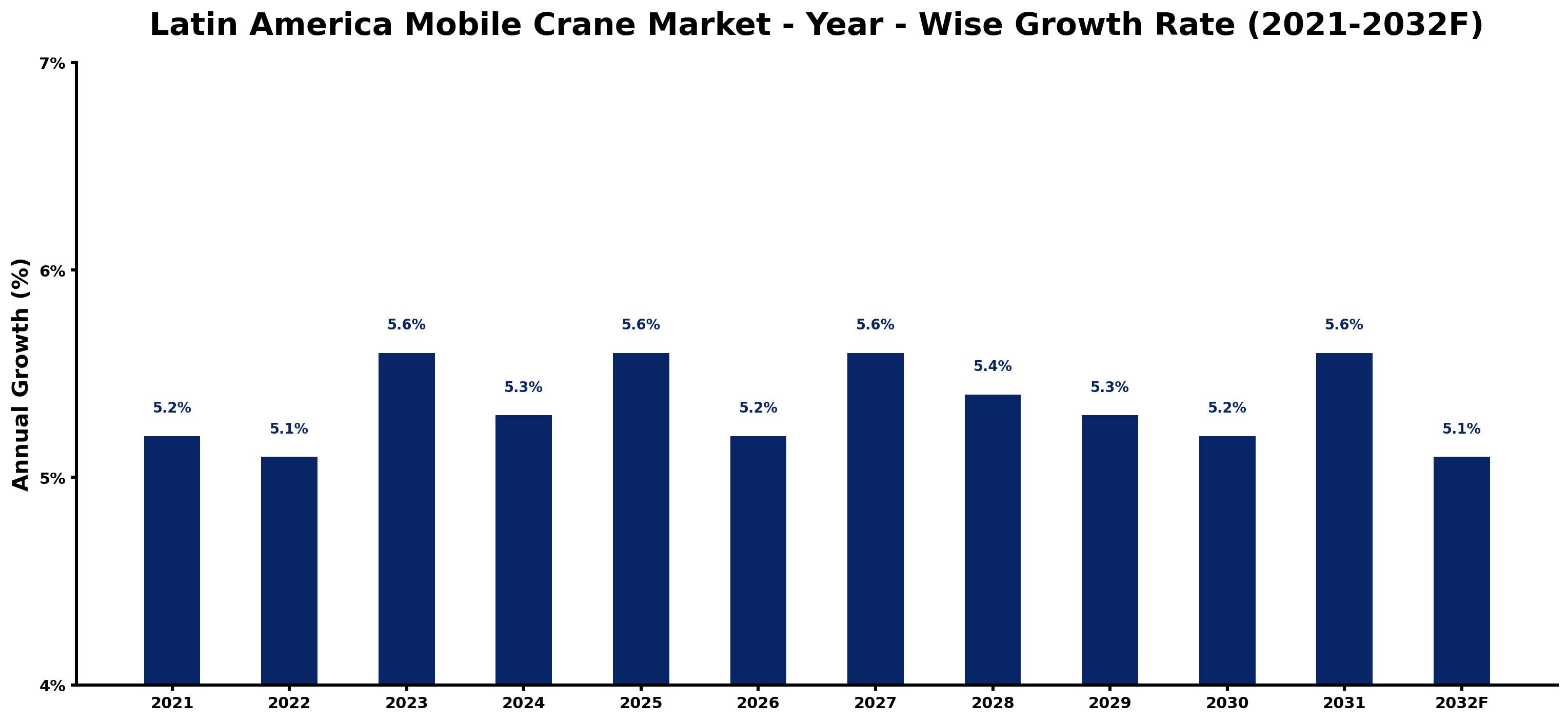
The table below presents the year‑wise growth rates along with the key drivers influencing the market
| Year | Growth Rate | Major Drivers |
| 2021 | 5.2% | Government infrastructure modernization initiatives |
| 2022 | 5.1% | Increasing adoption of advanced technologies |
| 2023 | 5.6% | Increasing industrial automation investments |
| 2024 | 5.3% | Expansion of transportation and logistics networks |
| 2025 | 5.6% | Expansion of commercial construction activities |
| 2026 | 5.2% | Increasing industrial infrastructure investments |
| 2027 | 5.6% | Rapid growth in telecom and data center sectors |
| 2028 | 5.4% | Increasing adoption of advanced technologies |
| 2029 | 5.3% | Increasing industrial infrastructure investments |
| 2030 | 5.2% | Expansion of transportation and logistics networks |
| 2031 | 5.6% | Increasing industrial infrastructure investments |
| 2032 | 5.1% | Increasing adoption of advanced technologies |
Note - Market size estimations and growth projections presented in this report are based on 6Wresearch's advanced forecasting approach, validated with industry datasets as of June 2026.
Latin America Mobile Crane Market Synopsis
Despite the setbacks faced during the pandemic, the Latin America Mobile Crane Market is on an upward trend. The post-COVID recovery phase is characterized by renewed investments and project launches, particularly in countries such as Chile and Colombia, which are leading the way in infrastructural development.
As the region witnesses a surge in urbanization and large-scale projects, the demand for mobile cranes is set to accelerate. The focus on enhancing efficiency and technological innovation in crane equipment positions the market favorably for sustained growth in the coming years.
Latin America Mobile Crane Market Key Takeaways
- The mobile crane market is projected to grow significantly, driven by construction and infrastructure investments.
- Chile and Colombia are anticipated to be the fastest-growing markets in the region.
- Technological advancements are enhancing the operational efficiency of mobile cranes.
- The mining sector's growth contributes substantially to the demand for mobile cranes.
- Government initiatives aimed at improving infrastructure are likely to bolster market expansion.
Evaluation of Restraints in Latin America Mobile Crane Market
While the prospects for the mobile crane market in Latin America are promising, certain constraints could impede growth. Economic volatility in the region, compounded by fluctuating commodity prices, can lead to unpredictability in investment patterns. Furthermore, the slow pace of regulatory approvals for construction projects often delays crane deployment, affecting market dynamics. Adherence to safety regulations and environmental concerns also present challenges that industry stakeholders must navigate.
Latin America Mobile Crane Market Trends
Current trends in the Latin America Mobile Crane Market point towards a shift towards more sophisticated and efficient machinery. A strong emphasis on automation and smart technologies is revolutionizing equipment functionality, making cranes safer and more reliable. Additionally, as companies increasingly prioritize sustainability, there is a noticeable rise in demand for eco-friendly crane options, reflecting a broader commitment to environmental stewardship across construction practices.
Latin America Mobile Crane Market Opportunities
Investment opportunities are ripe within the mobile crane market, particularly as governments pursue infrastructural improvements and urban development projects. The ongoing expansion of transportation networks and renewable energy initiatives provides a fertile ground for growth. Moreover, partnerships and collaborations between manufacturers and local firms can enhance market penetration and foster innovation, paving the way for new projects and deployments.
Government Initiatives in the Latin America Mobile Crane Market
Governments across Latin America are increasingly recognizing the importance of infrastructure development as a driver of economic growth. Initiatives focusing on public-private partnerships in construction projects and enhanced spending on utilities create an environment conducive to mobile crane demand. Supportive regulatory frameworks and incentives for modernizing construction fleets further facilitate market engagement, establishing a robust foundation for sustainable growth in this sector.
Future Insights of the Latin America Mobile Crane Market
Looking ahead to the years 2026-2032, the Latin America Mobile Crane Market is expected to experience dynamic growth. Enhanced urbanization efforts, coupled with a strategic focus on the mining and energy sectors, will continue to shape demand. Furthermore, innovations in crane technology—emphasizing efficiency and safety—are likely to attract significant investment, ensuring that the market remains competitive and aligned with global trends.
Latin America Mobile Crane Market Latest Developments (May 2025 - June 2026)
Recent developments in the Latin America mobile crane market have showcased a shift towards greater technological adoption. Various industry players are exploring automation and IoT integrations within crane systems to enhance operational efficiency. Additionally, strategic collaborations aimed at expanding distribution networks and service offerings have emerged as a key focus for businesses seeking to capture market share during the recovery phase.
Latin America Mobile Crane Market - Key Attractiveness of the Report
- 10 Years of Market Numbers
- Historical Data Starting from 2022 to 2025
- Base Year: 2025
- Forecast Data until 2032
- Key Performance Indicators Impacting the Market
- Major Upcoming Developments and Projects






































