Latin America Panel Board Market Size, Share & Growth Rate
The Latin America Panel Board Market was estimated at USD 212 Million in 2025 and is projected to reach USD 289 Million by 2032, growing at a CAGR of 4.5% from 2026 to 2032. This growth trajectory is driven primarily by an expanding construction industry across the region, significantly influenced by increased investments in infrastructure development. As urbanization and industrialization accelerate, the demand for advanced panel board solutions for power and distribution systems is set to further propel market expansion.
Latin America Panel Board Market Year-wise Growth Rate and Key Drivers
This graph highlights how the Latin America Panel Board Market has steadily grown over the years, supported by major growth factors.
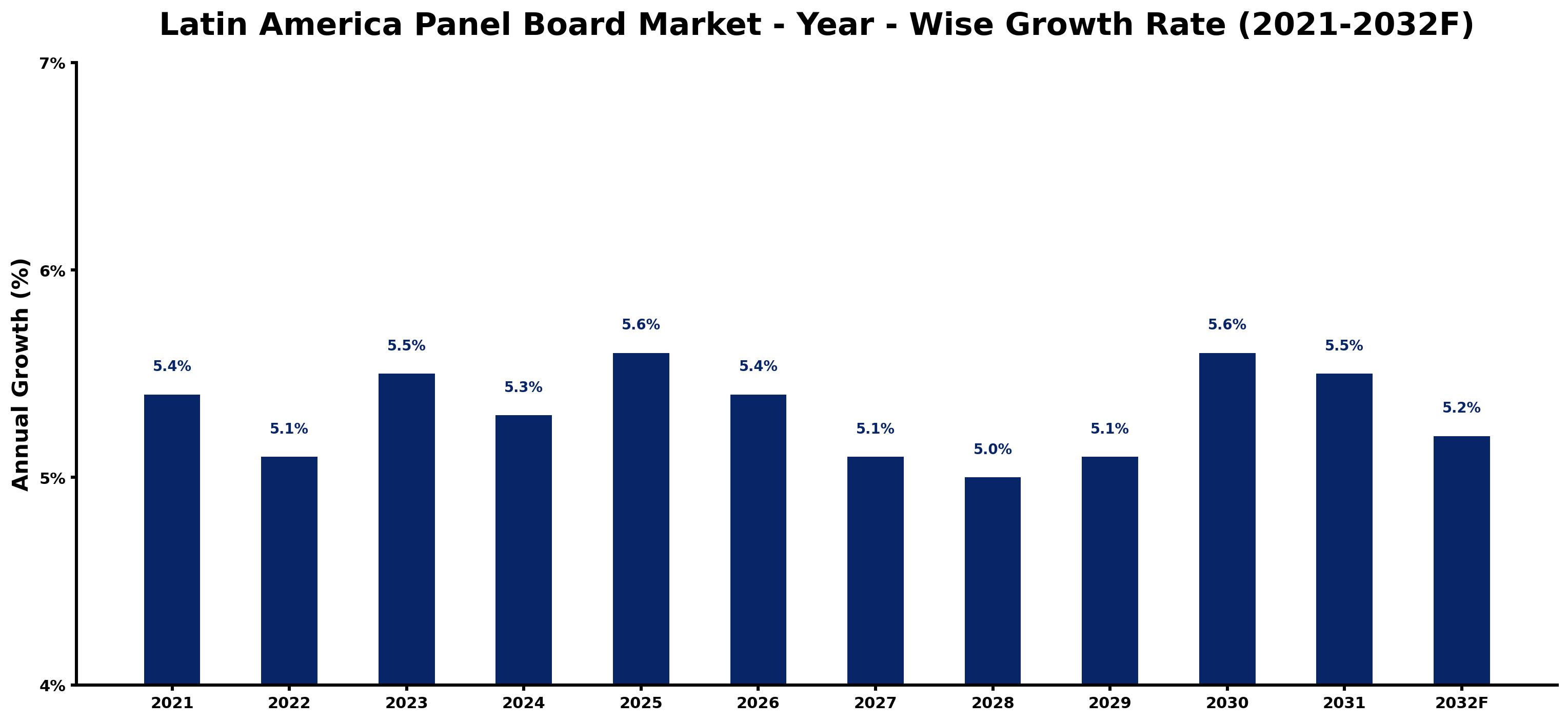
The table below presents the year‑wise growth rates along with the key drivers influencing the market
| Year | Growth Rate | Major Drivers |
| 2021 | 5.4% | Growing urbanization and commercial development |
| 2022 | 5.1% | Increasing smart city development projects |
| 2023 | 5.5% | Increasing industrial infrastructure investments |
| 2024 | 5.3% | Increasing smart city development projects |
| 2025 | 5.6% | Growing urbanization and commercial development |
| 2026 | 5.4% | Increasing industrial infrastructure investments |
| 2027 | 5.1% | Increasing industrial infrastructure investments |
| 2028 | 5.0% | Rapid growth in telecom and data center sectors |
| 2029 | 5.1% | Expansion of manufacturing activities |
| 2030 | 5.6% | Growing renewable energy integration projects |
| 2031 | 5.5% | Increasing industrial automation investments |
| 2032 | 5.2% | Expansion of manufacturing activities |
Note - Market size estimations and growth projections presented in this report are based on 6Wresearch’s advanced forecasting approach, validated with industry datasets as of June 2026.
Latin America Panel Board Market Synopsis
The most significant force currently shaping the Latin America Panel Board Market is the rapid urbanization occurring throughout key countries such as Brazil and Mexico. This trend has led to an urgent need for enhanced infrastructure, boosting the demand for reliable and efficient panel board systems. Additionally, the construction sector's robust growth serves as a catalyst for product innovation and deployment.
Investment in power transmission and distribution is also a critical factor driving market dynamics. As governments and private entities commit to bolstering energy infrastructures, particularly in urban centers, the demand for sophisticated panel board solutions is expected to rise, underpinning the sector's growth in the coming years.
Latin America Panel Board Market Key Takeaways
- The Latin America Panel Board Market is set for robust growth driven by infrastructure development.
- Brazil is projected to be the leading country in market growth due to its rapid urbanization and commercialization.
- Flush-mounting panel boards are gaining preference for their safety features and space efficiency.
- Key countries such as Mexico and Argentina are also contributing significantly to overall market dynamics.
- Post-COVID recovery is expected to stimulate market growth from the second half of 2020 through 2026.
Evaluation of Restraints in Latin America Panel Board Market
Despite the positive outlook, the Latin America Panel Board Market faces several restraints that could impede growth. Economic fluctuations and regulatory challenges in various countries may limit investments in infrastructure. Additionally, fluctuating raw material prices can pose a risk to manufacturers, affecting profitability and potentially leading to increased product costs. Lastly, the ongoing impact of the COVID-19 pandemic on supply chains may continue to create uncertainties in the market.
Latin America Panel Board Market Trends
Current trends in the Latin America Panel Board Market indicate a growing focus on technological advancements and sustainability. Manufacturers are increasingly adopting smart technology to enhance the functionality of panel boards, making them more user-friendly and efficient. Moreover, environmental concerns are driving the demand for energy-efficient solutions, prompting companies to innovate in eco-friendly materials and production processes.
Latin America Panel Board Market Opportunities
There are significant growth and investment opportunities within the Latin America Panel Board Market. With government initiatives aimed at improving energy efficiency and increasing infrastructure budgets, stakeholders can capitalize on the demand for advanced panel solutions. Furthermore, as commercial and residential construction accelerates in urban areas, manufacturers have the opportunity to introduce innovative products tailored to specific market needs.
Government Initiatives in the Latin America Panel Board Market
Government policies and public spending in Latin America are increasingly focused on enhancing energy infrastructure, which bodes well for the panel board market. Various programs aimed at promoting renewable energy sources and improving energy efficiency are being implemented. Public sector investments in infrastructure projects are also anticipated to rise, creating a favorable environment for market growth.
Future Insights of the Latin America Panel Board Market
Looking ahead to 2026-2032, the Latin America Panel Board Market is poised to experience substantial growth as urbanization continues to reshape the economic landscape. The emphasis on renewable energy and smarter infrastructure solutions will likely dictate product development. As energy demands rise, the market is expected to adapt by leveraging innovative technologies that enhance performance and sustainability.
Latin America Panel Board Market Latest Developments (May 2025 - June 2026)
Recent developments in the Latin America Panel Board Market indicate a shift towards integrating more sophisticated technologies within panel solutions. As manufacturers respond to evolving market demands, trends such as the adoption of Internet of Things (IoT) functionalities are gaining traction. Additionally, various countries are initiating large-scale infrastructure projects, setting the stage for increased product deployment.
Latin America Panel Board Market - Key Attractiveness of the Report
- 10 Years of Market Numbers
- Historical Data Starting from 2022 to 2025
- Base Year: 2025
- Forecast Data until 2032
- Key Performance Indicators Impacting the Market
- Major Upcoming Developments and Projects






































