Latin America Telehealth Market Summary
The latin america telehealth market was estimated at USD 417 Million in 2025 and is projected to reach USD 581 Million by 2032, growing at a CAGR of 5.9% from 2026 to 2032.
Latin America Telehealth Market Year-wise Growth Rate and Key Drivers
This graph highlights how the Latin America Telehealth Market has steadily grown over the past five years, supported by major growth factors.
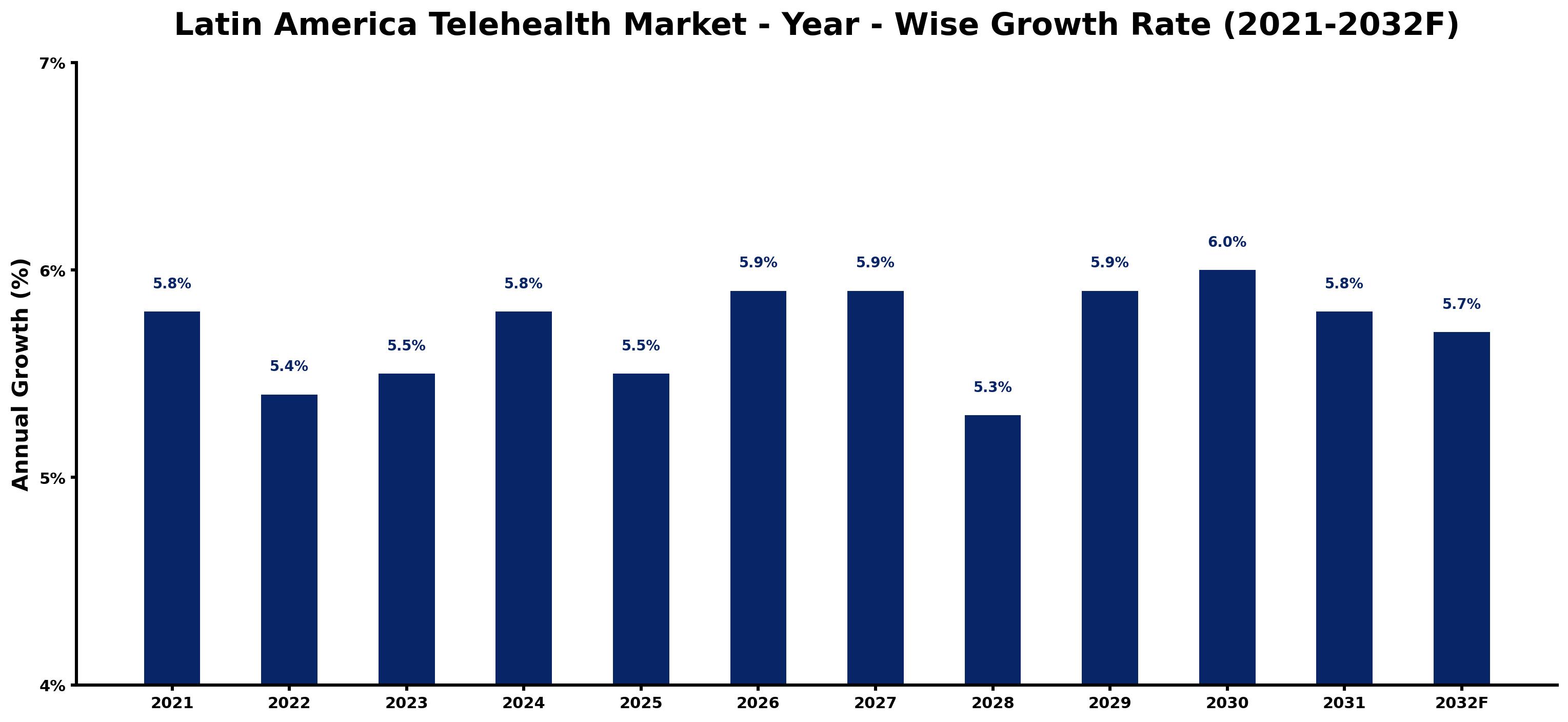
The table below presents the year wise growth rates along with the key drivers influencing the market
| Year | Growth Rate | Major Drivers |
| 2021 | 5.8% | Telehealth gained traction as many healthcare systems adapted to pandemic-related challenges. |
| 2022 | 5.4% | Increased smartphone penetration facilitated access to telehealth services across urban areas. |
| 2023 | 5.5% | Remote consultations became preferred due to convenience and improved patient engagement feedback. |
| 2024 | 5.8% | Healthcare providers invested in digital tools to enhance service delivery and patient experience. |
| 2025 | 5.5% | Partnerships between tech companies and hospitals emerged, expanding service offerings in telehealth. |
| 2026 | 5.9% | A surge in chronic disease management programs highlighted telehealth's effectiveness in rural regions. |
| 2027 | 5.9% | Insurance reimbursement models began to include virtual consultations, boosting market sustainability. |
| 2028 | 5.3% | Growing awareness of mental health issues led to increased utilization of teletherapy services. |
| 2029 | 5.9% | Technological innovations, such as AI diagnostics, transformed telehealth into a more efficient solution. |
| 2030 | 6.0% | Patient data privacy concerns prompted stronger cybersecurity measures within telehealth frameworks. |
| 2031 | 5.8% | Corporate wellness programs increasingly integrated telehealth, reflecting changing employer health strategies. |
| 2032 | 5.7% | An aging population created sustained demand for accessible, remote healthcare solutions. |
Note - Market size estimations and growth projections presented in this report are based on 6Wresearch's advanced forecasting approach, validated with industry datasets as of June 2026.
Latin America Telehealth Market Synopsis
The Latin America Telehealth Market is projected to reach 5.9% and witness significant growth during the forecast period (2026-2032). This growth trajectory is underpinned by various factors, including increasing digitization in healthcare, rising demand for remote healthcare services, and the ongoing need for improved healthcare accessibility across the region. The COVID-19 pandemic has acted as a catalyst, accelerating the adoption of telehealth technologies by both healthcare providers and consumers.
Latin America Telehealth Market Growth Drivers
The Latin America Telehealth Market is driven by several key factors that enhance its growth forecast. Firstly, the rising geriatric population in the region significantly impacts healthcare demand, as this demographic accounts for a substantial portion of healthcare expenditures. Additionally, the ongoing shift towards digital healthcare solutions, prompted by both consumer preferences and the need for cost-effective services, further bolsters market growth.
- Increased adoption of mobile health applications is enabling easier access to healthcare professionals.
- The convenience of remote consultation is particularly appealing to the geriatric population, who often face mobility challenges.
- Cost-effectiveness of telehealth services is attracting both patients and healthcare providers, easing financial burdens.
- Technological advancements in telecommunication are expanding the reach and capabilities of telehealth services.
- Improved digital literacy among healthcare professionals and patients is fostering greater acceptance of telehealth solutions.
Latin America Telehealth Market Challenges and Restraints
Despite its promising outlook, the Latin America Telehealth Market faces several challenges that could impede its growth. Infrastructure limitations in certain areas can restrict access to reliable internet and telecommunication services, hampering the effectiveness of telehealth platforms. Additionally, regulatory barriers and varying reimbursement policies across countries may hinder the adoption of telehealth solutions.
- Inconsistent internet access across rural and urban areas creates disparities in service availability.
- Regulatory frameworks governing telehealth practices vary significantly from country to country, complicating compliance.
- Limited awareness and understanding of telehealth benefits among certain demographics hinder widespread adoption.
- Concerns regarding data security and patient privacy may deter some users from engaging with telehealth services.
- Traditional healthcare systems may resist the shift towards telehealth due to established practices and fear of change.
Latin America Telehealth Market Government Investment and Initiatives
Government investment and initiatives play a crucial role in shaping the future of the Latin America Telehealth Market. Various countries within the region are actively implementing policies designed to enhance healthcare access through digitization.
- Governments are creating funding programs aimed at boosting telehealth infrastructure, particularly in underserved areas.
- Public health initiatives are increasingly promoting telehealth as a viable option for primary care, especially during healthcare crises.
- There is a focus on training healthcare professionals to utilize telehealth technologies effectively and safely.
- Partnerships between government bodies and private sector entities are being established to foster innovation in digital health solutions.
- Efforts are underway to standardize regulations and reimbursement policies to encourage broader telehealth adoption.
Latin America Telehealth Market Trends and Opportunities
The Latin America Telehealth Market presents numerous trends and opportunities that stakeholders can capitalize on to drive growth. With a growing emphasis on preventive care and chronic disease management, telehealth is being integrated into broader healthcare strategies.
- There is an increasing trend toward the use of telehealth platforms for mental health services, expanding access to psychological support.
- Wearable technology and health monitoring devices are becoming increasingly integrated with telehealth services, enabling proactive health management.
- Increased collaboration between telehealth providers and traditional healthcare facilities is fostering a more comprehensive care model.
- Emerging technologies, such as artificial intelligence and machine learning, are being leveraged to enhance telehealth functionalities.
- Growth in e-pharmacy services linked to telemedicine consultations is creating a holistic healthcare solution for patients.
Latin America Telehealth Market Latest Developments (May 2025 - June 2026)
Recent developments in the Latin America Telehealth Market indicate a dynamic landscape characterized by technological advancements and shifting healthcare paradigms. During this period, there has been a notable expansion in telehealth services, particularly in response to the ongoing impacts of the COVID-19 pandemic.
- Healthcare providers have increasingly embraced telehealth platforms to ensure continuity of care amid ongoing health concerns.
- Innovations in communication technology are enhancing the quality and reliability of virtual consultations.
- Regulatory frameworks are evolving to address the unique challenges posed by telehealth, facilitating smoother operations for service providers.
- Increased investment in telehealth initiatives by both public and private sectors reflects a growing commitment to improving healthcare access.
- Telehealth services are seeing enhanced integration with electronic health records, allowing for seamless patient management and data sharing.
Latin America Telehealth Market - Key Attractiveness of the Report
- 10 Years of Market Numbers
- Historical Data Starting from 2022 to 2025
- Base Year: 2025
- Forecast Data until 2032
- Key Performance Indicators Impacting the Market
- Major Upcoming Developments and Projects
Key Highlights of the Report:
- Latin America Telehealth Market Overview
- Latin America Telehealth Market Outlook
- Latin America Telehealth Market Forecast
- Historical Data of Telehealth Market Revenues and Volumes for the Period 2022-2032F
- Market Size & Forecast of Latin America Telehealth Market Revenues and Volumes for the Period 2022-2032F.
- Historical Data of Latin America Telehealth Market Revenues and Volumes, by Types, for the Period 2022-2032F
- Market Size & Forecast of Latin America Telehealth Market Revenues and Volumes, by Types, until 2032F
- Historical Data of Latin America Telehealth Market Revenues and Volumes, by Component, for the Period 2022-2032F
- Market Size & Forecast of Latin America Telehealth Market Revenues and Volumes, by Component, until 2032F
- Historical Data of Mexico Telehealth Market Revenues and Volumes, for the Period 2022-2032F.
- Market Size & Forecast of Mexico Telehealth Market Revenues and Volumes, until 2032F.
- Historical Data of Brazil Telehealth Market Revenues and Volumes, for the Period 2022-2032F.
- Market Size & Forecast of Brazil Telehealth Market Revenues and Volumes, until 2032F.
- Historical Data of Argentina Telehealth Market Revenues and Volumes, for the Period 2022-2032F.
- Market Size & Forecast of Argentina Telehealth Market Revenues and Volumes, until 2032F.
- Historical Data of Rest of Latin America Telehealth Market Revenues and Volumes, for the Period 2022-2032F.
- Market Size & Forecast of Rest of Latin America Telehealth Market Revenues and Volumes, until 2032F.
- Market Drivers and Restraints
- Latin America Telehealth Market Trends and Industry Life Cycle
- Porter’s Five Force Analysis
- Market Opportunity Assessment
- Latin America Telehealth Market Share, By Regions
- Latin America Telehealth Market Share, By Players
- Latin America Telehealth Market Overview on Competitive Benchmarking
- Company Profiles
- Key Strategic Recommendations
Markets Covered
The Latin America Telehealth Market report provides a detailed analysis of the following market segments:
- By Types:
- Tele Hospitals
- Tele Homes
- mHealth (Mobile Health)
- By Component:
- Product
- Hardware
- Software
- Other Types
- Services
- Teleradiology
- Telecardiology
- Teledermatology
- Telepsychiatry
- Other Services
- Product
- By Key Countries:
- Mexico
- Brazil
- Argentina
- Others






































