Latvia Building Automation Systems Market Top 5 Importing Countries and Market Competition (HHI) Analysis
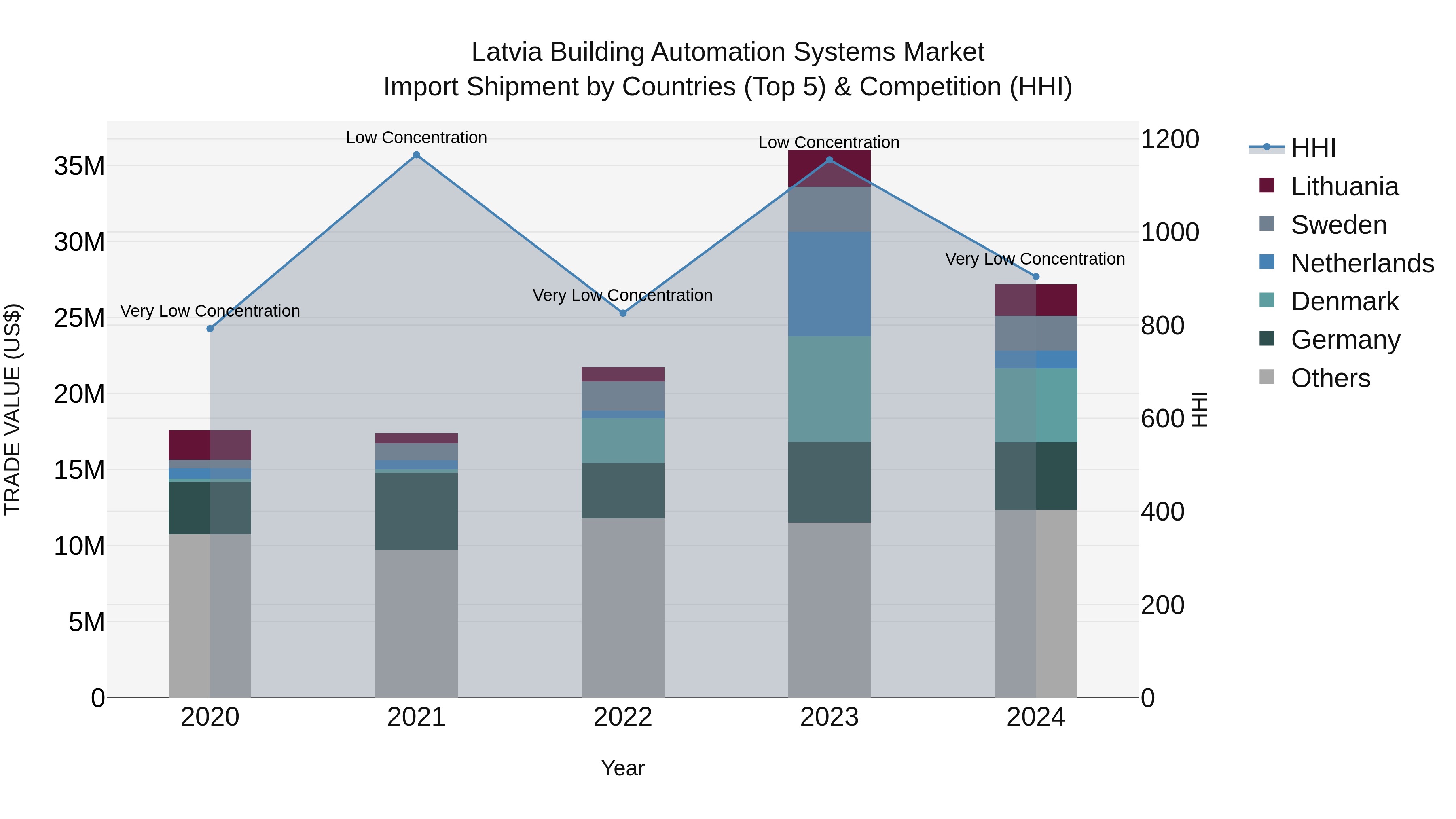
Latvia`s building automation systems import market experienced a significant shift in 2024, with top exporters being Denmark, Germany, Sweden, Lithuania, and Finland. The market showed very low concentration levels, indicating a diverse range of suppliers. Despite a slight decline in growth rate from the previous year, the compound annual growth rate (CAGR) from 2020 to 2024 remained strong at 11.53%, pointing towards a promising outlook for the industry in Latvia. The increased competition and variety of suppliers are likely driving innovation and offering more options for consumers in the market.
Key Highlights of the Report:
- Latvia Building Automation Systems Market Outlook
- Market Size of Latvia Building Automation Systems Market, 2025
- Forecast of Latvia Building Automation Systems Market, 2032
- Historical Data and Forecast of Latvia Building Automation Systems Revenues & Volume for the Period 2022 - 2032F
- Latvia Building Automation Systems Market Trend Evolution
- Latvia Building Automation Systems Market Drivers and Challenges
- Latvia Building Automation Systems Price Trends
- Latvia Building Automation Systems Porter`s Five Forces
- Latvia Building Automation Systems Industry Life Cycle
- Historical Data and Forecast of Latvia Building Automation Systems Market Revenues & Volume By Offering for the Period 2022 - 2032F
- Historical Data and Forecast of Latvia Building Automation Systems Market Revenues & Volume By Facility Management Systems for the Period 2022 - 2032F
- Historical Data and Forecast of Latvia Building Automation Systems Market Revenues & Volume By Security & Access Controls for the Period 2022 - 2032F
- Historical Data and Forecast of Latvia Building Automation Systems Market Revenues & Volume By Fire Protection Systems for the Period 2022 - 2032F
- Historical Data and Forecast of Latvia Building Automation Systems Market Revenues & Volume By BEM Software for the Period 2022 - 2032F
- Historical Data and Forecast of Latvia Building Automation Systems Market Revenues & Volume By BAS Services for the Period 2022 - 2032F
- Historical Data and Forecast of Latvia Building Automation Systems Market Revenues & Volume By Communication Technology for the Period 2022 - 2032F
- Historical Data and Forecast of Latvia Building Automation Systems Market Revenues & Volume By Wireless Technology for the Period 2022 - 2032F
- Historical Data and Forecast of Latvia Building Automation Systems Market Revenues & Volume By Wired Technology for the Period 2022 - 2032F
- Historical Data and Forecast of Latvia Building Automation Systems Market Revenues & Volume By Application for the Period 2022 - 2032F
- Historical Data and Forecast of Latvia Building Automation Systems Market Revenues & Volume By Commercial for the Period 2022 - 2032F
- Historical Data and Forecast of Latvia Building Automation Systems Market Revenues & Volume By Residential for the Period 2022 - 2032F
- Historical Data and Forecast of Latvia Building Automation Systems Market Revenues & Volume By Industrial for the Period 2022 - 2032F
- Latvia Building Automation Systems Import Export Trade Statistics
- Market Opportunity Assessment By Offering
- Market Opportunity Assessment By Communication Technology
- Market Opportunity Assessment By Application
- Latvia Building Automation Systems Top Companies Market Share
- Latvia Building Automation Systems Competitive Benchmarking By Technical and Operational Parameters
- Latvia Building Automation Systems Company Profiles
- Latvia Building Automation Systems Key Strategic Recommendations






































