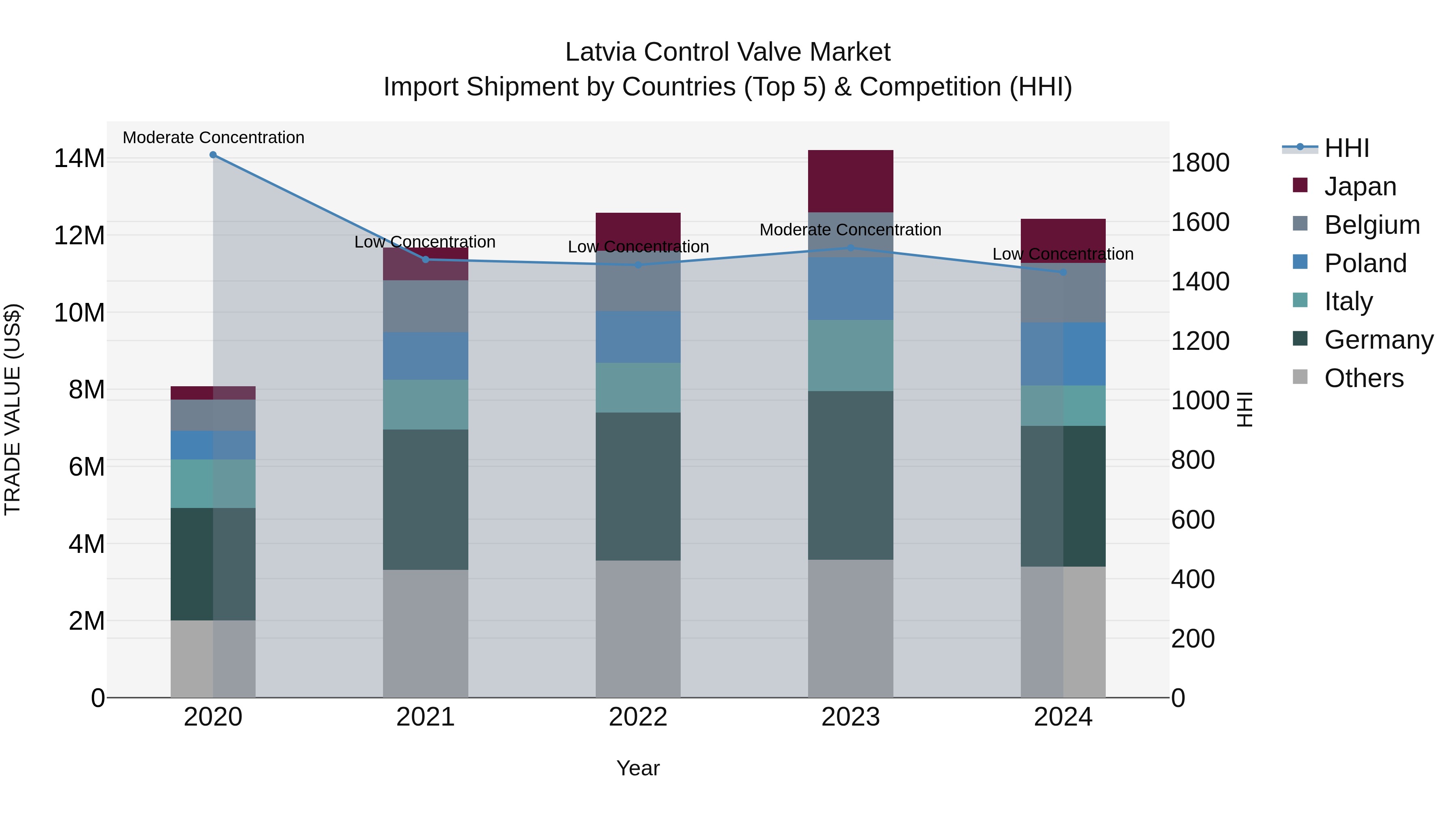
Latvia Control Valve Market Top 5 Importing Countries and Market Competition (HHI) Analysis
Latvia`s control valve import market witnessed a shift in concentration levels from moderate to low in 2024, indicating a more diverse range of suppliers. The top exporting countries to Latvia in 2024 include Germany, Poland, Belgium, Japan, and Italy, showcasing a mix of European and Asian suppliers. Despite a slight decline in growth rate from 2023 to 2024, the compound annual growth rate (CAGR) for the period 2020-2024 stands at a healthy 11.34%, reflecting a steady expansion in the market. Overall, Latvia`s control valve import sector continues to show resilience and potential for further development.
Latvia Control Valve Market Synopsis
The Latvia Control Valve Market is witnessing steady growth driven by the increasing adoption of advanced industrial automation technologies across various sectors such as oil and gas, water and wastewater, power generation, and chemical processing. The market is characterized by the presence of key players offering a wide range of control valves with features like precision control, high reliability, and efficiency. Additionally, the growing focus on improving process efficiency, reducing energy consumption, and enhancing operational performance is further fueling the demand for control valves in the country. Key trends in the market include the integration of digital technologies like IoT and smart sensors in control valves to enable remote monitoring and control. Overall, the Latvia Control Valve Market is poised for continued growth in the coming years as industries increasingly prioritize automation and optimization of their processes.
Latvia Control Valve Market Trends
The Latvia Control Valve Market is experiencing a growing demand for advanced control valve technologies driven by the increasing focus on automation and efficiency in various industries such as oil and gas, water and wastewater treatment, and chemical processing. The market is witnessing a shift towards smart control valves with digital communication capabilities, allowing for remote monitoring and control. Additionally, there is a rising emphasis on energy efficiency and environmental sustainability, leading to the adoption of control valves with improved energy-saving features. Opportunities lie in the development of innovative control valve solutions tailored to the specific needs of different sectors, as well as strategic partnerships and collaborations to enhance product offerings and market reach. Overall, the Latvia Control Valve Market is poised for growth, driven by technological advancements and industry demands for enhanced performance and sustainability.
Latvia Control Valve Market Challenges
In the Latvia Control Valve Market, some key challenges include intense competition from both domestic and international manufacturers, fluctuating raw material prices impacting production costs, and the need for continuous technological advancements to meet evolving customer requirements. Additionally, regulatory compliance and quality standards pose challenges for market players in ensuring adherence and certification. The market`s relatively small size and limited industrial base compared to larger European markets can also limit growth opportunities for companies operating in the control valve sector in Latvia. Overall, navigating these challenges requires companies to be agile, innovative, and strategic in their approach to stay competitive and capture market share in Latvia`s control valve industry.
Latvia Control Valve Market Investment Opportunities
The Latvia Control Valve Market is primarily driven by the increasing demand for automation and control solutions across various industries such as oil & gas, water & wastewater, power generation, and chemicals. With the growing emphasis on efficiency, safety, and accuracy in industrial processes, there is a rising need for control valves to regulate the flow of fluids and gases. Additionally, the adoption of advanced technologies such as smart valves and digital control systems is fueling market growth. Furthermore, stringent government regulations regarding environmental protection and energy conservation are encouraging industries to invest in control valves that can optimize energy consumption and reduce emissions, thus driving the market forward in Latvia.
Latvia Control Valve Market Government Polices
Government policies related to the Latvia Control Valve Market focus on promoting energy efficiency and sustainability in industrial processes. The government has implemented regulations and incentives to encourage the use of control valves that help reduce energy consumption and minimize environmental impact. Additionally, there are quality standards and certifications in place to ensure that control valves meet safety and performance requirements. The government also supports research and development efforts in the control valve sector to drive innovation and technological advancements. Overall, the policies aim to enhance the competitiveness of the Latvia Control Valve Market while advancing the country`s sustainable development goals.
Latvia Control Valve Market Future Outlook
The Latvia control valve market is expected to experience steady growth in the coming years, driven by increasing industrial automation and the growing demand for efficient control of fluid flow in various industries such as oil & gas, water treatment, and chemicals. The market is likely to benefit from advancements in control valve technology, including the integration of IoT and smart capabilities for improved monitoring and control. Additionally, the emphasis on energy efficiency and cost reduction in industrial processes will further fuel the demand for control valves in Latvia. Overall, the market is poised for expansion, supported by favorable economic conditions and the ongoing modernization of industrial infrastructure in the country.
Key Highlights of the Report:
- Latvia Control Valve Market Outlook
- Market Size of Latvia Control Valve Market, 2024
- Forecast of Latvia Control Valve Market, 2031
- Historical Data and Forecast of Latvia Control Valve Revenues & Volume for the Period 2021-2031
- Latvia Control Valve Market Trend Evolution
- Latvia Control Valve Market Drivers and Challenges
- Latvia Control Valve Price Trends
- Latvia Control Valve Porter`s Five Forces
- Latvia Control Valve Industry Life Cycle
- Historical Data and Forecast of Latvia Control Valve Market Revenues & Volume By Component for the Period 2021-2031
- Historical Data and Forecast of Latvia Control Valve Market Revenues & Volume By Actuators for the Period 2021-2031
- Historical Data and Forecast of Latvia Control Valve Market Revenues & Volume By Valve Body for the Period 2021-2031
- Historical Data and Forecast of Latvia Control Valve Market Revenues & Volume By Type for the Period 2021-2031
- Historical Data and Forecast of Latvia Control Valve Market Revenues & Volume By Rotary for the Period 2021-2031
- Historical Data and Forecast of Latvia Control Valve Market Revenues & Volume By Linear for the Period 2021-2031
- Historical Data and Forecast of Latvia Control Valve Market Revenues & Volume By Industry for the Period 2021-2031
- Historical Data and Forecast of Latvia Control Valve Market Revenues & Volume By Oil & Gas for the Period 2021-2031
- Historical Data and Forecast of Latvia Control Valve Market Revenues & Volume By Water & Wastewater Treatment for the Period 2021-2031
- Historical Data and Forecast of Latvia Control Valve Market Revenues & Volume By Energy & Power for the Period 2021-2031
- Historical Data and Forecast of Latvia Control Valve Market Revenues & Volume By Chemicals for the Period 2021-2031
- Latvia Control Valve Import Export Trade Statistics
- Market Opportunity Assessment By Component
- Market Opportunity Assessment By Type
- Market Opportunity Assessment By Industry
- Latvia Control Valve Top Companies Market Share
- Latvia Control Valve Competitive Benchmarking By Technical and Operational Parameters
- Latvia Control Valve Company Profiles
- Latvia Control Valve Key Strategic Recommendations






































