Latvia Cutting Machinery and Equipment Market Top 5 Importing Countries and Market Competition (HHI) Analysis
Latvia saw a shift in the concentration of cutting machinery and equipment import shipments in 2024, moving from low to moderate concentration. Despite a slight decline in growth rate from 2023 to 2024, the compound annual growth rate (CAGR) over the past four years stands at a steady 2.82%. Top exporting countries to Latvia in 2024 include Norway, Poland, Estonia, Spain, and Germany, indicating a diverse import source base. This data suggests a stable market for cutting machinery and equipment in Latvia, with potential for further growth and development in the coming years.
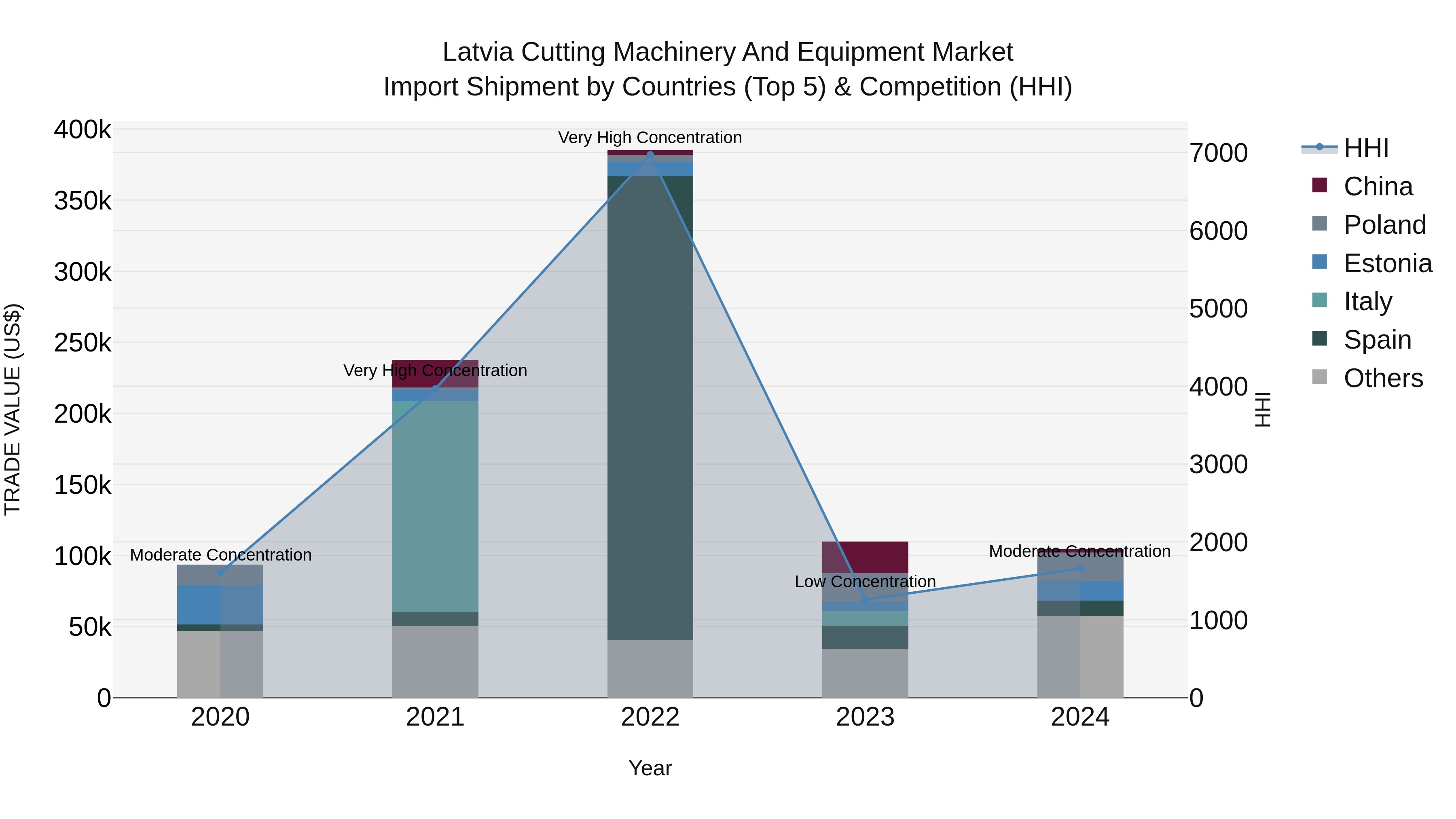
Key Highlights of the Report:
- Latvia Cutting Machinery and Equipment Market Outlook
- Market Size of Latvia Cutting Machinery and Equipment Market, 2025
- Forecast of Latvia Cutting Machinery and Equipment Market, 2032
- Historical Data and Forecast of Latvia Cutting Machinery and Equipment Revenues & Volume for the Period 2022 - 2032F
- Latvia Cutting Machinery and Equipment Market Trend Evolution
- Latvia Cutting Machinery and Equipment Market Drivers and Challenges
- Latvia Cutting Machinery and Equipment Price Trends
- Latvia Cutting Machinery and Equipment Porter`s Five Forces
- Latvia Cutting Machinery and Equipment Industry Life Cycle
- Historical Data and Forecast of Latvia Cutting Machinery and Equipment Market Revenues & Volume By Equipment Type for the Period 2022 - 2032F
- Historical Data and Forecast of Latvia Cutting Machinery and Equipment Market Revenues & Volume By Manual for the Period 2022 - 2032F
- Historical Data and Forecast of Latvia Cutting Machinery and Equipment Market Revenues & Volume By Mechanized for the Period 2022 - 2032F
- Historical Data and Forecast of Latvia Cutting Machinery and Equipment Market Revenues & Volume By Technology Type for the Period 2022 - 2032F
- Historical Data and Forecast of Latvia Cutting Machinery and Equipment Market Revenues & Volume By Carbon arc cutting for the Period 2022 - 2032F
- Historical Data and Forecast of Latvia Cutting Machinery and Equipment Market Revenues & Volume By Laser Cutting for the Period 2022 - 2032F
- Historical Data and Forecast of Latvia Cutting Machinery and Equipment Market Revenues & Volume By Oxy-fuel cutting for the Period 2022 - 2032F
- Historical Data and Forecast of Latvia Cutting Machinery and Equipment Market Revenues & Volume By Plasma cutting for the Period 2022 - 2032F
- Historical Data and Forecast of Latvia Cutting Machinery and Equipment Market Revenues & Volume By Waterjet cutting for the Period 2022 - 2032F
- Historical Data and Forecast of Latvia Cutting Machinery and Equipment Market Revenues & Volume By End-use for the Period 2022 - 2032F
- Historical Data and Forecast of Latvia Cutting Machinery and Equipment Market Revenues & Volume By Automotive for the Period 2022 - 2032F
- Historical Data and Forecast of Latvia Cutting Machinery and Equipment Market Revenues & Volume By Construction for the Period 2022 - 2032F
- Historical Data and Forecast of Latvia Cutting Machinery and Equipment Market Revenues & Volume By General metal fabrication for the Period 2022 - 2032F
- Historical Data and Forecast of Latvia Cutting Machinery and Equipment Market Revenues & Volume By Heavy Equipment Fabrication for the Period 2022 - 2032F
- Historical Data and Forecast of Latvia Cutting Machinery and Equipment Market Revenues & Volume By Shipbuilding & Offshore for the Period 2022 - 2032F
- Historical Data and Forecast of Latvia Cutting Machinery and Equipment Market Revenues & Volume By Others for the Period 2022 - 2032F
- Latvia Cutting Machinery and Equipment Import Export Trade Statistics
- Market Opportunity Assessment By Equipment Type
- Market Opportunity Assessment By Technology Type
- Market Opportunity Assessment By End-use
- Latvia Cutting Machinery and Equipment Top Companies Market Share
- Latvia Cutting Machinery and Equipment Competitive Benchmarking By Technical and Operational Parameters
- Latvia Cutting Machinery and Equipment Company Profiles
- Latvia Cutting Machinery and Equipment Key Strategic Recommendations






































