Latvia Cyclohexane Market Size (2020-2030)
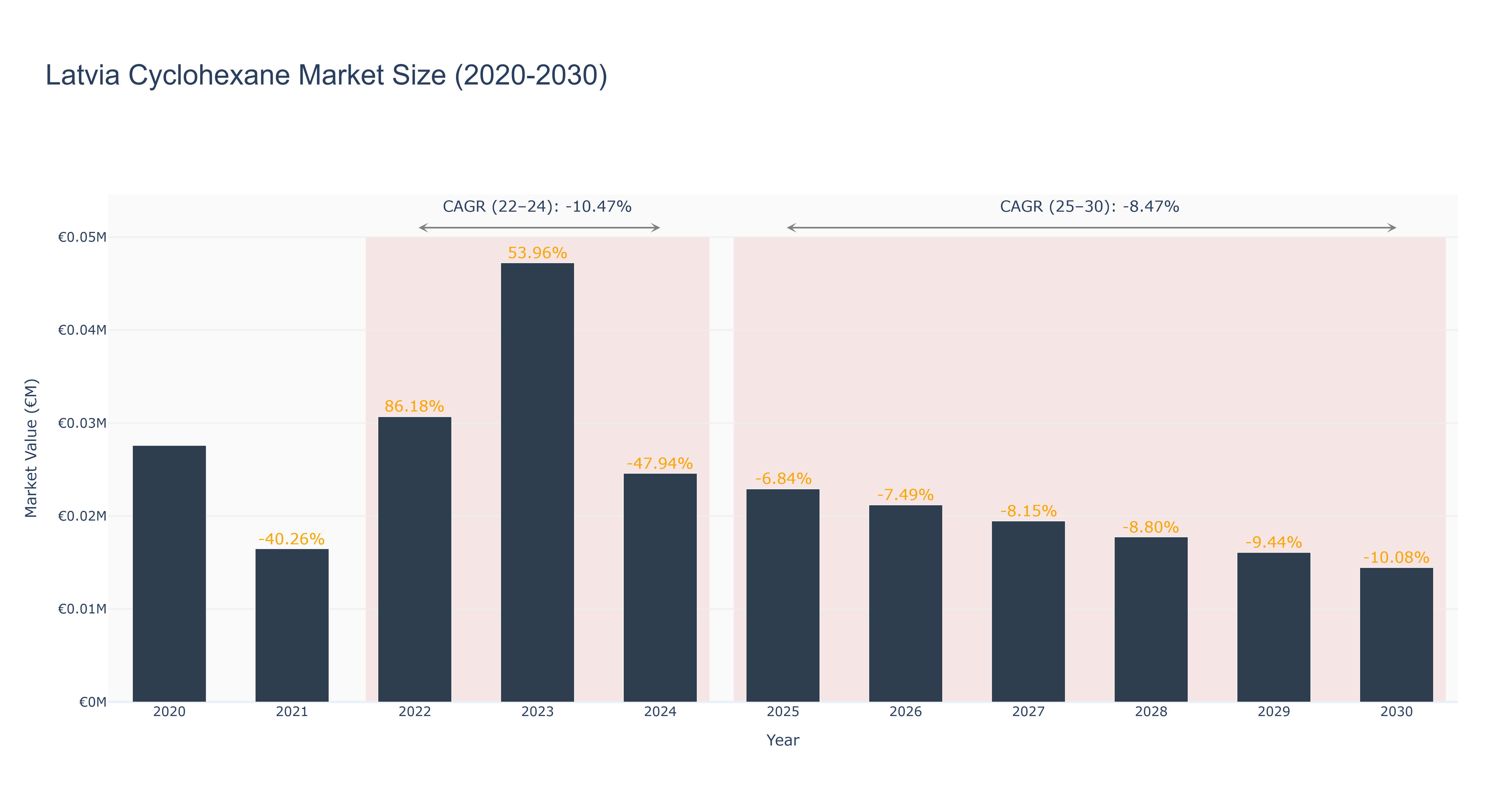
Latvia Cyclohexane Market has experienced fluctuations in market size over the years. The peak market size of €0.05 million was observed in 2023, followed by a decline to €0.02 million in 2024. The market is forecasted to continue shrinking, with a projected size of €0.01 million in 2030. The CAGR for the period 2022-24 was -10.47%, while for 2025-30 it is estimated at -8.47%. The market saw growth in 2022 due to increased demand from various industries, but subsequent declines can be attributed to economic uncertainties and changing consumer preferences. Looking ahead, Latvia is set to invest in renewable energy projects to reduce dependency on traditional sources, which could impact the cyclohexane market positively in the long run.
Latvia Cyclohexane Market: Production & Trade Performance (2019-2025)
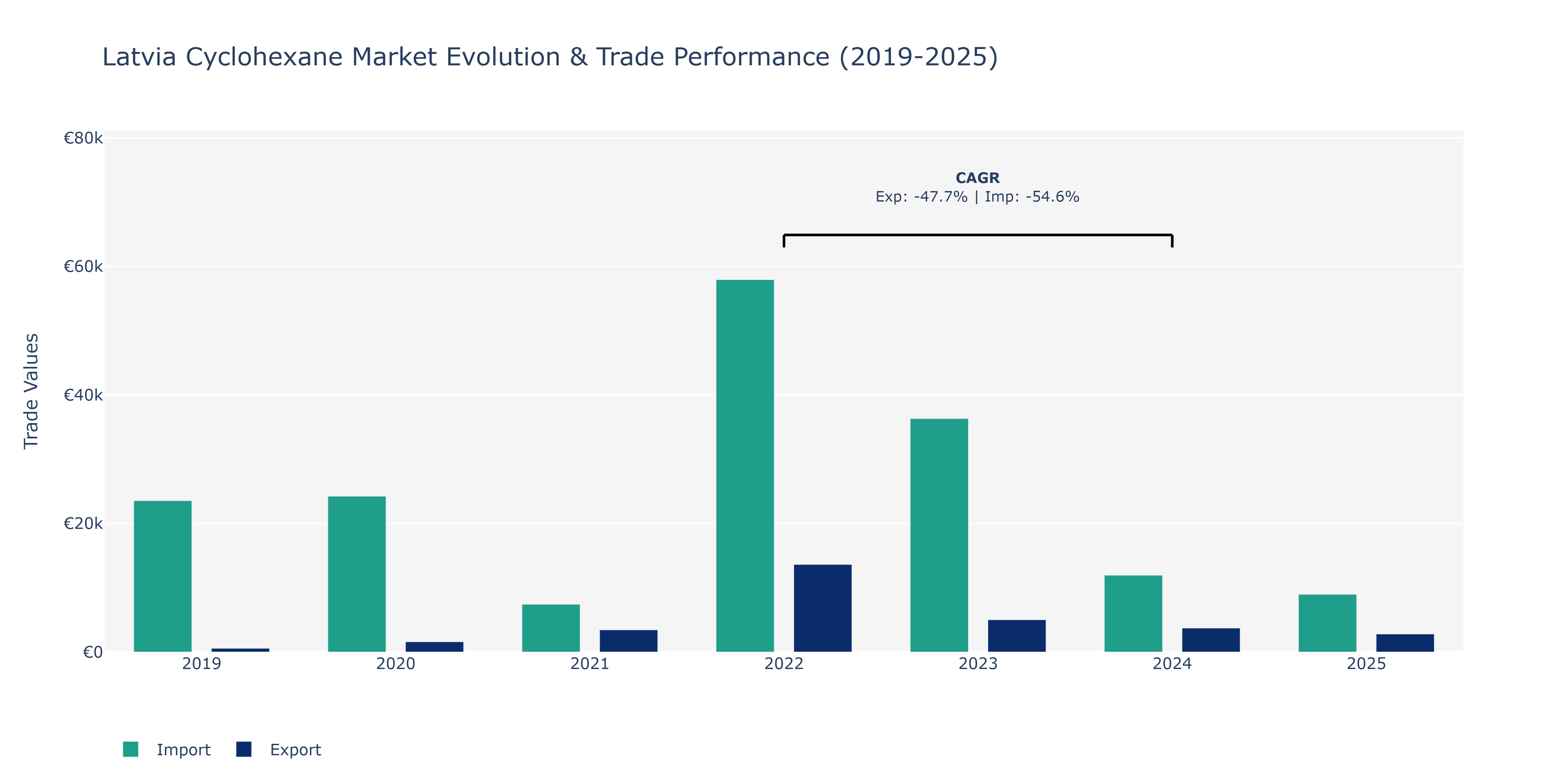
The Latvia Cyclohexane Market experienced notable fluctuations in both exports and imports from 2019 to 2025. In 2019, exports stood at €590 million while imports were significantly higher at €23.55 billion. The following year, exports surged to €1.59 billion, but imports remained relatively stable at €24.24 billion. The year 2021 saw a substantial increase in exports to €3.46 billion, while imports decreased to €7.43 billion. However, in 2022, there was a remarkable spike in exports to €13.63 billion, accompanied by a substantial increase in imports to €57.94 billion. The market then witnessed a decline in both exports and imports in 2023 and 2024. Exports decreased to €5.03 billion in 2023 and further dropped to €3.73 billion in 2024, while imports decreased to €36.33 billion in 2023 and €11.95 billion in 2024. By 2025, exports were at €2.81 billion, and imports were at €8.98 billion. These fluctuations can be attributed to various factors such as changes in global demand for cyclohexane, shifts in production capacities within the region, as well as macroeconomic conditions impacting trade flows. The decrease in CAGR for both exports and imports from 2022 to 2024 reflects a period of adjustment in the market, possibly influenced by regulatory changes or shifts in supply chains within the industry, reinforcing the need for market players to adapt to evolving dynamics and optimize their strategies to navigate such fluctuations effectively.
Key Highlights of the Report:
- Latvia Cyclohexane Market Outlook
- Market Size of Latvia Cyclohexane Market, 2025
- Forecast of Latvia Cyclohexane Market, 2032
- Historical Data and Forecast of Latvia Cyclohexane Revenues & Volume for the Period 2022 - 2032F
- Latvia Cyclohexane Market Trend Evolution
- Latvia Cyclohexane Market Drivers and Challenges
- Latvia Cyclohexane Price Trends
- Latvia Cyclohexane Porter`s Five Forces
- Latvia Cyclohexane Industry Life Cycle
- Historical Data and Forecast of Latvia Cyclohexane Market Revenues & Volume By Application for the Period 2022 - 2032F
- Historical Data and Forecast of Latvia Cyclohexane Market Revenues & Volume By Adipic acid for the Period 2022 - 2032F
- Historical Data and Forecast of Latvia Cyclohexane Market Revenues & Volume By Caprolactam for the Period 2022 - 2032F
- Historical Data and Forecast of Latvia Cyclohexane Market Revenues & Volume By Others for the Period 2022 - 2032F
- Historical Data and Forecast of Latvia Cyclohexane Market Revenues & Volume By End-use for the Period 2022 - 2032F
- Historical Data and Forecast of Latvia Cyclohexane Market Revenues & Volume By Nylon 6 for the Period 2022 - 2032F
- Historical Data and Forecast of Latvia Cyclohexane Market Revenues & Volume By Nylon 66 for the Period 2022 - 2032F
- Historical Data and Forecast of Latvia Cyclohexane Market Revenues & Volume By Others for the Period 2022 - 2032F
- Latvia Cyclohexane Import Export Trade Statistics
- Market Opportunity Assessment By Application
- Market Opportunity Assessment By End-use
- Latvia Cyclohexane Top Companies Market Share
- Latvia Cyclohexane Competitive Benchmarking By Technical and Operational Parameters
- Latvia Cyclohexane Company Profiles
- Latvia Cyclohexane Key Strategic Recommendations






































