Latvia Diesel Engine Market Size (2020-2030)
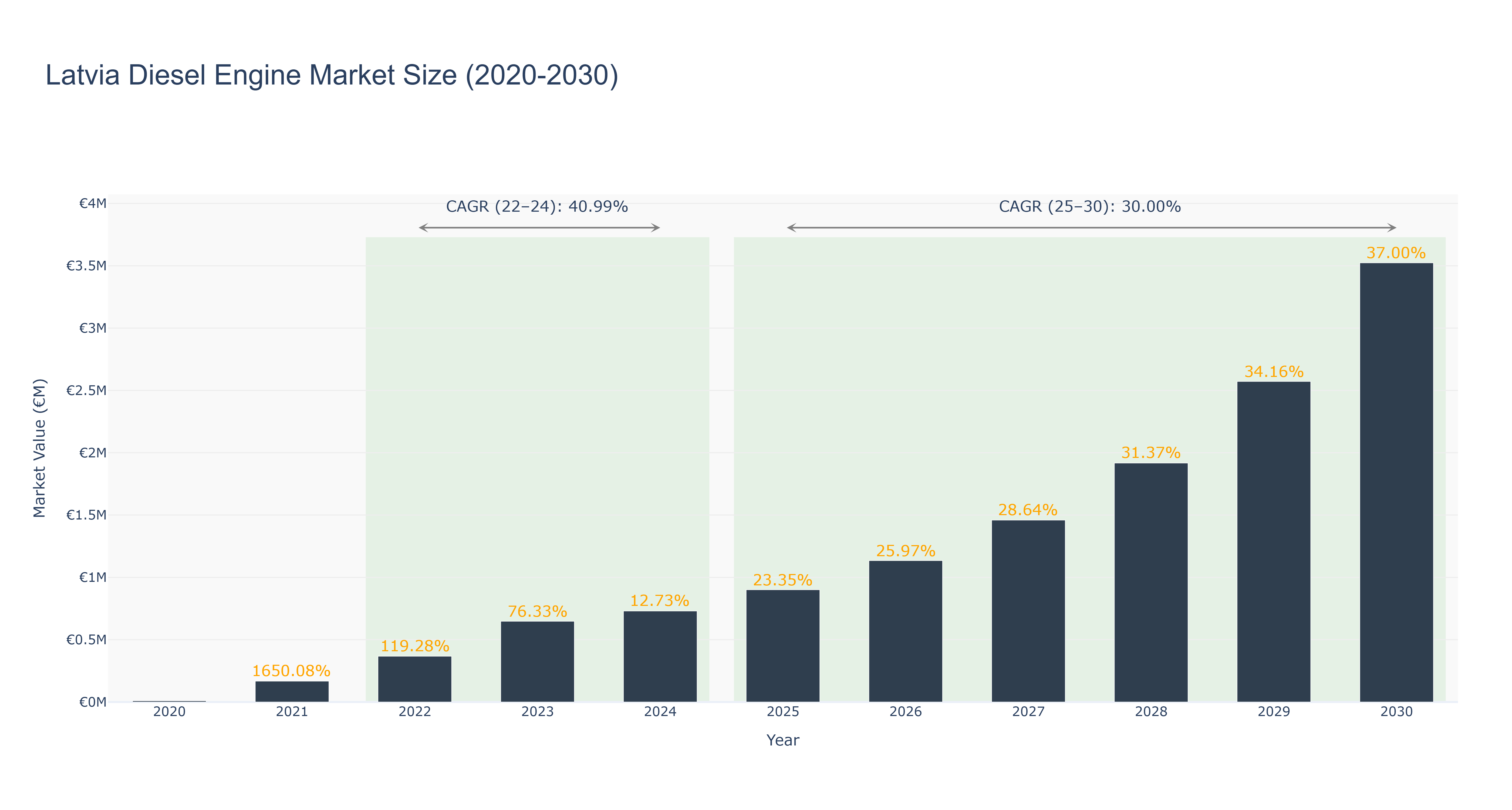
Latvia Diesel Engine Market has shown a strong growth trajectory from 2020 to 2030. The market size peaked at €3.52 million in 2030, with steady growth over the years. From 2020 to 2024, the market size increased from €0.01 million to €0.73 million, driven by increasing demand for diesel engines in various industries. Notably, the CAGR for this period stood at 40.99%, reflecting robust expansion. Looking ahead, the forecasted market size from 2025 to 2030 is expected to reach €3.52 million, with a CAGR of 30.0%. This growth can be attributed to ongoing infrastructure projects and investments in sustainable energy solutions in Latvia. Future developments in the market include collaborations with global manufacturers to enhance product offerings and cater to evolving consumer needs.
Latvia Diesel Engine Market: Production & Trade Performance (2019-2025)
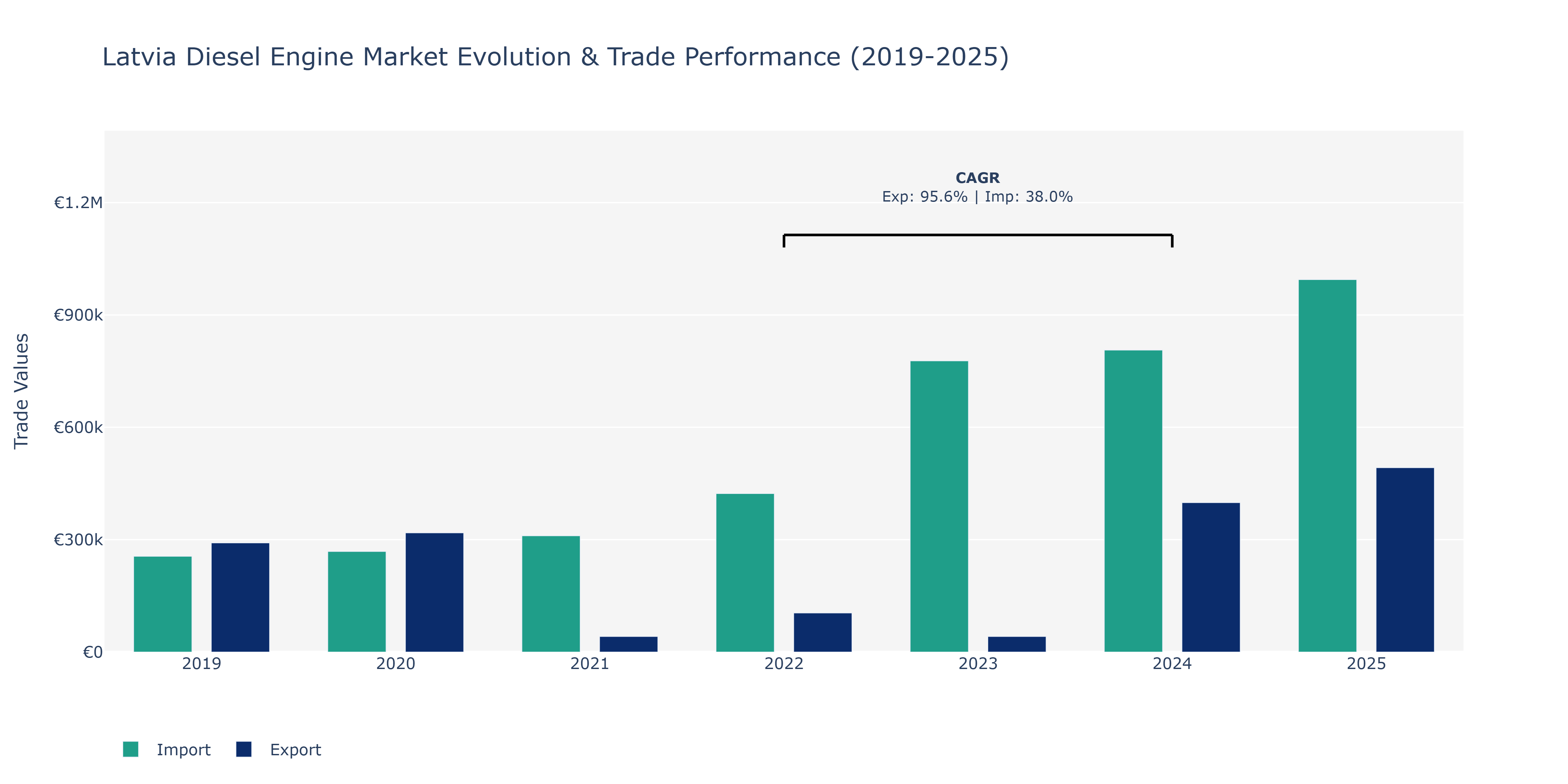
In the Latvia Diesel Engine Market, exports showed a fluctuating pattern over the years. In 2019, exports stood at €291.4 thousand, increasing to €318.05 thousand in 2020. However, there was a substantial drop in 2021 to €41.48 thousand before rebounding to €492.12 thousand in 2025, indicating a notable peak. Conversely, imports followed a more consistent upward trajectory, starting at €255.47 thousand in 2019 and steadily rising to €994.38 thousand by 2025, with a particularly sharp increase from 2023 to 2025. These trends could be attributed to shifts in global demand for diesel engines, local regulatory changes, and technological advancements in the sector. The surge in imports may be linked to infrastructure development projects and increased industrial activities, while the variability in exports might reflect changing market dynamics and competitiveness in the international market.
Key Highlights of the Report:
- Latvia Diesel Engine Market Outlook
- Market Size of Latvia Diesel Engine Market, 2025
- Forecast of Latvia Diesel Engine Market, 2032
- Historical Data and Forecast of Latvia Diesel Engine Revenues & Volume for the Period 2022 - 2032F
- Latvia Diesel Engine Market Trend Evolution
- Latvia Diesel Engine Market Drivers and Challenges
- Latvia Diesel Engine Price Trends
- Latvia Diesel Engine Porter`s Five Forces
- Latvia Diesel Engine Industry Life Cycle
- Historical Data and Forecast of Latvia Diesel Engine Market Revenues & Volume By Power Rating for the Period 2022 - 2032F
- Historical Data and Forecast of Latvia Diesel Engine Market Revenues & Volume By 0.5 MW 1 MW for the Period 2022 - 2032F
- Historical Data and Forecast of Latvia Diesel Engine Market Revenues & Volume By Up to 0.5 MW for the Period 2022 - 2032F
- Historical Data and Forecast of Latvia Diesel Engine Market Revenues & Volume By 2 MW 5 MW for the Period 2022 - 2032F
- Historical Data and Forecast of Latvia Diesel Engine Market Revenues & Volume By 1 MW 2 MW for the Period 2022 - 2032F
- Historical Data and Forecast of Latvia Diesel Engine Market Revenues & Volume By Above 5 MW for the Period 2022 - 2032F
- Historical Data and Forecast of Latvia Diesel Engine Market Revenues & Volume By for the Period 2022 - 2032F
- Historical Data and Forecast of Latvia Diesel Engine Market Revenues & Volume By End User for the Period 2022 - 2032F
- Historical Data and Forecast of Latvia Diesel Engine Market Revenues & Volume By Automotive for the Period 2022 - 2032F
- Historical Data and Forecast of Latvia Diesel Engine Market Revenues & Volume By Non-Automotive for the Period 2022 - 2032F
- Latvia Diesel Engine Import Export Trade Statistics
- Market Opportunity Assessment By Power Rating
- Market Opportunity Assessment By End User
- Latvia Diesel Engine Top Companies Market Share
- Latvia Diesel Engine Competitive Benchmarking By Technical and Operational Parameters
- Latvia Diesel Engine Company Profiles
- Latvia Diesel Engine Key Strategic Recommendations






































