Latvia Fragrance Ingredients Market Top 5 Importing Countries and Market Competition (HHI) Analysis
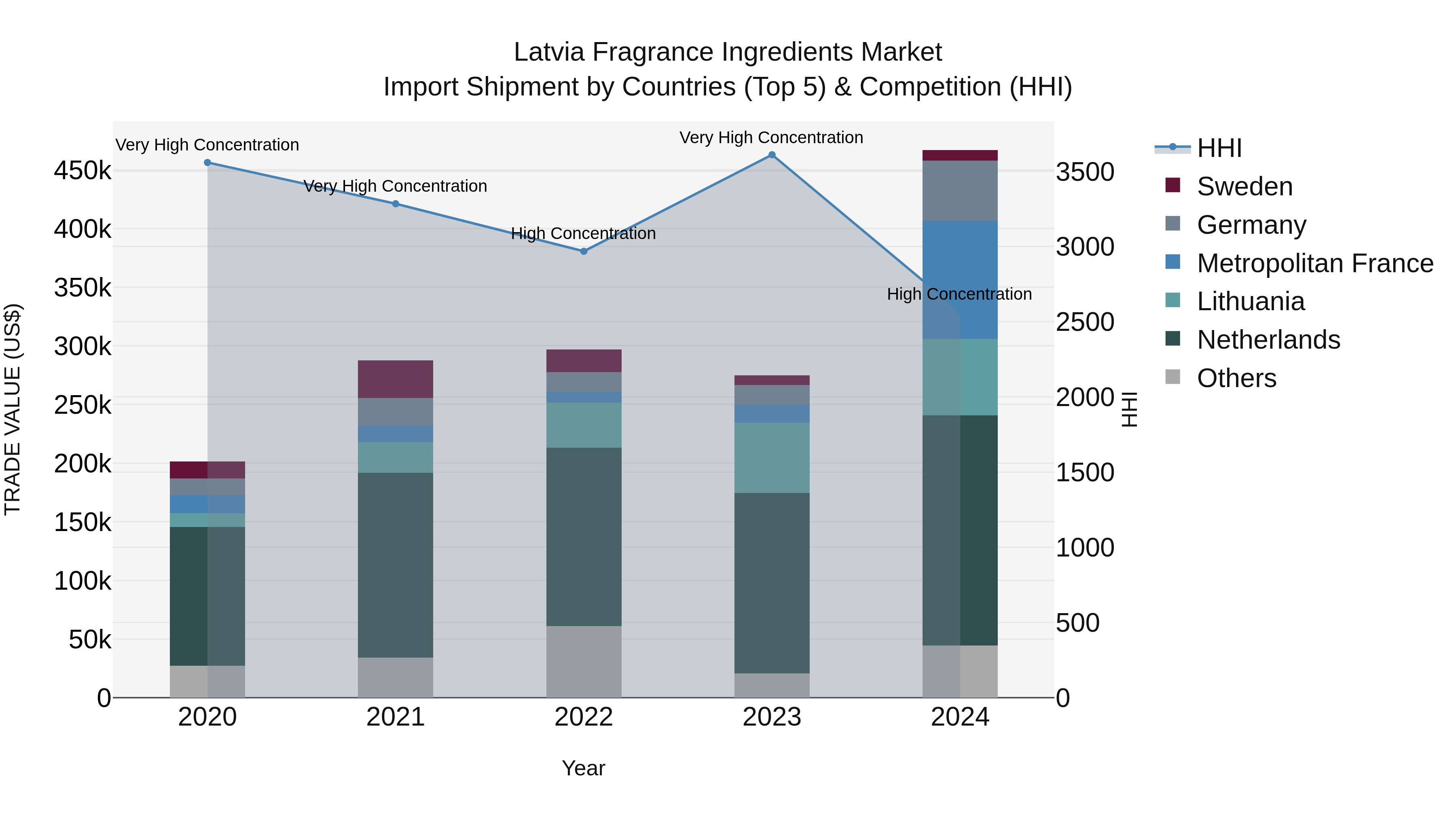
The fragrance ingredients import market in Latvia continues to show promising growth, with key suppliers such as Netherlands, Metropolitan France, Lithuania, Germany, and the UK leading the way in 2024. Despite a high concentration level in 2023, the market has slightly improved in terms of competition in 2024. The impressive compound annual growth rate (CAGR) of 23.39% from 2020 to 2024 indicates a strong upward trend, with a notable growth rate of 69.84% from 2023 to 2024. This suggests a thriving market with increasing demand for fragrance ingredients in Latvia.
Key Highlights of the Report:
- Latvia Fragrance Ingredients Market Outlook
- Market Size of Latvia Fragrance Ingredients Market, 2025
- Forecast of Latvia Fragrance Ingredients Market, 2032
- Historical Data and Forecast of Latvia Fragrance Ingredients Revenues & Volume for the Period 2022 - 2032F
- Latvia Fragrance Ingredients Market Trend Evolution
- Latvia Fragrance Ingredients Market Drivers and Challenges
- Latvia Fragrance Ingredients Price Trends
- Latvia Fragrance Ingredients Porter`s Five Forces
- Latvia Fragrance Ingredients Industry Life Cycle
- Historical Data and Forecast of Latvia Fragrance Ingredients Market Revenues & Volume By Type for the Period 2022 - 2032F
- Historical Data and Forecast of Latvia Fragrance Ingredients Market Revenues & Volume By Essential Oils for the Period 2022 - 2032F
- Historical Data and Forecast of Latvia Fragrance Ingredients Market Revenues & Volume By Aroma Chemicals for the Period 2022 - 2032F
- Historical Data and Forecast of Latvia Fragrance Ingredients Market Revenues & Volume By Application for the Period 2022 - 2032F
- Historical Data and Forecast of Latvia Fragrance Ingredients Market Revenues & Volume By Cosmetics & toiletries for the Period 2022 - 2032F
- Historical Data and Forecast of Latvia Fragrance Ingredients Market Revenues & Volume By Fine fragrances for the Period 2022 - 2032F
- Historical Data and Forecast of Latvia Fragrance Ingredients Market Revenues & Volume By Soaps & detergents for the Period 2022 - 2032F
- Historical Data and Forecast of Latvia Fragrance Ingredients Market Revenues & Volume By Others for the Period 2022 - 2032F
- Latvia Fragrance Ingredients Import Export Trade Statistics
- Market Opportunity Assessment By Type
- Market Opportunity Assessment By Application
- Latvia Fragrance Ingredients Top Companies Market Share
- Latvia Fragrance Ingredients Competitive Benchmarking By Technical and Operational Parameters
- Latvia Fragrance Ingredients Company Profiles
- Latvia Fragrance Ingredients Key Strategic Recommendations






































