Latvia Hair Shampoo Market Size (2020-2030)
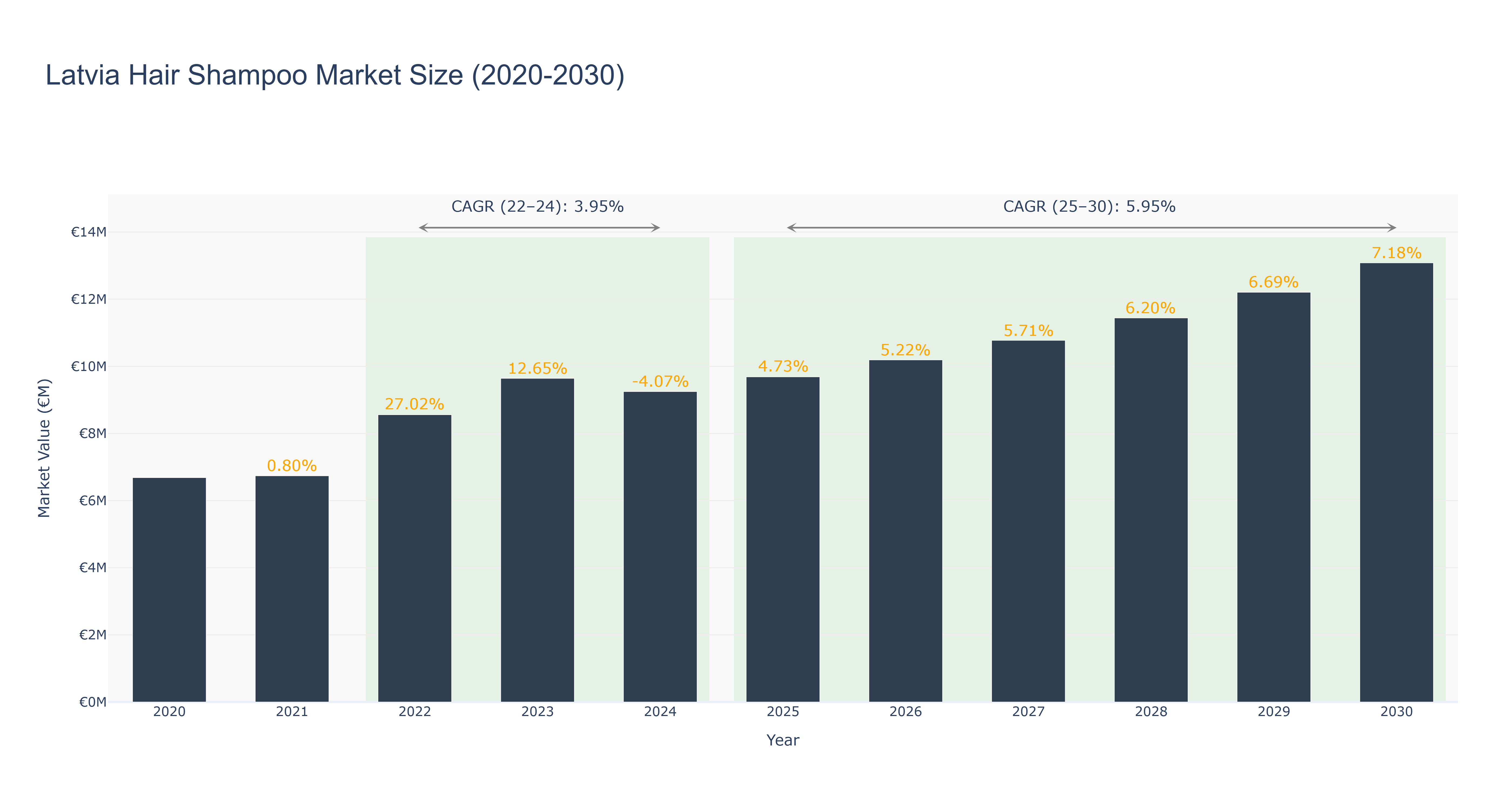
Latvia Hair Shampoo Market has shown a steady growth trajectory over the years. The peak market size of €13.08 million is projected for 2030, with an impressive CAGR of 5.95% from 2025 to 2030. The market experienced fluctuations in the past, with a decline in 2024 due to a temporary market saturation, which was overcome by strategic marketing initiatives leading to consistent growth thereafter. Industry drivers such as increasing consumer awareness of personal grooming and hygiene have fueled this market's expansion. Looking ahead, upcoming advancements in sustainable packaging solutions and the introduction of innovative product formulations are expected to drive further growth in the Latvia Hair Shampoo Market.
Latvia Hair Shampoo Market: Production & Trade Performance (2019-2025)
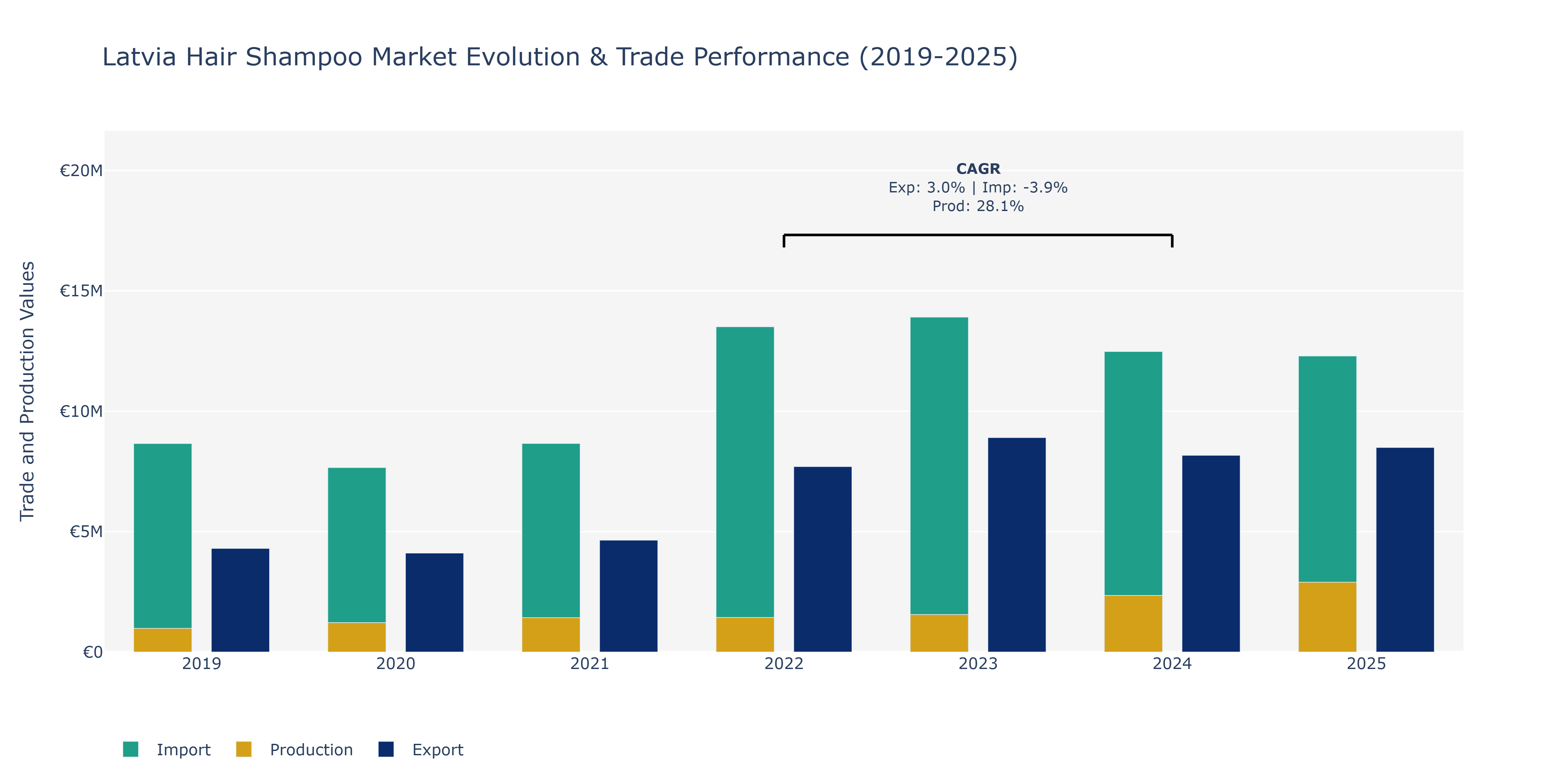
In the Latvia Hair Shampoo Market, from 2019 to 2025, Exports experienced fluctuations. In 2022, there was a substantial increase to approximately €7.7 million, followed by a slight decrease in the following years but remaining above €8 billion. Imports followed a similar pattern, peaking in 2023 at around €13.9 million before decreasing in the subsequent years. Production showed a consistent upward trend, increasing from €982.6 million in 2019 to around €2.9 billion in 2025. The notable peak in production in 2025 aligns with a growing demand for hair care products globally, as consumers increasingly prioritize personal grooming and wellness. The fluctuations in exports and imports can be attributed to changes in international trade agreements, currency exchange rates, and evolving consumer preferences for hair care products, emphasizing the market's responsiveness to external factors.
Latvia Hair Shampoo Market Synopsis
The Latvia Hair Shampoo Market is characterized by a growing demand for natural and organic products, driven by increasing consumer awareness of the benefits of such products. Key players in the market are focusing on developing innovative formulas that cater to specific hair concerns such as dryness, damage, and dandruff. The market is also witnessing a trend towards sulfate-free and paraben-free shampoos, in line with the global shift towards cleaner beauty products. Distribution channels in Latvia include supermarkets, pharmacies, specialty stores, and online retailers, providing consumers with a wide range of options to choose from. Overall, the Latvia Hair Shampoo Market is poised for steady growth as consumers continue to prioritize hair care products that offer both effectiveness and safety.
Latvia Hair Shampoo Market Trends
The Latvia Hair Shampoo Market is experiencing a shift towards natural and organic products, driven by increasing consumer awareness about the benefits of chemical-free formulations. With a growing focus on sustainability and eco-friendliness, there is a rising demand for shampoos with clean ingredients and packaging. Opportunities lie in developing innovative products that cater to specific hair concerns, such as dandruff control, hair growth, and color protection. Additionally, the market is witnessing a surge in online sales channels, presenting a chance for brands to expand their reach and engage with consumers through digital platforms. Collaborations with influencers and celebrities can also help companies gain visibility and credibility in the competitive landscape of the Latvia Hair Shampoo Market.
Latvia Hair Shampoo Market Challenges
In the Latvia Hair Shampoo Market, some key challenges include intense competition from both domestic and international brands, price sensitivity among consumers due to economic factors, and changing consumer preferences towards natural and organic products. Additionally, limited marketing budgets for smaller local brands can make it difficult to effectively reach and engage target customers. Distribution challenges, such as limited shelf space in retail stores and the dominance of larger brands in securing prime placement, can also hinder the growth of newer entrants in the market. Adapting to evolving trends and consumer demands while maintaining cost competitiveness poses a significant challenge for companies operating in the Latvia Hair Shampoo Market.
Latvia Hair Shampoo Market Investment Opportunities
The drivers fueling the growth of the Latvia hair shampoo market include increasing consumer awareness about personal grooming and hygiene, rising disposable incomes leading to higher spending on premium hair care products, and a growing trend towards natural and organic products. Demand for specialized shampoos for different hair types and concerns, such as anti-dandruff, volumizing, and color protection, is also contributing to market expansion. Furthermore, aggressive marketing strategies by key players, innovative product launches, and the availability of a wide range of products in both traditional brick-and-mortar stores and online platforms are boosting market penetration. The influence of social media influencers and celebrities endorsing hair care products is also playing a significant role in driving consumer preferences and purchase decisions in the Latvia hair shampoo market.
Latvia Hair Shampoo Market Government Polices
In Latvia, the Hair Shampoo Market is subject to various government regulations and policies aimed at ensuring product safety and consumer protection. The Latvian government mandates that all hair shampoo products comply with strict quality standards set by the National Health Service and the Food and Veterinary Service. These regulations include requirements for ingredient labeling, product testing, and packaging standards to safeguard consumer health. Additionally, the government imposes taxes on hair shampoo products, which can impact pricing and market competitiveness. Overall, government policies in Latvia`s Hair Shampoo Market prioritize consumer safety and fair competition among industry players.
Latvia Hair Shampoo Market Future Outlook
The future outlook for the Latvia Hair Shampoo Market appears promising, driven by factors such as increasing consumer awareness regarding hair care, growing disposable income levels, and the rising focus on personal grooming. With a shift towards natural and organic products, there is a growing demand for shampoos free from harsh chemicals and artificial additives. Innovative product offerings, such as sulfate-free, vegan, and cruelty-free shampoos, are expected to gain traction among consumers. Additionally, the e-commerce boom in Latvia is likely to provide opportunities for market expansion, enabling easier access to a wider range of hair care products. Overall, the Hair Shampoo Market in Latvia is poised for growth, with a strong emphasis on quality, innovation, and sustainability driving consumer preferences.
Key Highlights of the Report:
- Latvia Hair Shampoo Market Outlook
- Market Size of Latvia Hair Shampoo Market, 2024
- Forecast of Latvia Hair Shampoo Market, 2031
- Historical Data and Forecast of Latvia Hair Shampoo Revenues & Volume for the Period 2021- 2031
- Latvia Hair Shampoo Market Trend Evolution
- Latvia Hair Shampoo Market Drivers and Challenges
- Latvia Hair Shampoo Price Trends
- Latvia Hair Shampoo Porter's Five Forces
- Latvia Hair Shampoo Industry Life Cycle
- Historical Data and Forecast of Latvia Hair Shampoo Market Revenues & Volume By Product Type for the Period 2021- 2031
- Historical Data and Forecast of Latvia Hair Shampoo Market Revenues & Volume By 2-in-1 Shampoos for the Period 2021- 2031
- Historical Data and Forecast of Latvia Hair Shampoo Market Revenues & Volume By Anti-Dandruff Shampoos for the Period 2021- 2031
- Historical Data and Forecast of Latvia Hair Shampoo Market Revenues & Volume By Kids Shampoos for the Period 2021- 2031
- Historical Data and Forecast of Latvia Hair Shampoo Market Revenues & Volume By Medicated Shampoos for the Period 2021- 2031
- Historical Data and Forecast of Latvia Hair Shampoo Market Revenues & Volume By Standard Shampoos for the Period 2021- 2031
- Historical Data and Forecast of Latvia Hair Shampoo Market Revenues & Volume By Others for the Period 2021- 2031
- Historical Data and Forecast of Latvia Hair Shampoo Market Revenues & Volume By Distribution Channel for the Period 2021- 2031
- Historical Data and Forecast of Latvia Hair Shampoo Market Revenues & Volume By Supermarkets/Hypermarkets for the Period 2021- 2031
- Historical Data and Forecast of Latvia Hair Shampoo Market Revenues & Volume By Specialty Stores for the Period 2021- 2031
- Historical Data and Forecast of Latvia Hair Shampoo Market Revenues & Volume By Online Retail Stores for the Period 2021- 2031
- Historical Data and Forecast of Latvia Hair Shampoo Market Revenues & Volume By Pharmacies/Drugstore for the Period 2021- 2031
- Historical Data and Forecast of Latvia Hair Shampoo Market Revenues & Volume By Others for the Period 2021- 2031
- Latvia Hair Shampoo Import Export Trade Statistics
- Market Opportunity Assessment By Product Type
- Market Opportunity Assessment By Distribution Channel
- Latvia Hair Shampoo Top Companies Market Share
- Latvia Hair Shampoo Competitive Benchmarking By Technical and Operational Parameters
- Latvia Hair Shampoo Company Profiles
- Latvia Hair Shampoo Key Strategic Recommendations






































