Latvia Magnetic Separator Market Top 5 Importing Countries and Market Competition (HHI) Analysis
In 2024, Latvia saw a significant influx of magnetic separator imports from Estonia, Norway (excluding Svalbard and Jan Mayen), Germany, Sweden, and Ukraine. The high Herfindahl-Hirschman Index (HHI) indicates a concentrated market. Despite a remarkable compound annual growth rate (CAGR) of 46.08% from 2020 to 2024, there was a slight decline in the growth rate from 2023 to 2024 (-7.8%). The market dynamics suggest a strong demand for magnetic separators in Latvia, driven by imports from key exporting countries in the region.
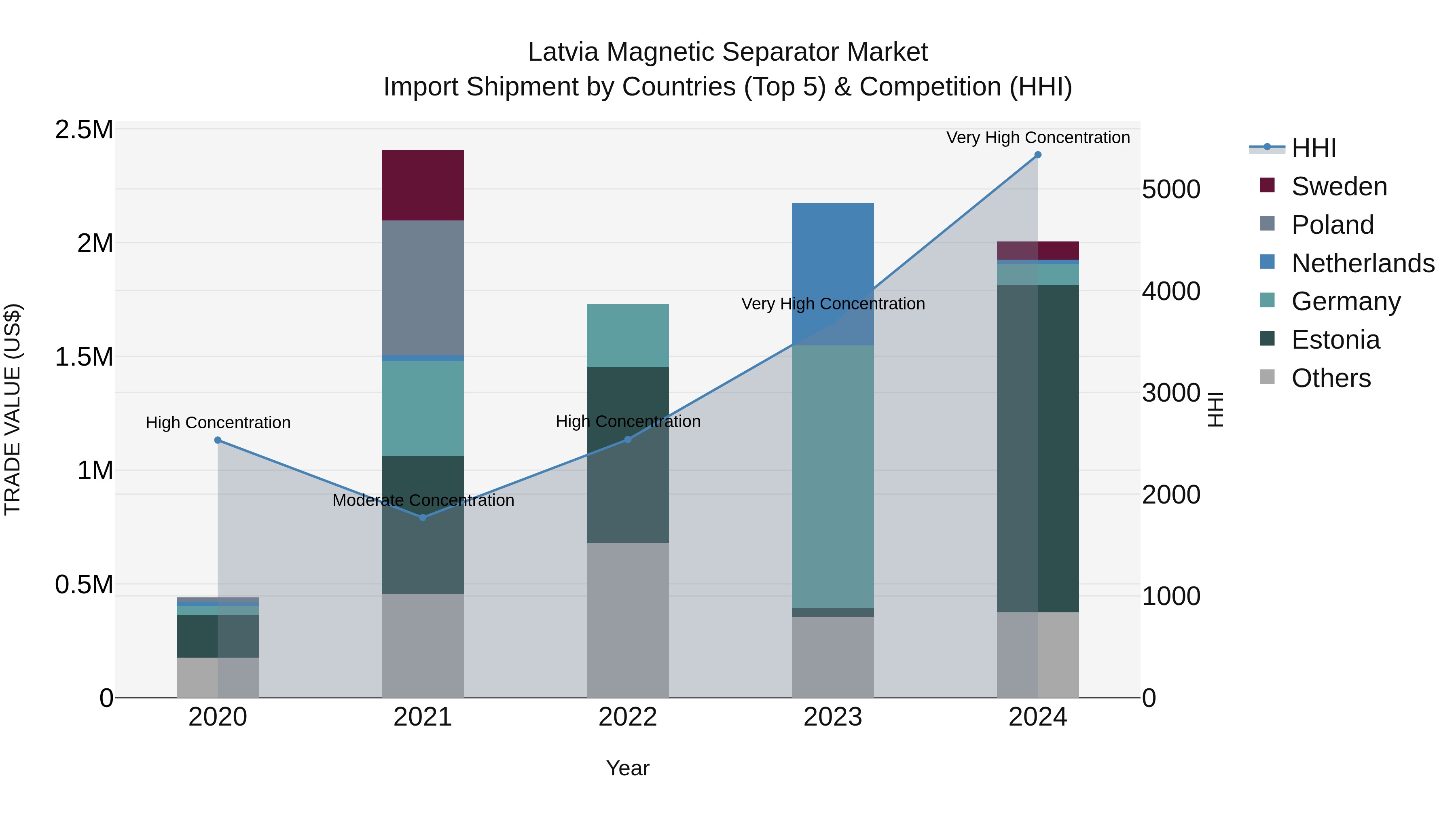
Latvia Magnetic Separator Market Synopsis
The Latvia magnetic separator market is experiencing steady growth driven by increasing demand across industries such as mining, recycling, and food processing. The market is primarily dominated by permanent magnetic separators due to their cost-effectiveness and efficiency in separating ferrous materials. Factors such as strict environmental regulations and the need for efficient waste management solutions are driving the adoption of magnetic separators in the country. Additionally, advancements in technology, such as the development of high-intensity magnetic separators, are further fueling market growth. Key players in the Latvia magnetic separator market include companies like Eriez, Bunting Magnetics, and Master Magnets, who are focusing on product innovation and strategic partnerships to strengthen their market position. Overall, the market is expected to continue its growth trajectory in the coming years.
Latvia Magnetic Separator Market Trends
The Latvia Magnetic Separator Market is experiencing steady growth driven by increasing demand across various industries such as mining, recycling, and food processing. The market is witnessing a trend towards the development of technologically advanced magnetic separators with higher efficiency and automation capabilities. Opportunities in the market lie in the adoption of magnetic separators for improved material purification, metal recovery, and protection of processing equipment. Additionally, the growing focus on environmental sustainability and strict regulations related to waste management are creating opportunities for the implementation of magnetic separators for efficient separation and recycling processes. Market players can capitalize on these trends by investing in research and development to introduce innovative solutions tailored to the specific needs of the Latvian market.
Latvia Magnetic Separator Market Challenges
In the Latvia Magnetic Separator Market, some challenges that are often faced include intense competition from both domestic and international manufacturers, which can lead to pricing pressures and reduced profit margins. Additionally, fluctuations in raw material prices can impact manufacturing costs, making it challenging for companies to maintain a competitive edge. Another key challenge is the need for continuous innovation and technological advancements to meet evolving customer demands and environmental regulations. Ensuring product quality and reliability while keeping up with rapidly changing market trends also presents a significant challenge for market players. Overall, navigating these challenges requires strategic planning, investment in research and development, and a deep understanding of customer needs in order to stay competitive in the Latvia Magnetic Separator Market.
Latvia Magnetic Separator Market Investment Opportunities
The Latvia Magnetic Separator Market is primarily driven by the increasing demand from industries such as mining, recycling, and food processing for efficient separation of ferrous materials. The growing emphasis on environmental sustainability and stringent regulations regarding waste management have also contributed to the market growth, as magnetic separators are crucial in removing metal contaminants from various materials. Additionally, technological advancements in magnetic separator designs, such as high-intensity magnetic fields and automation features, are enhancing the efficiency and effectiveness of separation processes, further driving market expansion. The rising investments in infrastructure development and the expanding industrial sector in Latvia are expected to continue fueling the demand for magnetic separators in the foreseeable future.
Latvia Magnetic Separator Market Government Polices
Government policies related to the Latvia Magnetic Separator Market primarily focus on promoting environmental sustainability, compliance with EU regulations, and fostering innovation in the industry. The government of Latvia has implemented regulations to ensure that magnetic separator manufacturers adhere to strict environmental standards to minimize impact on the environment. Additionally, Latvia is a member of the European Union, and as such, companies operating in the magnetic separator market must comply with EU regulations and standards. The government also supports research and development initiatives to encourage innovation in magnetic separator technologies, aiming to enhance the competitiveness of the market both domestically and internationally. Overall, the government policies in Latvia aim to create a conducive environment for the growth and sustainability of the magnetic separator market while promoting responsible business practices.
Latvia Magnetic Separator Market Future Outlook
The Latvia Magnetic Separator Market is expected to witness steady growth in the coming years due to increasing industrialization and the rising demand for efficient material separation processes. The market is likely to be driven by the growing mining and recycling sectors, which use magnetic separators for the extraction and purification of various materials. Additionally, stringent environmental regulations regarding waste management and recycling are anticipated to boost the adoption of magnetic separators in Latvia. Technological advancements leading to the development of more advanced and efficient magnetic separator systems are also expected to fuel market growth. Overall, the Latvia Magnetic Separator Market is poised for expansion, with opportunities for manufacturers to innovate and cater to the evolving needs of industries requiring material separation solutions.
Key Highlights of the Report:
- Latvia Magnetic Separator Market Outlook
- Market Size of Latvia Magnetic Separator Market, 2024
- Forecast of Latvia Magnetic Separator Market, 2031
- Historical Data and Forecast of Latvia Magnetic Separator Revenues & Volume for the Period 2021-2031
- Latvia Magnetic Separator Market Trend Evolution
- Latvia Magnetic Separator Market Drivers and Challenges
- Latvia Magnetic Separator Price Trends
- Latvia Magnetic Separator Porter`s Five Forces
- Latvia Magnetic Separator Industry Life Cycle
- Historical Data and Forecast of Latvia Magnetic Separator Market Revenues & Volume By Type for the Period 2021-2031
- Historical Data and Forecast of Latvia Magnetic Separator Market Revenues & Volume By Drum for the Period 2021-2031
- Historical Data and Forecast of Latvia Magnetic Separator Market Revenues & Volume By Overb for the Period 2021-2031
- Historical Data and Forecast of Latvia Magnetic Separator Market Revenues & Volume By Magnet Type for the Period 2021-2031
- Historical Data and Forecast of Latvia Magnetic Separator Market Revenues & Volume By Permanent Magnets for the Period 2021-2031
- Historical Data and Forecast of Latvia Magnetic Separator Market Revenues & Volume By Electromagnets for the Period 2021-2031
- Historical Data and Forecast of Latvia Magnetic Separator Market Revenues & Volume By Industry for the Period 2021-2031
- Historical Data and Forecast of Latvia Magnetic Separator Market Revenues & Volume By Mining for the Period 2021-2031
- Historical Data and Forecast of Latvia Magnetic Separator Market Revenues & Volume By Recycling for the Period 2021-2031
- Historical Data and Forecast of Latvia Magnetic Separator Market Revenues & Volume By Food & Beverages for the Period 2021-2031
- Latvia Magnetic Separator Import Export Trade Statistics
- Market Opportunity Assessment By Type
- Market Opportunity Assessment By Magnet Type
- Market Opportunity Assessment By Industry
- Latvia Magnetic Separator Top Companies Market Share
- Latvia Magnetic Separator Competitive Benchmarking By Technical and Operational Parameters
- Latvia Magnetic Separator Company Profiles
- Latvia Magnetic Separator Key Strategic Recommendations






































