Latvia Salicylic Acid Market Size (2020-2030)
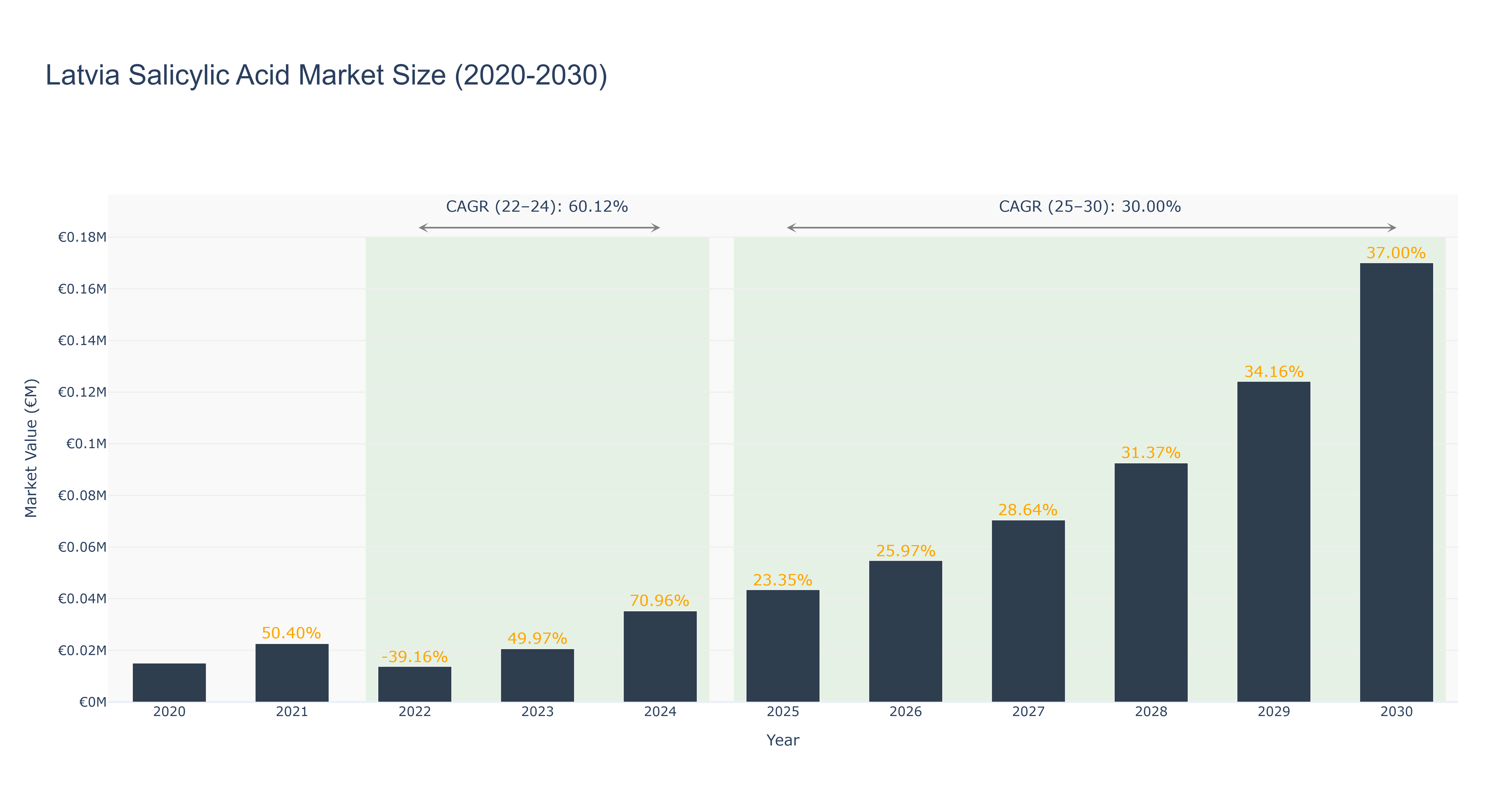
The Latvia Salicylic Acid Market has exhibited significant volatility from 2020 to 2024, with a peak market size of €35.23 thousand in 2024, reflecting an impressive growth rate of 70.96% compared to the previous year. Following a substantial decline in 2022, where the market contracted by 39.16%, the market rebounded strongly in 2023 with a 49.97% increase, driven by rising demand in pharmaceuticals and skincare products. The actual compound annual growth rate (CAGR) from 2022 to 2024 is a robust 60.12%. Looking ahead, the forecasted period from 2025 to 2030 shows a more stable growth trajectory with a projected CAGR of 30.00%, culminating in a market size of €170.07 thousand by 2030. This growth is anticipated to be supported by increasing investments in research and development, as well as a rising trend in eco-friendly and organic formulations within the cosmetics and pharmaceutical sectors.
Latvia Salicylic Acid Market: Production & Trade Performance (2019-2025)
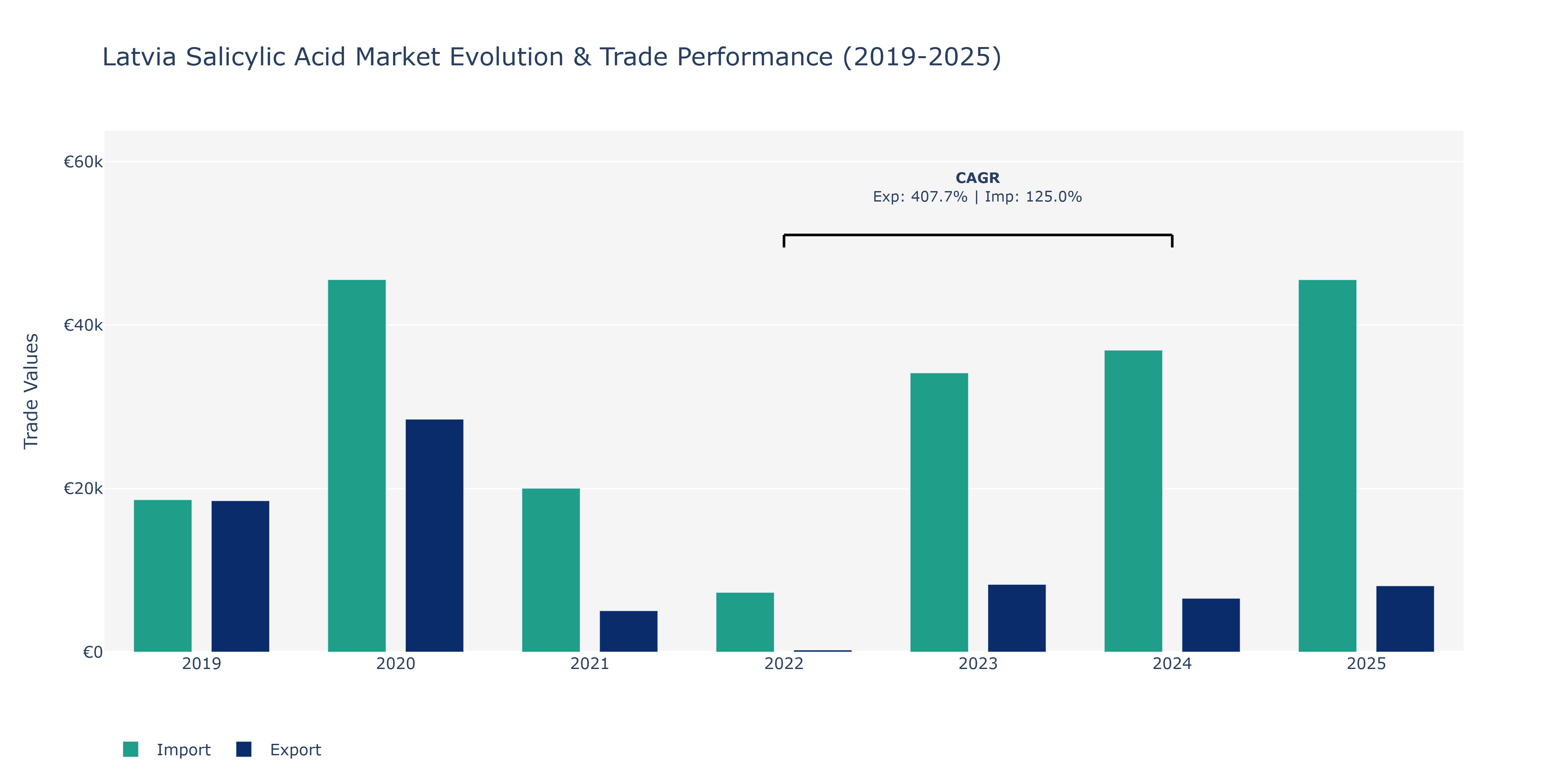
The Latvia Salicylic Acid Market witnessed notable fluctuations in exports and imports from 2019 to 2025. In 2020, there was a substantial surge in exports to €28.49 thousand, followed by a sharp decline in 2021 to €5.05 thousand. This abrupt decrease could be attributed to various factors such as global demand shifts, supply chain disruptions, or changes in production capacities. Conversely, imports soared to €45.56 thousand in 2020, signifying a significant spike likely influenced by increased demand or strategic sourcing decisions. The year 2023 marked a resurgence in both exports and imports, with values reaching €8.27 thousand and €34.16 thousand, respectively. This recovery might be linked to market stabilization, improved trade relations, or enhanced product quality. The consistent growth in imports showcases the market's reliance on external suppliers, emphasizing the need for diversification strategies to mitigate risks associated with dependency on specific regions or suppliers.
Key Highlights of the Report:
- Latvia Salicylic Acid Market Outlook
- Market Size of Latvia Salicylic Acid Market, 2025
- Forecast of Latvia Salicylic Acid Market, 2032
- Historical Data and Forecast of Latvia Salicylic Acid Revenues & Volume for the Period 2022 - 2032F
- Latvia Salicylic Acid Market Trend Evolution
- Latvia Salicylic Acid Market Drivers and Challenges
- Latvia Salicylic Acid Price Trends
- Latvia Salicylic Acid Porter`s Five Forces
- Latvia Salicylic Acid Industry Life Cycle
- Historical Data and Forecast of Latvia Salicylic Acid Market Revenues & Volume By Application for the Period 2022 - 2032F
- Historical Data and Forecast of Latvia Salicylic Acid Market Revenues & Volume By Pharmaceutical for the Period 2022 - 2032F
- Historical Data and Forecast of Latvia Salicylic Acid Market Revenues & Volume By Food & Preservatives for the Period 2022 - 2032F
- Historical Data and Forecast of Latvia Salicylic Acid Market Revenues & Volume By Cosmetics for the Period 2022 - 2032F
- Historical Data and Forecast of Latvia Salicylic Acid Market Revenues & Volume By Others for the Period 2022 - 2032F
- Latvia Salicylic Acid Import Export Trade Statistics
- Market Opportunity Assessment By Application
- Latvia Salicylic Acid Top Companies Market Share
- Latvia Salicylic Acid Competitive Benchmarking By Technical and Operational Parameters
- Latvia Salicylic Acid Company Profiles
- Latvia Salicylic Acid Key Strategic Recommendations






































