Latvia Ultra-thin Glass Market Top 5 Importing Countries and Market Competition (HHI) Analysis
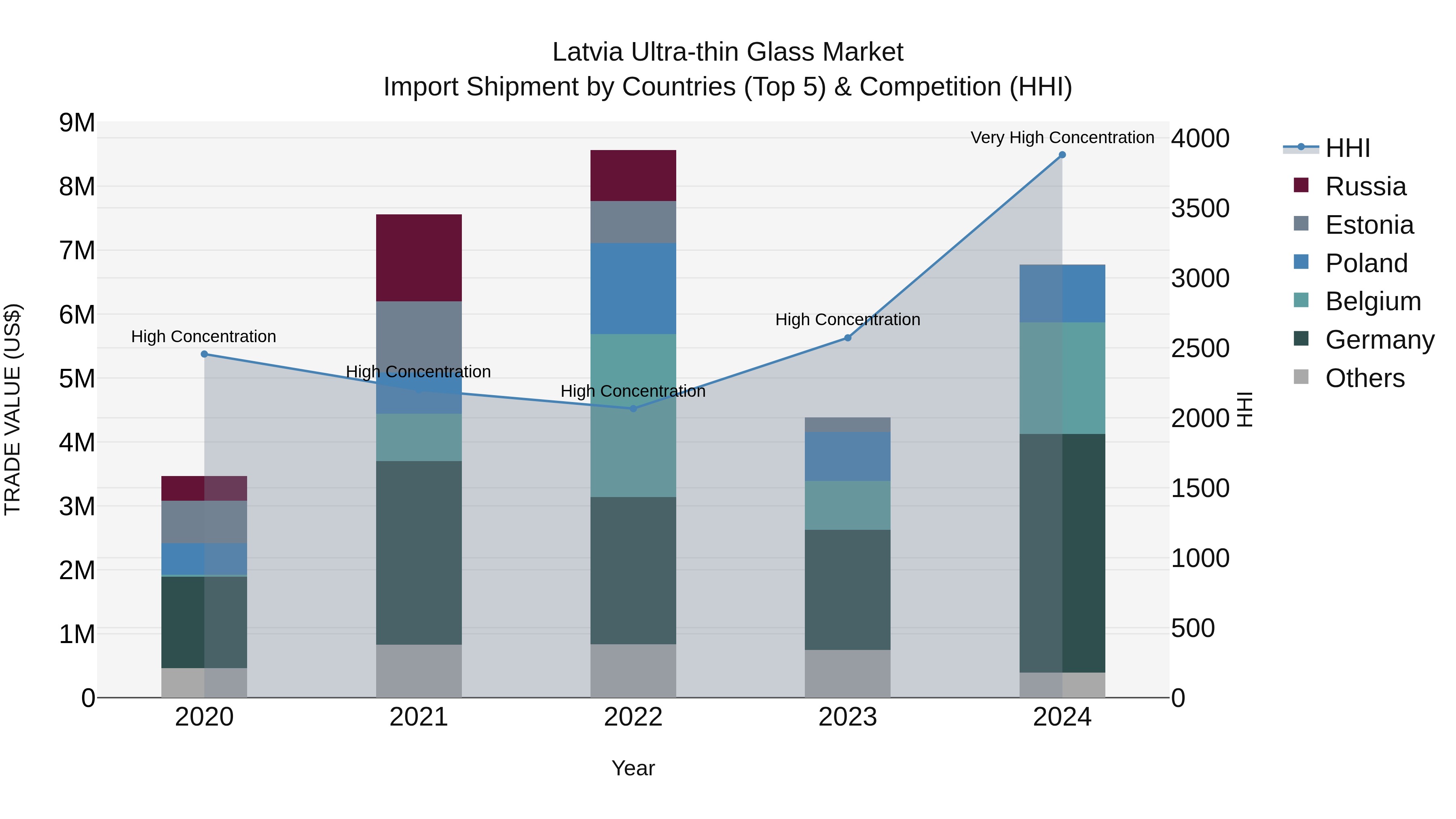
The import shipments of ultra-thin glass in Latvia have shown significant growth and concentration in recent years. The top exporting countries such as Germany, Belgium, and Poland have strengthened their presence in the Latvian market, contributing to a high Herfindahl-Hirschman Index (HHI). The industry has experienced robust growth with a remarkable compound annual growth rate (CAGR) of 18.21% from 2020 to 2024. The sharp growth rate of 54.6% from 2023 to 2024 indicates a rapidly expanding market for ultra-thin glass in Latvia, suggesting potential opportunities for further market penetration and development.
Key Highlights of the Report:
- Latvia Ultra-thin Glass Market Outlook
- Market Size of Latvia Ultra-thin Glass Market, 2025
- Forecast of Latvia Ultra-thin Glass Market, 2032
- Historical Data and Forecast of Latvia Ultra-thin Glass Revenues & Volume for the Period 2022 - 2032F
- Latvia Ultra-thin Glass Market Trend Evolution
- Latvia Ultra-thin Glass Market Drivers and Challenges
- Latvia Ultra-thin Glass Price Trends
- Latvia Ultra-thin Glass Porter`s Five Forces
- Latvia Ultra-thin Glass Industry Life Cycle
- Historical Data and Forecast of Latvia Ultra-thin Glass Market Revenues & Volume By Manufacturing Process for the Period 2022 - 2032F
- Historical Data and Forecast of Latvia Ultra-thin Glass Market Revenues & Volume By Float for the Period 2022 - 2032F
- Historical Data and Forecast of Latvia Ultra-thin Glass Market Revenues & Volume By Fusion for the Period 2022 - 2032F
- Historical Data and Forecast of Latvia Ultra-thin Glass Market Revenues & Volume By Down-Draw for the Period 2022 - 2032F
- Historical Data and Forecast of Latvia Ultra-thin Glass Market Revenues & Volume By Application for the Period 2022 - 2032F
- Historical Data and Forecast of Latvia Ultra-thin Glass Market Revenues & Volume By Semiconductor Substrate for the Period 2022 - 2032F
- Historical Data and Forecast of Latvia Ultra-thin Glass Market Revenues & Volume By Touch Panel Display for the Period 2022 - 2032F
- Historical Data and Forecast of Latvia Ultra-thin Glass Market Revenues & Volume By Fingerprint Sensor for the Period 2022 - 2032F
- Latvia Ultra-thin Glass Import Export Trade Statistics
- Market Opportunity Assessment By Manufacturing Process
- Market Opportunity Assessment By Application
- Latvia Ultra-thin Glass Top Companies Market Share
- Latvia Ultra-thin Glass Competitive Benchmarking By Technical and Operational Parameters
- Latvia Ultra-thin Glass Company Profiles
- Latvia Ultra-thin Glass Key Strategic Recommendations






































