Latvia Zinc Market Size (2020-2030)
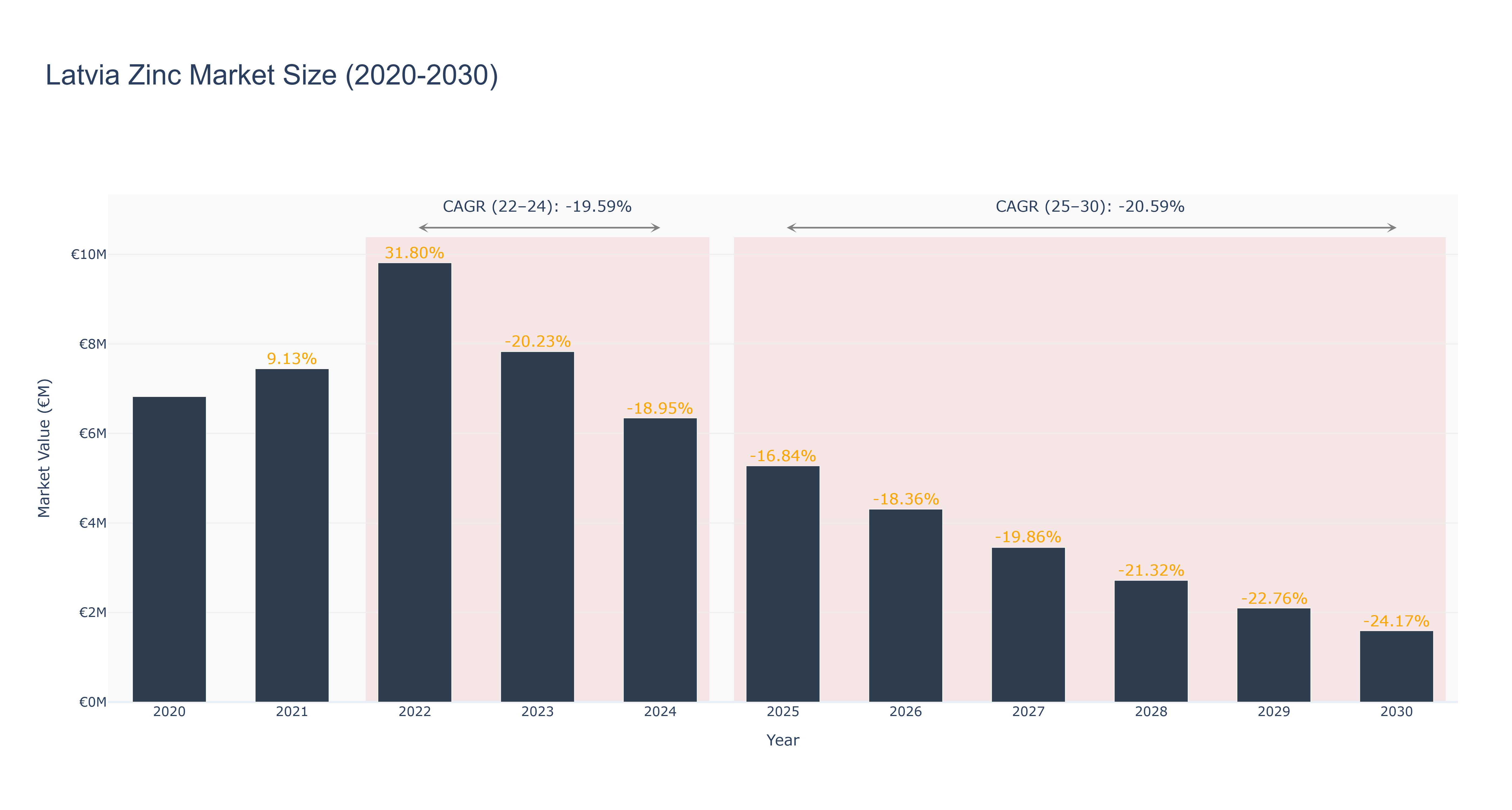
The Latvia Zinc Market experienced significant fluctuations between 2020 and 2024, peaking in 2022 with a market size of €9.81 million and a remarkable growth rate of 31.80%. However, this growth was not sustainable, as the market contracted sharply in 2023 and 2024, resulting in sizes of €7.83 million and €6.34 million, respectively, leading to an actual CAGR of -19.59% over this period. Looking ahead to 2025-2030, the forecasted market reveals a continued decline, with sizes projected to fall from €5.28 million in 2025 to €1.59 million by 2030, reflecting a CAGR of -20.59%. This downturn can be attributed to factors such as reduced demand in key industries, supply chain disruptions, and increasing competition from alternative materials. While there are no specific upcoming projects highlighted, broader economic trends and shifts in global zinc demand will likely influence market dynamics in the coming years.
Latvia Zinc Market: Production & Trade Performance (2019-2025)
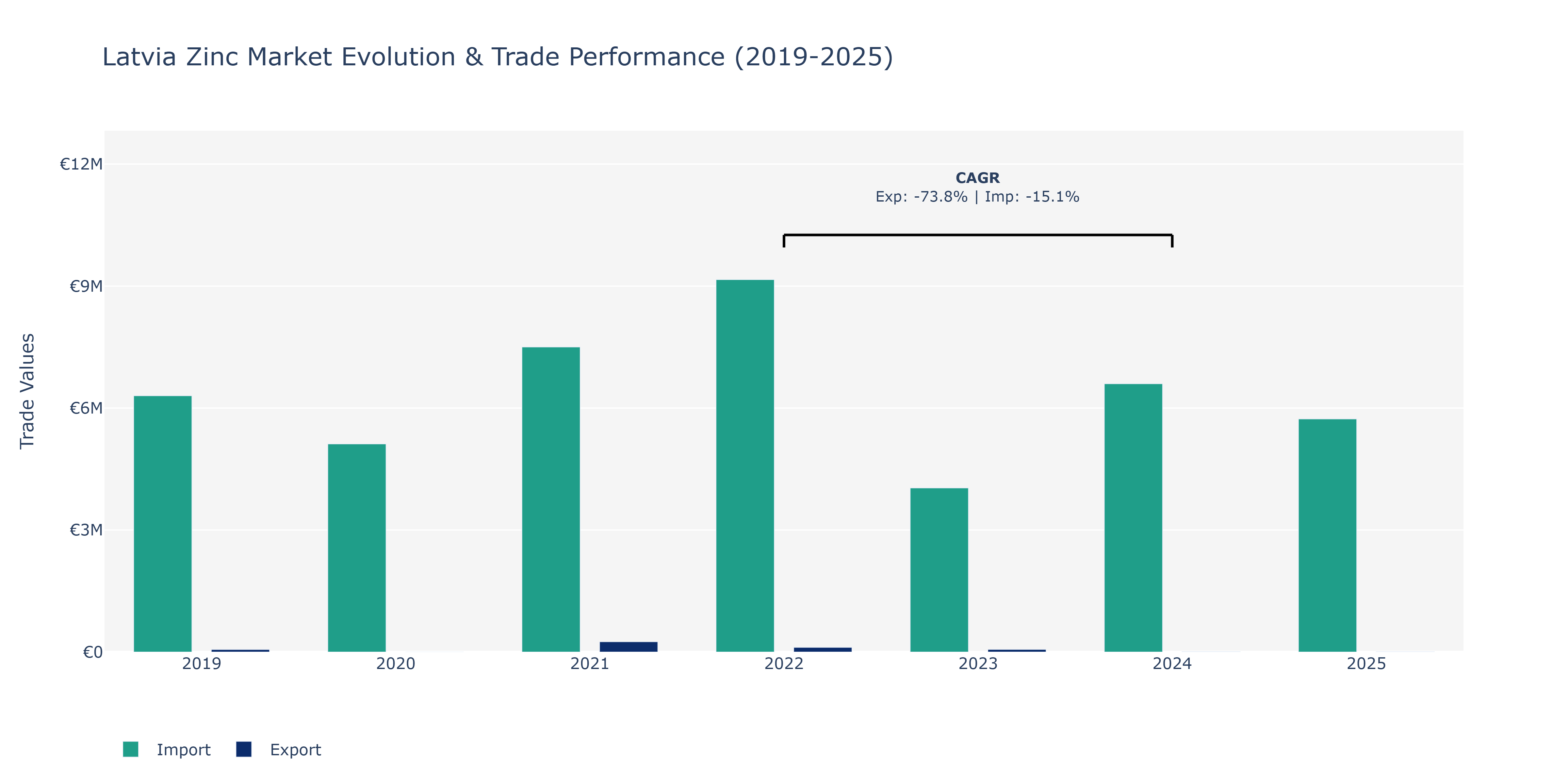
Between 2019 and 2025, Latvia's Zinc Market experienced varied trends in exports and imports. In 2019, exports stood at €61.57 thousand, gradually declining to €5.91 thousand by 2025. This downward trend could be attributed to fluctuating global demand for zinc products and competition from other market players. On the other hand, imports surged from €6.3 million in 2019 to €5.73 million in 2025, with a notable peak in 2021 at €7.5 million. The rise in imports can be linked to the country's industrial growth and increased infrastructure projects requiring zinc. The market saw a substantial decline in exports and a slight decrease in imports between 2022 and 2024, aligning with the negative compound annual growth rate (CAGR) of -73.79% for exports and -15.12% for imports during this period. This decline could be influenced by global economic slowdowns affecting the demand for zinc products. Efforts to diversify the export market and strategic partnerships with key importers could help stabilize Latvia's Zinc Market in the coming years.
Key Highlights of the Report:
- Latvia Zinc Market Outlook
- Market Size of Latvia Zinc Market, 2025
- Forecast of Latvia Zinc Market, 2032
- Historical Data and Forecast of Latvia Zinc Revenues & Volume for the Period 2022 - 2032F
- Latvia Zinc Market Trend Evolution
- Latvia Zinc Market Drivers and Challenges
- Latvia Zinc Price Trends
- Latvia Zinc Porter`s Five Forces
- Latvia Zinc Industry Life Cycle
- Historical Data and Forecast of Latvia Zinc Market Revenues & Volume By Applications for the Period 2022 - 2032F
- Historical Data and Forecast of Latvia Zinc Market Revenues & Volume By Galvanizingfor the Period 2022 - 2032F
- Historical Data and Forecast of Latvia Zinc Market Revenues & Volume By Die casting for the Period 2022 - 2032F
- Historical Data and Forecast of Latvia Zinc Market Revenues & Volume By Brass and bronze for the Period 2022 - 2032F
- Historical Data and Forecast of Latvia Zinc Market Revenues & Volume By Othersfor the Period 2022 - 2032F
- Historical Data and Forecast of Latvia Zinc Market Revenues & Volume By End-users for the Period 2022 - 2032F
- Historical Data and Forecast of Latvia Zinc Market Revenues & Volume By Constructionfor the Period 2022 - 2032F
- Historical Data and Forecast of Latvia Zinc Market Revenues & Volume By Transportationfor the Period 2022 - 2032F
- Historical Data and Forecast of Latvia Zinc Market Revenues & Volume By Consumer goods for the Period 2022 - 2032F
- Historical Data and Forecast of Latvia Zinc Market Revenues & Volume By Othersfor the Period 2022 - 2032F
- Latvia Zinc Import Export Trade Statistics
- Market Opportunity Assessment By Applications
- Market Opportunity Assessment By End-users
- Latvia Zinc Top Companies Market Share
- Latvia Zinc Competitive Benchmarking By Technical and Operational Parameters
- Latvia Zinc Company Profiles
- Latvia Zinc Key Strategic Recommendations






































