Lithuania Acetonitrile Market Size (2020-2030)
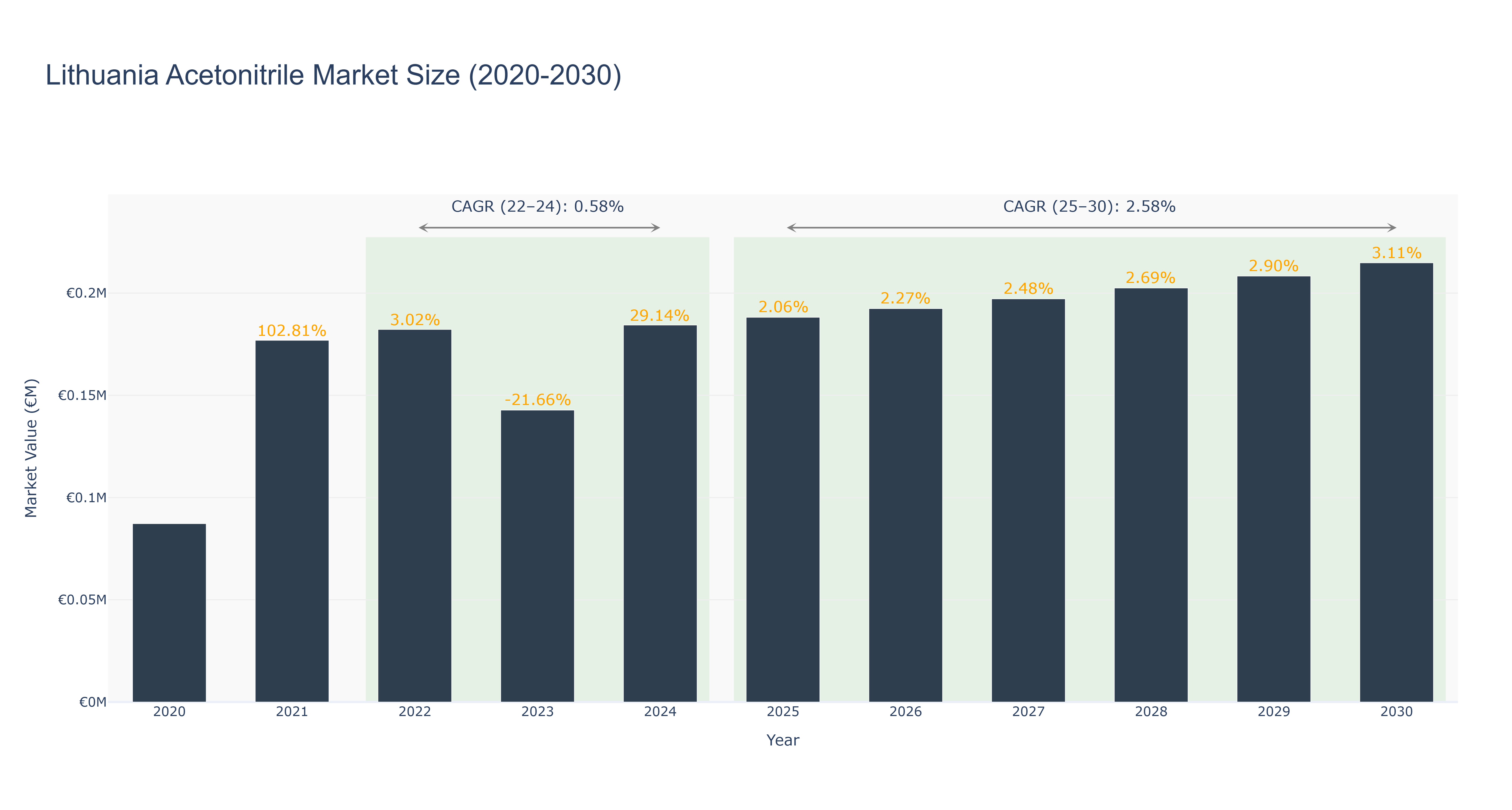
The Lithuania Acetonitrile Market experienced a significant peak in 2021, with a market size of €176.87 thousand, reflecting a remarkable growth of 102.81%. However, actual data from 2022 to 2024 indicates a decline, with the market size dropping to €142.74 thousand in 2023, driven by factors such as fluctuating demand and economic uncertainties, resulting in a modest CAGR of 0.58% for this period. Looking ahead, the market is projected to rebound with an increase to €188.13 thousand by 2025, supported by a more favorable CAGR of 2.58% from 2025 to 2030. This growth is expected to be fueled by advancements in the pharmaceutical and chemical industries, alongside increasing applications of acetonitrile in laboratories and production processes. The ongoing development of innovative projects within these sectors will likely bolster demand, ensuring a steady upward trajectory for the market through the end of the decade.
Lithuania Acetonitrile Market: Production & Trade Performance (2019-2025)
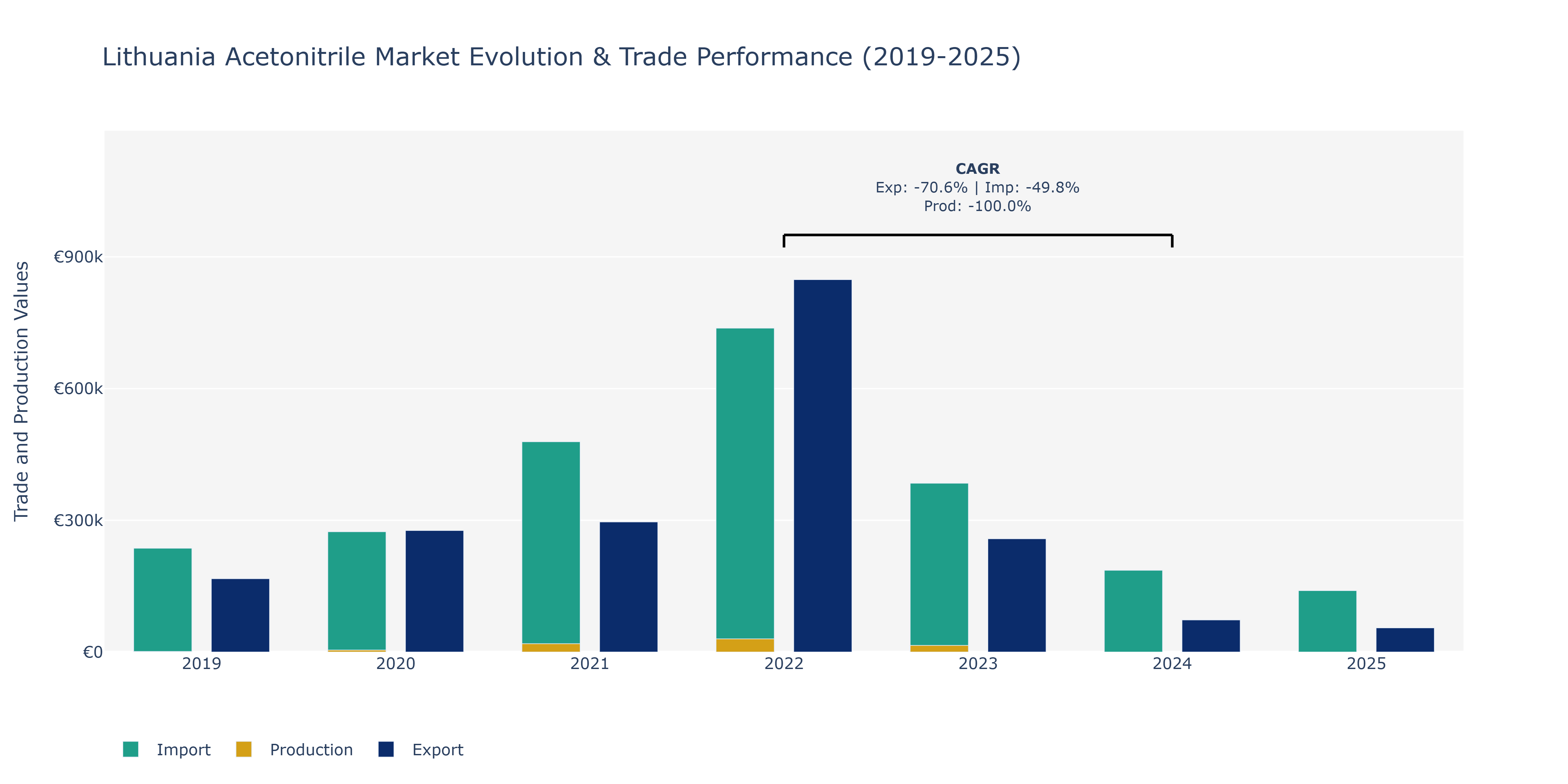
Between 2019 and 2025, the Lithuania Acetonitrile Market saw notable shifts in exports, imports, and production. Export value surged from €166.96 thousand in 2019 to a peak of €848.07 thousand in 2022, before a sharp decline in subsequent years, hitting €54.97 thousand in 2025. Conversely, imports displayed fluctuations, climbing steadily from €236.34 thousand in 2019 to a high of €478.82 thousand in 2021, then dropping to €139.94 thousand in 2025. Production peaked at €30.00 billion in 2022 before plummeting to €15.00 billion in 2023. The fluctuating export and import trends can be attributed to global demand variations, geopolitical factors affecting trade agreements, and price competitiveness. The production decline may stem from supply chain disruptions, technological advancements impacting production efficiency, and regulatory changes impacting domestic manufacturing capabilities. To maintain market competitiveness, stakeholders should focus on enhancing production efficiency, diversifying export markets, and closely monitoring global trade dynamics to capitalize on emerging opportunities.
Key Highlights of the Report:
- Lithuania Acetonitrile Market Outlook
- Market Size of Lithuania Acetonitrile Market, 2025
- Forecast of Lithuania Acetonitrile Market, 2032
- Historical Data and Forecast of Lithuania Acetonitrile Revenues & Volume for the Period 2022 - 2032F
- Lithuania Acetonitrile Market Trend Evolution
- Lithuania Acetonitrile Market Drivers and Challenges
- Lithuania Acetonitrile Price Trends
- Lithuania Acetonitrile Porter`s Five Forces
- Lithuania Acetonitrile Industry Life Cycle
- Historical Data and Forecast of Lithuania Acetonitrile Market Revenues & Volume By Type for the Period 2022 - 2032F
- Historical Data and Forecast of Lithuania Acetonitrile Market Revenues & Volume By Derivative for the Period 2022 - 2032F
- Historical Data and Forecast of Lithuania Acetonitrile Market Revenues & Volume By Solvent for the Period 2022 - 2032F
- Historical Data and Forecast of Lithuania Acetonitrile Market Revenues & Volume By Application for the Period 2022 - 2032F
- Historical Data and Forecast of Lithuania Acetonitrile Market Revenues & Volume By Pharmaceutical for the Period 2022 - 2032F
- Historical Data and Forecast of Lithuania Acetonitrile Market Revenues & Volume By Analytical Industry for the Period 2022 - 2032F
- Historical Data and Forecast of Lithuania Acetonitrile Market Revenues & Volume By Agrochemical for the Period 2022 - 2032F
- Historical Data and Forecast of Lithuania Acetonitrile Market Revenues & Volume By Extraction for the Period 2022 - 2032F
- Lithuania Acetonitrile Import Export Trade Statistics
- Market Opportunity Assessment By Type
- Market Opportunity Assessment By Application
- Lithuania Acetonitrile Top Companies Market Share
- Lithuania Acetonitrile Competitive Benchmarking By Technical and Operational Parameters
- Lithuania Acetonitrile Company Profiles
- Lithuania Acetonitrile Key Strategic Recommendations






































