Lithuania Auto Catalyst Market Size (2020-2030)
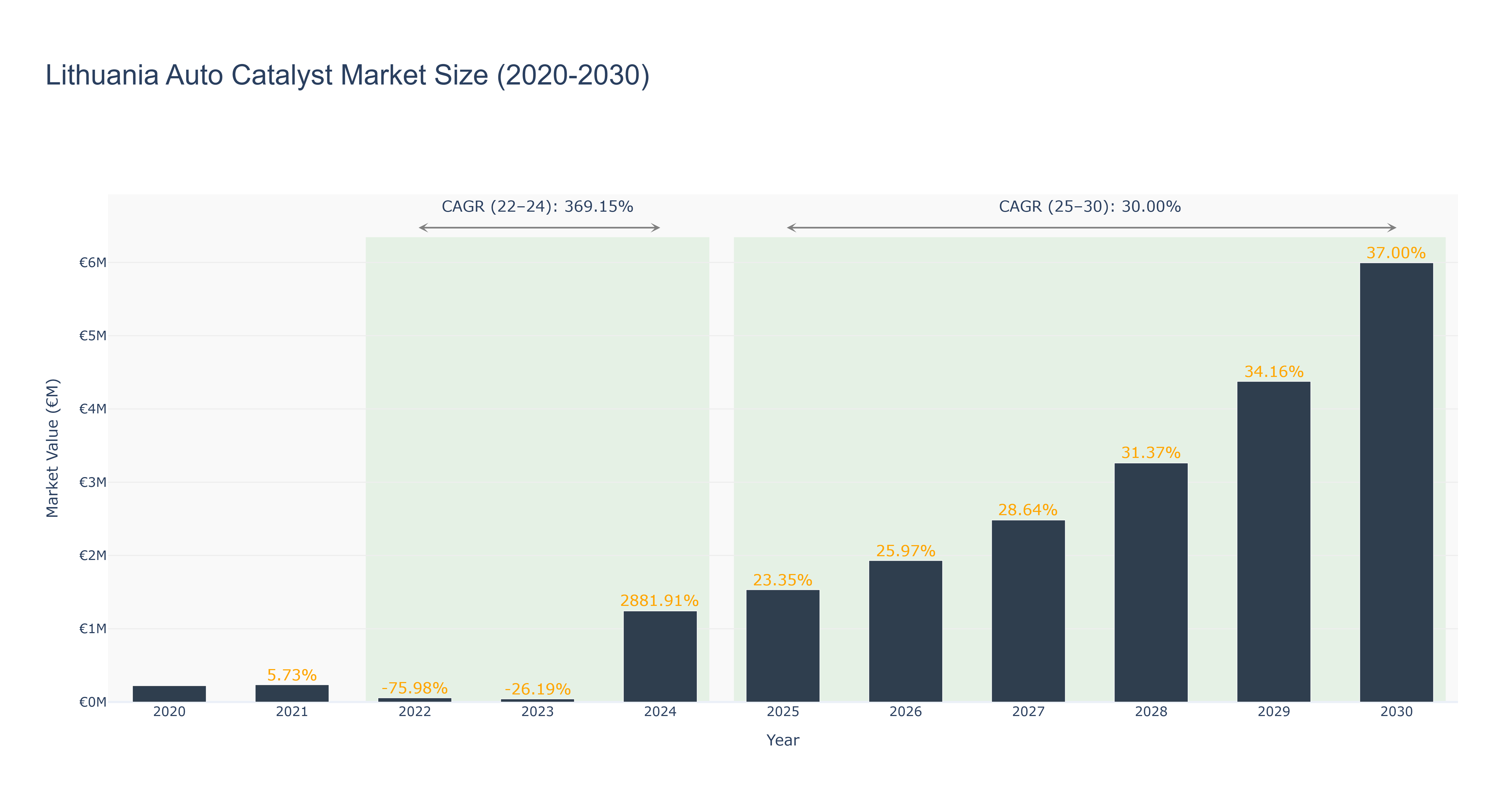
The Lithuania Auto Catalyst Market has shown a remarkable growth trajectory over the past decade. The peak market size of €5.99 million in 2030 reflects a substantial increase from €0.22 million in 2020. The market experienced significant fluctuations, with a notable decline in market size from 2020 to 2022, attributed to economic challenges. However, a rapid recovery and subsequent exponential growth from 2024 onwards can be attributed to increased demand for eco-friendly automotive solutions. The CAGR for the period 2022-24 was an impressive 369.15%, showcasing a strong rebound. Looking ahead, a steady CAGR of 30.0% from 2025 to 2030 is forecasted, driven by ongoing advancements in automotive technology and stringent environmental regulations. Recent developments include collaborations with leading car manufacturers to develop innovative catalyst solutions, positioning Lithuania as a key player in the global auto catalyst market.
Lithuania Auto Catalyst Market: Production & Trade Performance (2019-2025)
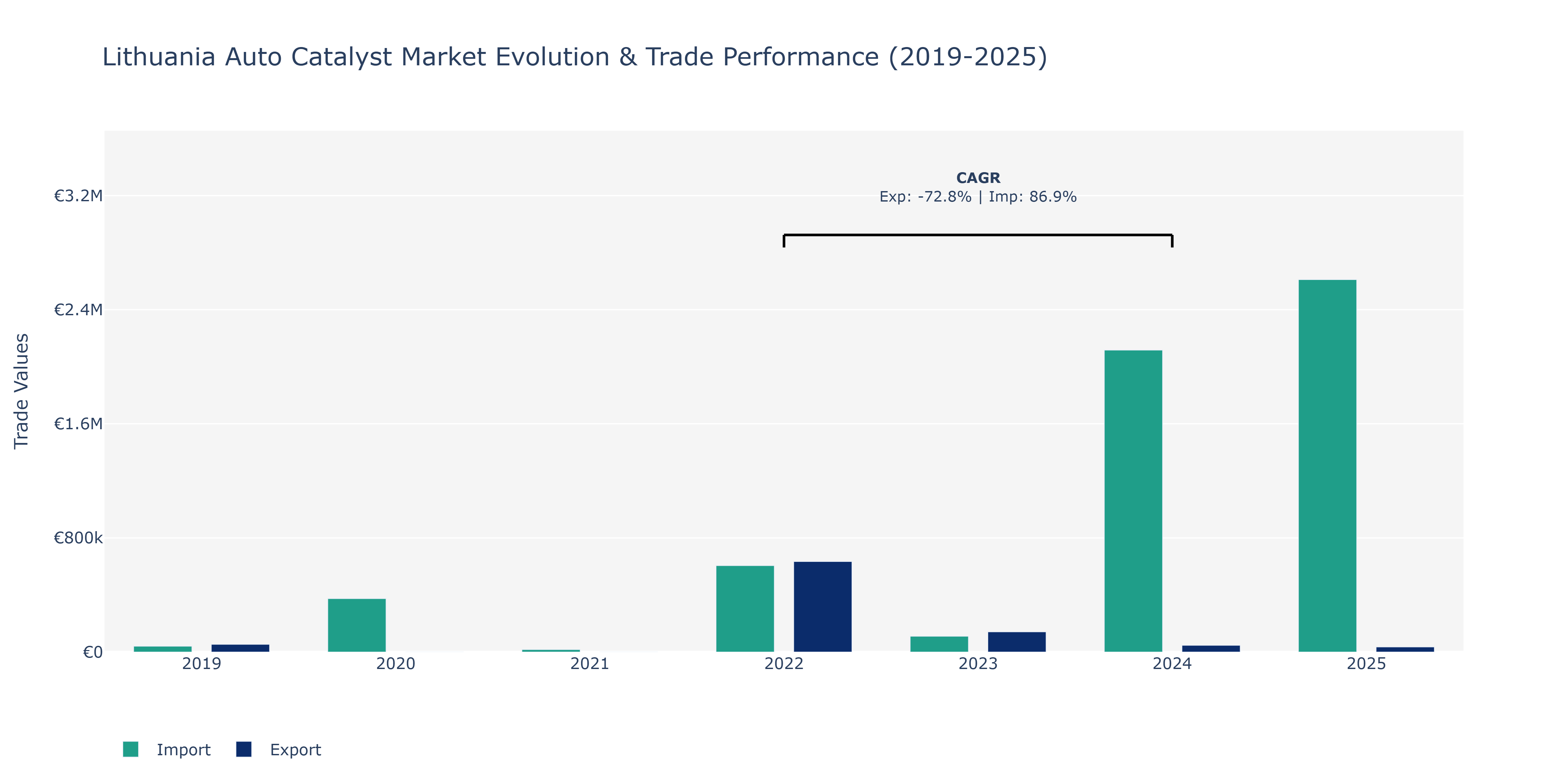
Between 2019 and 2025, Lithuania's Auto Catalyst Market exhibited various trends in Exports and Imports. In 2019, Exports stood at €53.79 thousand, while Imports were €40.61 thousand. In 2020, Imports surged to €374.44 thousand. The year 2021 saw Imports decrease to €17.02 thousand. Subsequently, 2022 marked a substantial rise in Exports to €634.43 thousand and Imports to €605.71 thousand. However, by 2023, Exports dropped to €141.51 thousand, with Imports at €110.31 thousand. In 2024, Exports further decreased to €46.9 thousand, but Imports peaked at €2.12 million. Finally, in 2025, Exports amounted to €35.26 thousand, while Imports slightly declined to €2.61 million. The significant fluctuations in Imports can be attributed to changes in global demand for auto catalysts, affected by emission regulations, technological advancements, and shifts in the automotive industry towards cleaner vehicles. These movements emphasize the market's responsiveness to external factors and the importance of staying abreast of industry developments for strategic decision-making.
Key Highlights of the Report:
- Lithuania Auto catalyst Market Outlook
- Market Size of Lithuania Auto catalyst Market, 2024
- Forecast of Lithuania Auto catalyst Market, 2031
- Historical Data and Forecast of Lithuania Auto catalyst Revenues & Volume for the Period 2021- 2031
- Lithuania Auto catalyst Market Trend Evolution
- Lithuania Auto catalyst Market Drivers and Challenges
- Lithuania Auto catalyst Price Trends
- Lithuania Auto catalyst Porter's Five Forces
- Lithuania Auto catalyst Industry Life Cycle
- Historical Data and Forecast of Lithuania Auto catalyst Market Revenues & Volume By Application for the Period 2021- 2031
- Historical Data and Forecast of Lithuania Auto catalyst Market Revenues & Volume By LDV-Diesel for the Period 2021- 2031
- Historical Data and Forecast of Lithuania Auto catalyst Market Revenues & Volume By LDV-Gasoline for the Period 2021- 2031
- Historical Data and Forecast of Lithuania Auto catalyst Market Revenues & Volume By HDV for the Period 2021- 2031
- Lithuania Auto catalyst Import Export Trade Statistics
- Market Opportunity Assessment By Application
- Lithuania Auto catalyst Top Companies Market Share
- Lithuania Auto catalyst Competitive Benchmarking By Technical and Operational Parameters
- Lithuania Auto catalyst Company Profiles
- Lithuania Auto catalyst Key Strategic Recommendations






































