Lithuania Automatic Bottle Labeling Machine Market Size (2020-2030)
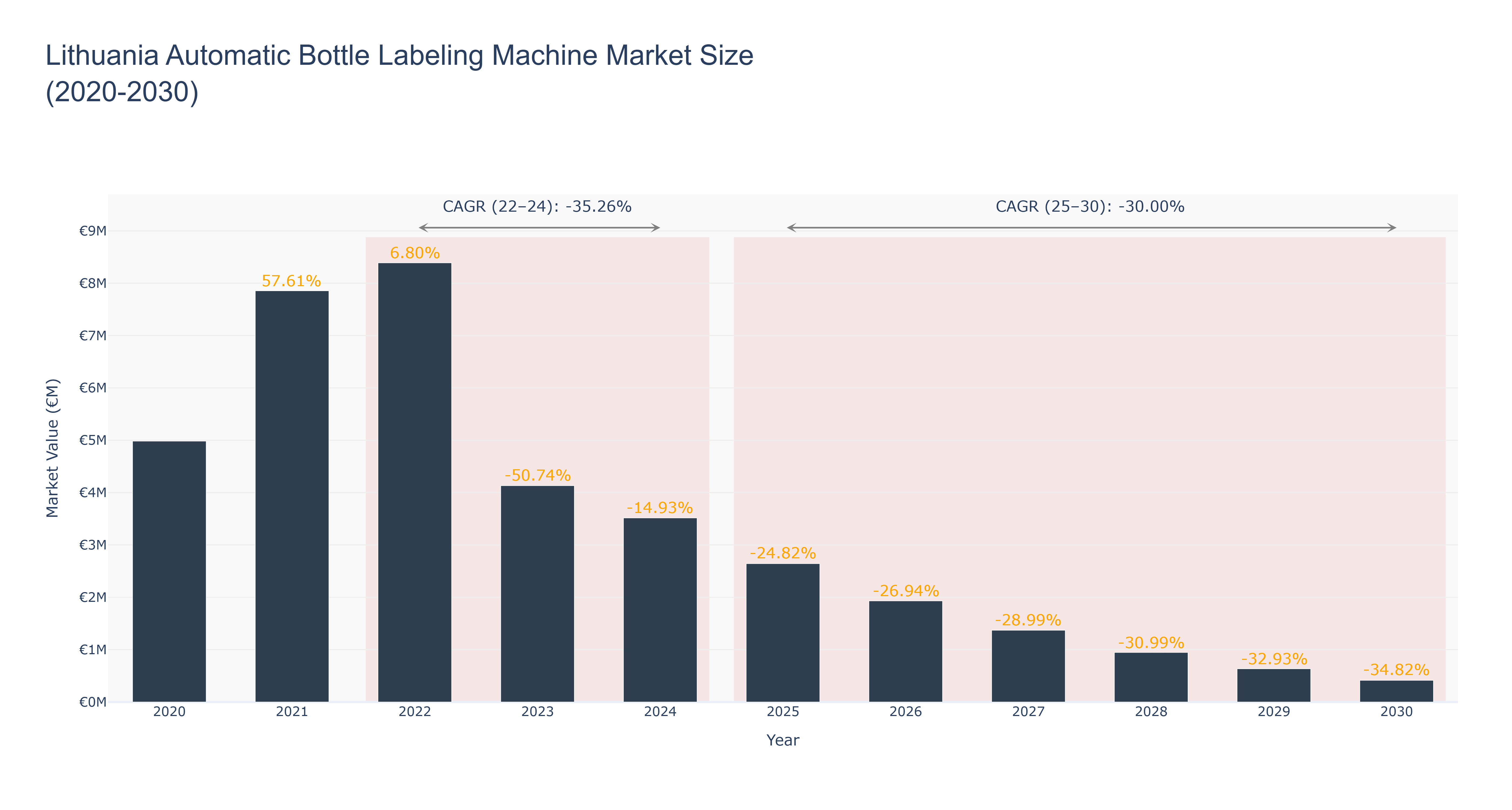
The Lithuania Automatic Bottle Labeling Machine Market experienced a peak in 2021, reaching a market size of €7.85 million, which represented a remarkable growth of 57.61% from the previous year. However, the subsequent years saw a significant downturn, with actual market sizes declining to €4.13 million in 2023 and €3.52 million in 2024, reflecting a CAGR of -35.26% for the period 2022-2024. The forecasted outlook from 2025 to 2030 indicates a continued contraction, with projected market sizes decreasing to €413.62 thousand by 2030 and a CAGR of -30.00%. This decline can be attributed to several factors, including market saturation, shifts in consumer preferences towards alternative labeling technologies, and economic challenges faced by the local manufacturing sector. While there are currently no significant upcoming projects to stimulate growth, ongoing technological advancements in automation may eventually create opportunities for revitalization in this niche market.
Lithuania Automatic Bottle Labeling Machine Market: Production & Trade Performance (2019-2025)
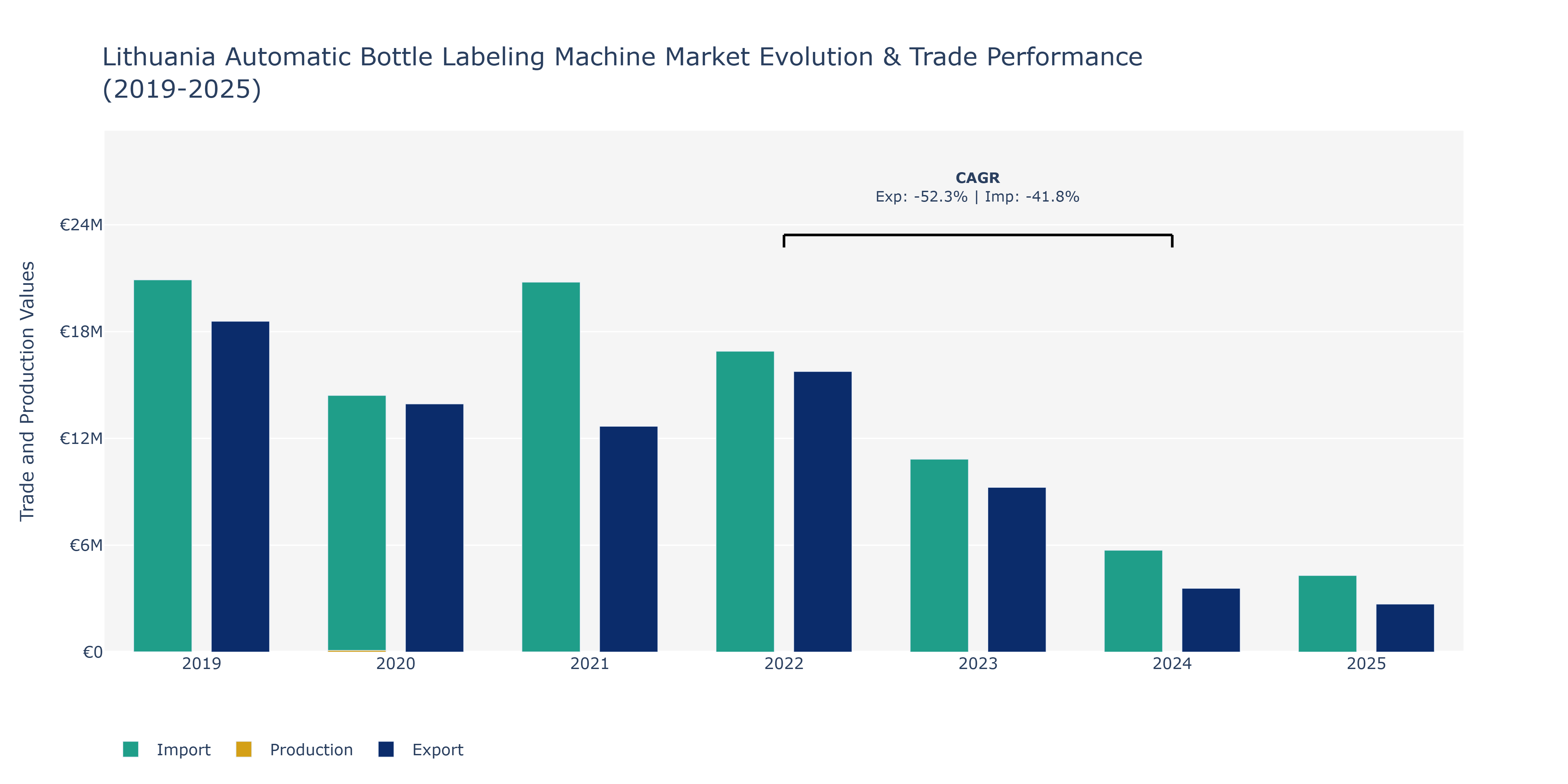
In the Lithuania Automatic Bottle Labeling Machine Market, exports saw a steady decline from €18.58 million in 2019 to €2.69 million in 2025. This drop can be attributed to various factors such as changes in global demand, competitive pricing strategies, and technological advancements impacting production costs. Imports, on the other hand, fluctuated over the years, reaching a peak of €20.78 million in 2021 before decreasing to €4.3 million in 2025. This fluctuation could be influenced by shifts in government regulations, trade agreements, and economic conditions affecting the purchasing power of businesses. Production levels remained relatively stable, with a noteworthy increase from €11.79 million in 2019 to €90 million in 2020, indicating potential market expansion and upgrades in manufacturing capabilities. These trends highlight the market's sensitivity to external factors and the need for industry players to adapt swiftly to changing conditions for sustainable growth.
Key Highlights of the Report:
- Lithuania Automatic Bottle Labeling Machine Market Outlook
- Market Size of Lithuania Automatic Bottle Labeling Machine Market, 2024
- Forecast of Lithuania Automatic Bottle Labeling Machine Market, 2031
- Historical Data and Forecast of Lithuania Automatic Bottle Labeling Machine Revenues & Volume for the Period 2021- 2031
- Lithuania Automatic Bottle Labeling Machine Market Trend Evolution
- Lithuania Automatic Bottle Labeling Machine Market Drivers and Challenges
- Lithuania Automatic Bottle Labeling Machine Price Trends
- Lithuania Automatic Bottle Labeling Machine Porter's Five Forces
- Lithuania Automatic Bottle Labeling Machine Industry Life Cycle
- Historical Data and Forecast of Lithuania Automatic Bottle Labeling Machine Market Revenues & Volume By Type for the Period 2021- 2031
- Historical Data and Forecast of Lithuania Automatic Bottle Labeling Machine Market Revenues & Volume By Pressure Sensitive/Self Adhesive Label for the Period 2021- 2031
- Historical Data and Forecast of Lithuania Automatic Bottle Labeling Machine Market Revenues & Volume By Shrink Sleeve Label for the Period 2021- 2031
- Historical Data and Forecast of Lithuania Automatic Bottle Labeling Machine Market Revenues & Volume By Glue Based Label for the Period 2021- 2031
- Historical Data and Forecast of Lithuania Automatic Bottle Labeling Machine Market Revenues & Volume By In-Mold Label for the Period 2021- 2031
- Historical Data and Forecast of Lithuania Automatic Bottle Labeling Machine Market Revenues & Volume By Machine Type for the Period 2021- 2031
- Historical Data and Forecast of Lithuania Automatic Bottle Labeling Machine Market Revenues & Volume By Semi-Automatic for the Period 2021- 2031
- Historical Data and Forecast of Lithuania Automatic Bottle Labeling Machine Market Revenues & Volume By Single Side for the Period 2021- 2031
- Historical Data and Forecast of Lithuania Automatic Bottle Labeling Machine Market Revenues & Volume By Double Side for the Period 2021- 2031
- Historical Data and Forecast of Lithuania Automatic Bottle Labeling Machine Market Revenues & Volume By Automatic Bottle for the Period 2021- 2031
- Historical Data and Forecast of Lithuania Automatic Bottle Labeling Machine Market Revenues & Volume By Single Side for the Period 2021- 2031
- Historical Data and Forecast of Lithuania Automatic Bottle Labeling Machine Market Revenues & Volume By Double Side for the Period 2021- 2031
- Historical Data and Forecast of Lithuania Automatic Bottle Labeling Machine Market Revenues & Volume By End-Use Industry for the Period 2021- 2031
- Historical Data and Forecast of Lithuania Automatic Bottle Labeling Machine Market Revenues & Volume By Food and Beverages for the Period 2021- 2031
- Historical Data and Forecast of Lithuania Automatic Bottle Labeling Machine Market Revenues & Volume By Pharmaceuticals for the Period 2021- 2031
- Historical Data and Forecast of Lithuania Automatic Bottle Labeling Machine Market Revenues & Volume By Cosmetics and Personal Care for the Period 2021- 2031
- Historical Data and Forecast of Lithuania Automatic Bottle Labeling Machine Market Revenues & Volume By Others for the Period 2021- 2031
- Lithuania Automatic Bottle Labeling Machine Import Export Trade Statistics
- Market Opportunity Assessment By Type
- Market Opportunity Assessment By Machine Type
- Market Opportunity Assessment By End-Use Industry
- Lithuania Automatic Bottle Labeling Machine Top Companies Market Share
- Lithuania Automatic Bottle Labeling Machine Competitive Benchmarking By Technical and Operational Parameters
- Lithuania Automatic Bottle Labeling Machine Company Profiles
- Lithuania Automatic Bottle Labeling Machine Key Strategic Recommendations






































