Lithuania Automotive Shock Absorber Market Size (2020-2030)
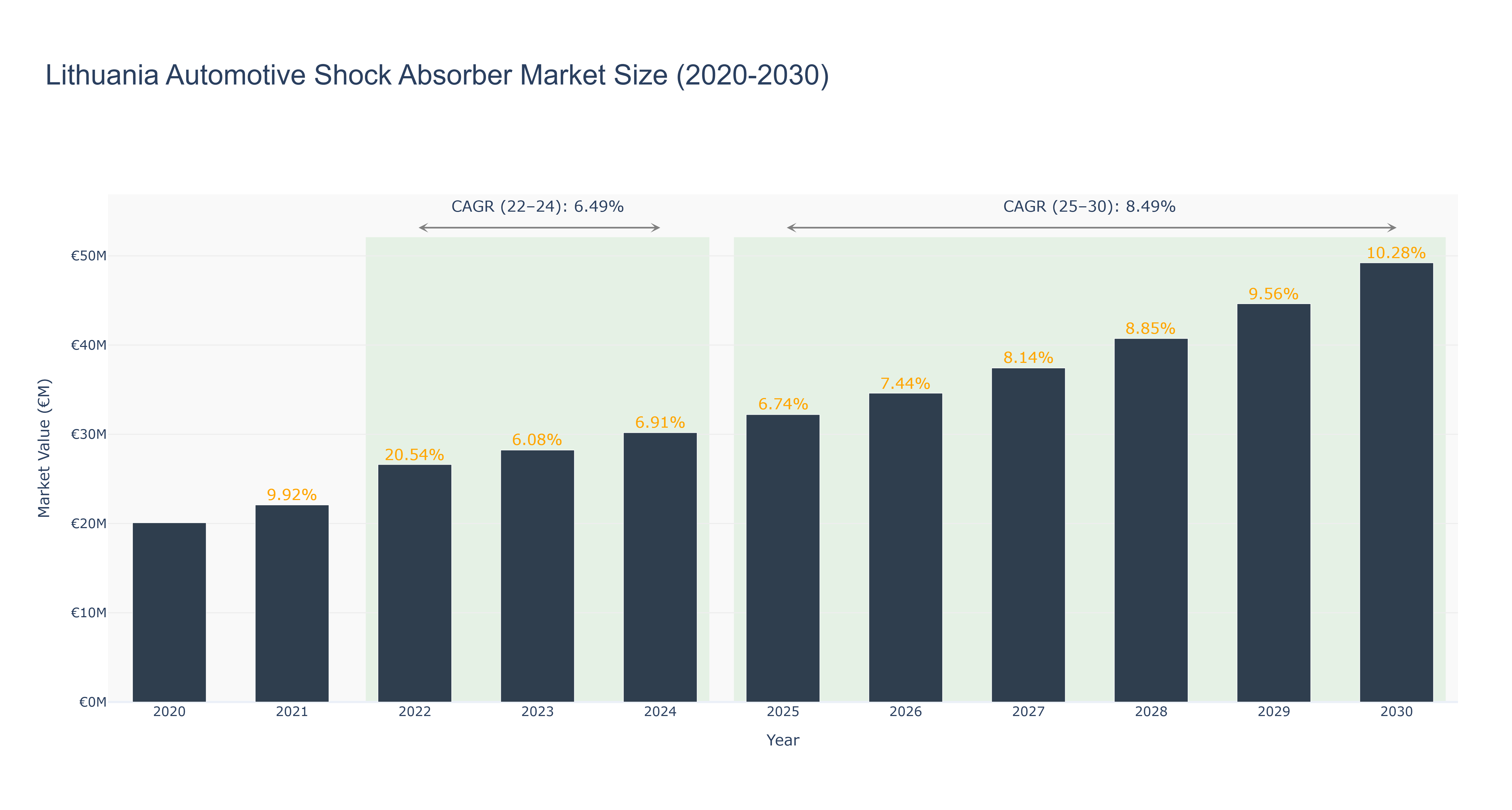
The Lithuania Automotive Shock Absorber Market has demonstrated robust growth from 2020 to 2024, with the market size peaking at €30.18 million in 2024, reflecting a CAGR of 6.49% during the actual period (2022-2024). This growth trajectory has been driven by increasing automotive production and a rising demand for vehicle safety and comfort. Transitioning to the forecasted period (2025-2030), the market is projected to expand significantly, reaching €49.21 million by 2030, with an anticipated CAGR of 8.49%. This positive outlook is supported by ongoing advancements in automotive technology, a growing emphasis on electric vehicles, and an expanding consumer base. As Lithuania continues to enhance its automotive infrastructure and embrace sustainability trends, the demand for high-quality shock absorbers is expected to flourish, positioning the market for continued expansion in the coming years.
Lithuania Automotive Shock Absorber Market: Production & Trade Performance (2019-2025)
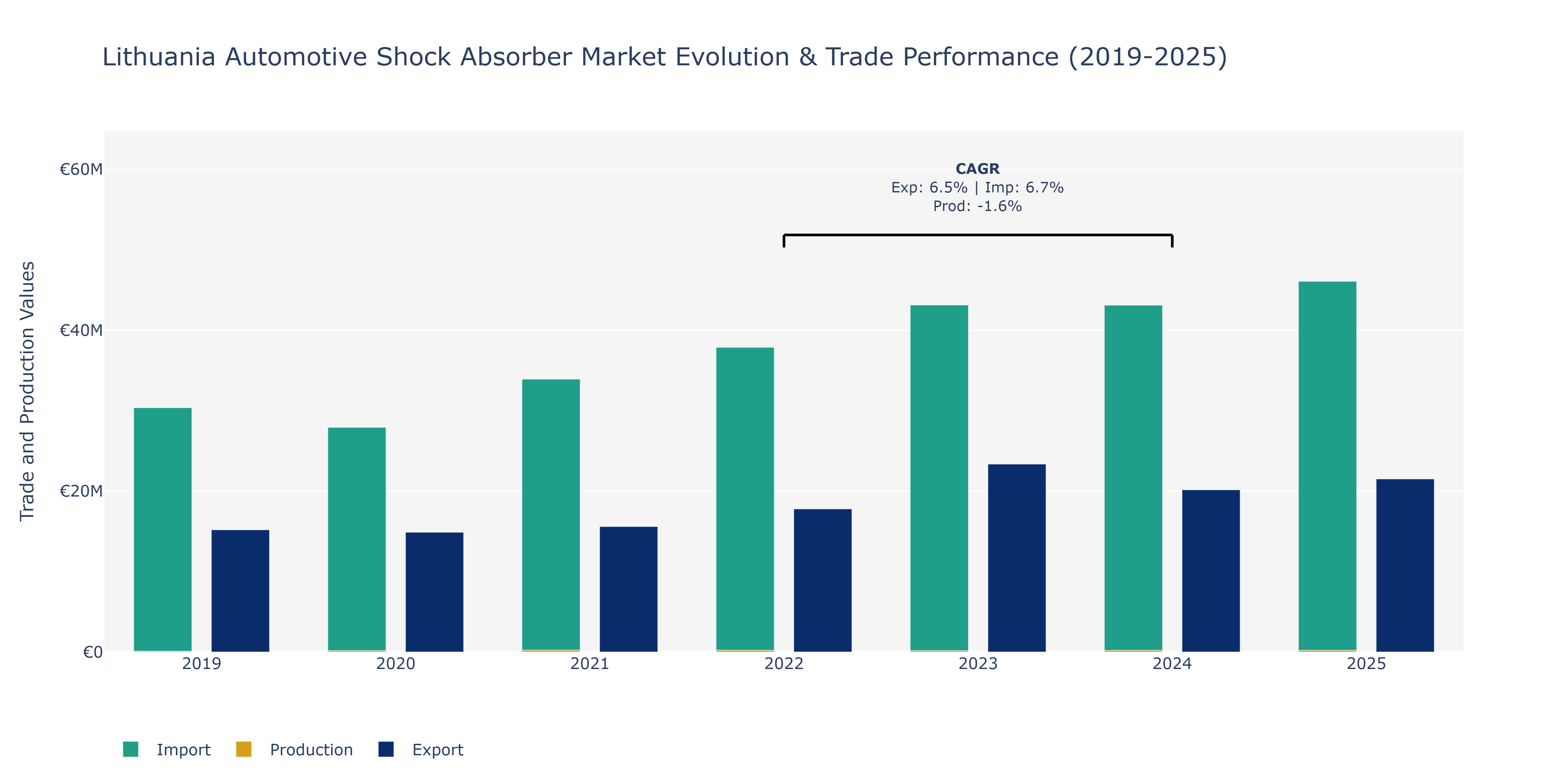
In the Lithuania Automotive Shock Absorber Market, from 2019 to 2025, exports witnessed a fluctuating trajectory. Starting at €15.2 million in 2019, there was a slight decline in 2020 to €14.89 million before a remarkable uptrend reaching €23.37 million in 2023, then settling at €21.52 million in 2025. This growth can be attributed to the country's continued focus on enhancing automotive component manufacturing efficiency and quality to meet increasing global demand. In contrast, imports followed a similar pattern, starting at €30.37 million in 2019, dipping to €27.93 million in 2020, then steadily climbing to €46.08 million in 2025. The surge in imports could be linked to the industry's need for advanced technologies and materials not readily available domestically. Production, commencing at €109.2 million in 2019, grew steadily until 2021, peaking at €230 million, before slightly dropping to €213.7 million in 2025. The decline in production could be due to supply chain disruptions or technological transitions within the manufacturing processes. To sustain market competitiveness, local manufacturers might need to focus on innovation and operational resilience.
Key Highlights of the Report:
- Lithuania Automotive Shock Absorber Market Outlook
- Market Size of Lithuania Automotive Shock Absorber Market, 2025
- Forecast of Lithuania Automotive Shock Absorber Market, 2032
- Historical Data and Forecast of Lithuania Automotive Shock Absorber Revenues & Volume for the Period 2022 - 2032
- Lithuania Automotive Shock Absorber Market Trend Evolution
- Lithuania Automotive Shock Absorber Market Drivers and Challenges
- Lithuania Automotive Shock Absorber Price Trends
- Lithuania Automotive Shock Absorber Porter's Five Forces
- Lithuania Automotive Shock Absorber Industry Life Cycle
- Historical Data and Forecast of Lithuania Automotive Shock Absorber Market Revenues & Volume By Mechanism for the Period 2022 - 2032
- Historical Data and Forecast of Lithuania Automotive Shock Absorber Market Revenues & Volume By Gas Charged for the Period 2022 - 2032
- Historical Data and Forecast of Lithuania Automotive Shock Absorber Market Revenues & Volume By Hydraulic for the Period 2022 - 2032
- Historical Data and Forecast of Lithuania Automotive Shock Absorber Market Revenues & Volume By Product Type for the Period 2022 - 2032
- Historical Data and Forecast of Lithuania Automotive Shock Absorber Market Revenues & Volume By Conventional Shock Absorber for the Period 2022 - 2032
- Historical Data and Forecast of Lithuania Automotive Shock Absorber Market Revenues & Volume By Regenerative Shock Absorber for the Period 2022 - 2032
- Historical Data and Forecast of Lithuania Automotive Shock Absorber Market Revenues & Volume By Technology for the Period 2022 - 2032
- Historical Data and Forecast of Lithuania Automotive Shock Absorber Market Revenues & Volume By Active for the Period 2022 - 2032
- Historical Data and Forecast of Lithuania Automotive Shock Absorber Market Revenues & Volume By Passive for the Period 2022 - 2032
- Historical Data and Forecast of Lithuania Automotive Shock Absorber Market Revenues & Volume By Vehicle Type for the Period 2022 - 2032
- Historical Data and Forecast of Lithuania Automotive Shock Absorber Market Revenues & Volume By Two and Three Wheelers for the Period 2022 - 2032
- Historical Data and Forecast of Lithuania Automotive Shock Absorber Market Revenues & Volume By Passenger Vehicles for the Period 2022 - 2032
- Historical Data and Forecast of Lithuania Automotive Shock Absorber Market Revenues & Volume By Commercial Vehicles for the Period 2022 - 2032
- Historical Data and Forecast of Lithuania Automotive Shock Absorber Market Revenues & Volume By Sales Channel for the Period 2022 - 2032
- Historical Data and Forecast of Lithuania Automotive Shock Absorber Market Revenues & Volume By OEMs for the Period 2022 - 2032
- Historical Data and Forecast of Lithuania Automotive Shock Absorber Market Revenues & Volume By Aftermarket for the Period 2022 - 2032
- Lithuania Automotive Shock Absorber Import Export Trade Statistics
- Market Opportunity Assessment By Mechanism
- Market Opportunity Assessment By Product Type
- Market Opportunity Assessment By Technology
- Market Opportunity Assessment By Vehicle Type
- Market Opportunity Assessment By Sales Channel
- Lithuania Automotive Shock Absorber Top Companies Market Share
- Lithuania Automotive Shock Absorber Competitive Benchmarking By Technical and Operational Parameters
- Lithuania Automotive Shock Absorber Company Profiles
- Lithuania Automotive Shock Absorber Key Strategic Recommendations






































