Lithuania Camphor Market Size (2020-2030)
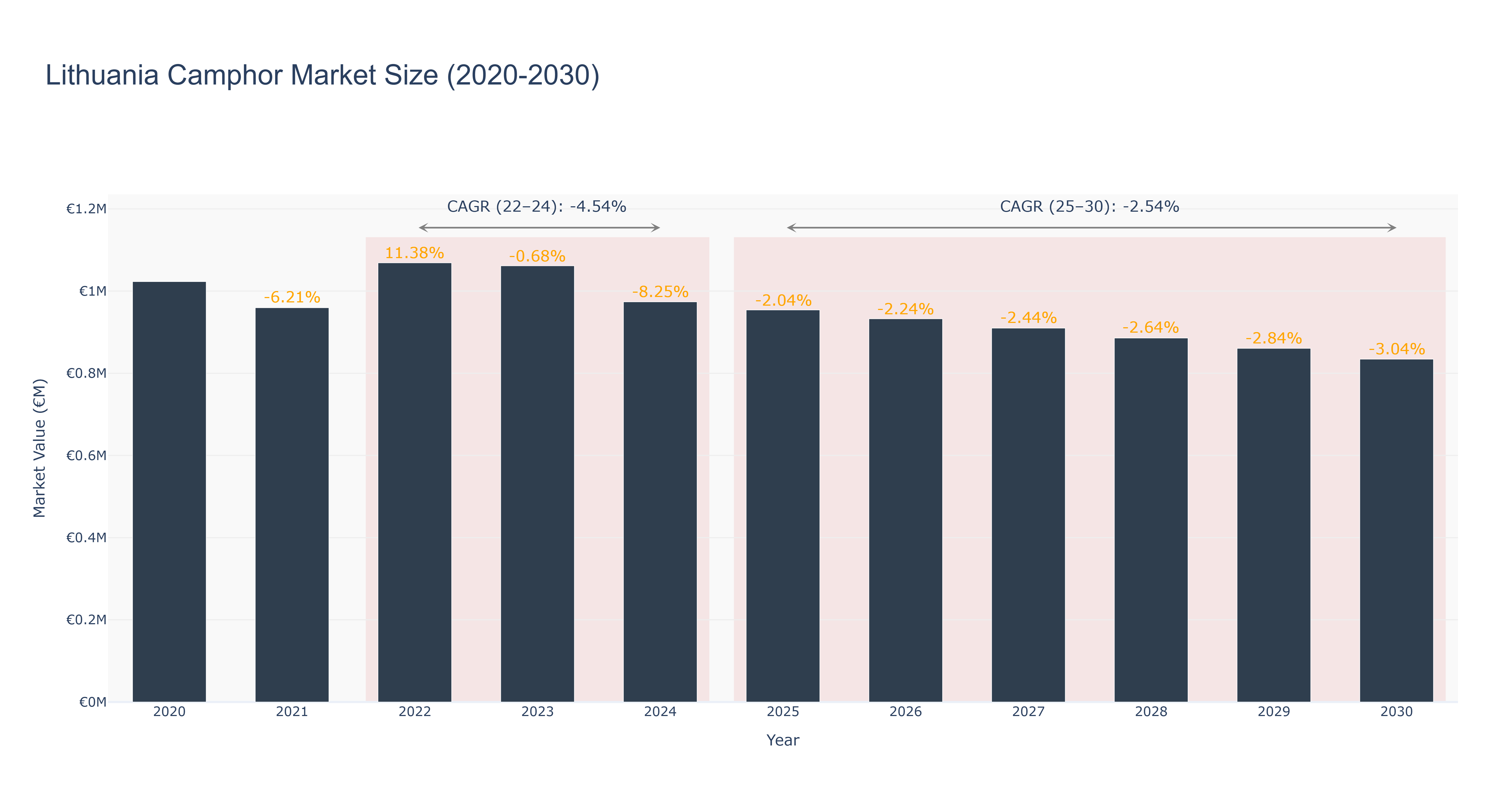
The Lithuania Camphor Market experienced a peak market size of €1.07 million in 2022, followed by a decline to €0.95 million in 2025. The market is forecasted to continue decreasing to €0.83 million by 2030, with a CAGR of -4.54% from 2022 to 2024 and -2.54% from 2025 to 2030. The market faced challenges due to economic slowdowns and changing consumer preferences, leading to a steady decline in market size. However, efforts to diversify product offerings and expand into new markets are expected to drive growth in the coming years. Recent developments in sustainable sourcing practices and innovative marketing strategies are poised to enhance market competitiveness and attract a broader consumer base in the near future.
Lithuania Camphor Market: Production & Trade Performance (2019-2025)
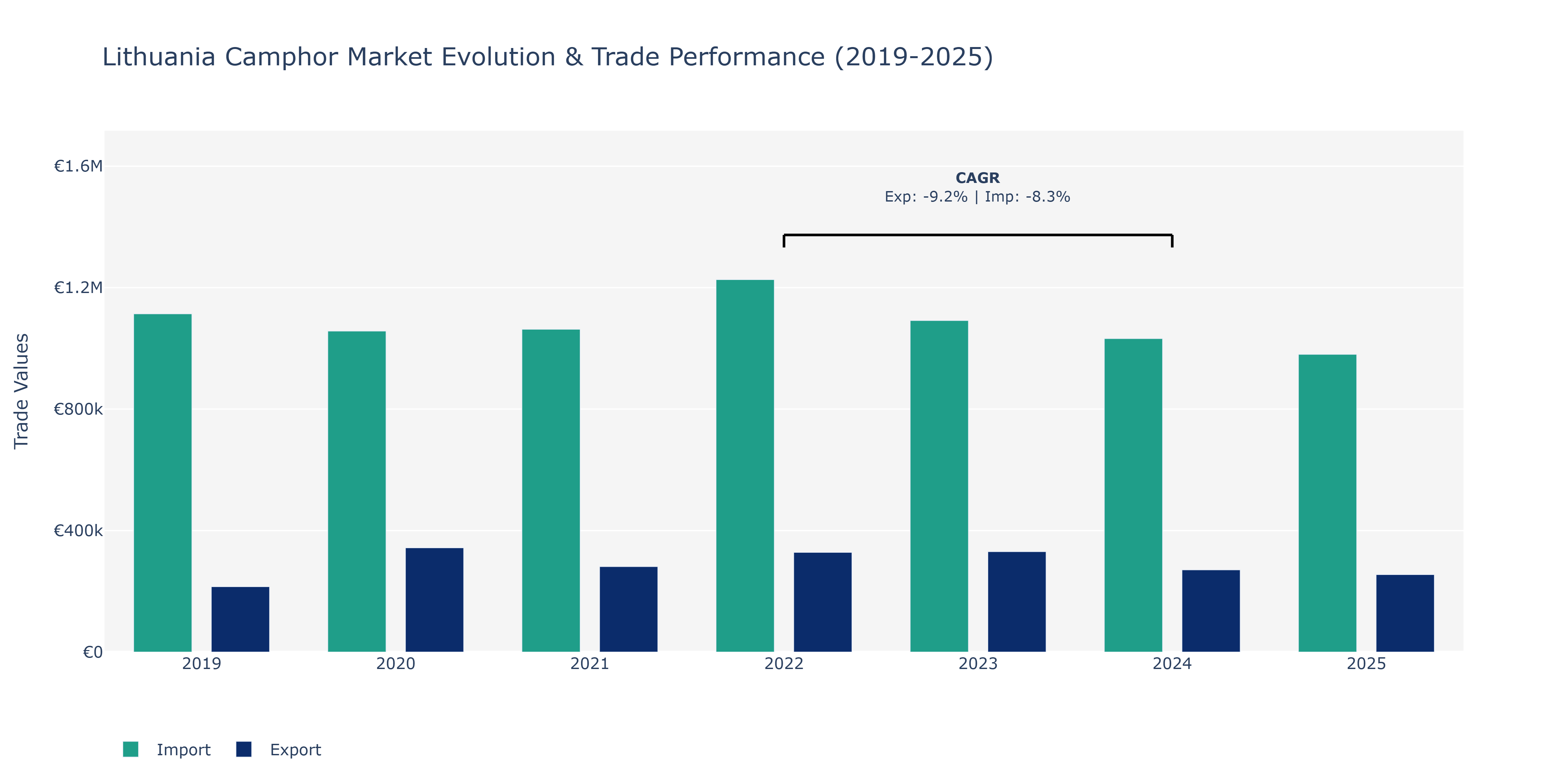
Between 2019 and 2025, Lithuania's Camphor Market witnessed notable fluctuations in both exports and imports. Exports peaked at €343.21 thousand in 2020, followed by a decline to €254.81 thousand in 2025. Conversely, imports reached their highest point in 2022 at €1.23 million before decreasing to €0.98 million in 2025. The decrease in exports from 2020 to 2025 can be attributed to shifts in global demand, supply chain disruptions, and evolving consumer preferences towards alternative products. On the import side, the peak in 2022 could be linked to increased production capacities or strategic procurement decisions. However, the subsequent decline might reflect changing trade dynamics, cost considerations, or market saturation. These trends underscore the importance of market adaptability and strategic planning in the face of dynamic global market conditions.
Key Highlights of the Report:
- Lithuania Camphor Market Outlook
- Market Size of Lithuania Camphor Market, 2025
- Forecast of Lithuania Camphor Market, 2032
- Historical Data and Forecast of Lithuania Camphor Revenues & Volume for the Period 2022 - 2032F
- Lithuania Camphor Market Trend Evolution
- Lithuania Camphor Market Drivers and Challenges
- Lithuania Camphor Price Trends
- Lithuania Camphor Porter's Five Forces
- Lithuania Camphor Industry Life Cycle
- Historical Data and Forecast of Lithuania Camphor Market Revenues & Volume By Product Type for the Period 2022 - 2032F
- Historical Data and Forecast of Lithuania Camphor Market Revenues & Volume By Tablets for the Period 2022 - 2032F
- Historical Data and Forecast of Lithuania Camphor Market Revenues & Volume By Oil for the Period 2022 - 2032F
- Historical Data and Forecast of Lithuania Camphor Market Revenues & Volume By Application for the Period 2022 - 2032F
- Historical Data and Forecast of Lithuania Camphor Market Revenues & Volume By Pharmaceuticals for the Period 2022 - 2032F
- Historical Data and Forecast of Lithuania Camphor Market Revenues & Volume By Religious Rituals for the Period 2022 - 2032F
- Historical Data and Forecast of Lithuania Camphor Market Revenues & Volume By End User for the Period 2022 - 2032F
- Historical Data and Forecast of Lithuania Camphor Market Revenues & Volume By Healthcare for the Period 2022 - 2032F
- Historical Data and Forecast of Lithuania Camphor Market Revenues & Volume By Households for the Period 2022 - 2032F
- Historical Data and Forecast of Lithuania Camphor Market Revenues & Volume By Source for the Period 2022 - 2032F
- Historical Data and Forecast of Lithuania Camphor Market Revenues & Volume By Natural (Plant-Based) for the Period 2022 - 2032F
- Historical Data and Forecast of Lithuania Camphor Market Revenues & Volume By Synthetic for the Period 2022 - 2032F
- Lithuania Camphor Import Export Trade Statistics
- Market Opportunity Assessment By Product Type
- Market Opportunity Assessment By Application
- Market Opportunity Assessment By End User
- Market Opportunity Assessment By Source
- Lithuania Camphor Top Companies Market Share
- Lithuania Camphor Competitive Benchmarking By Technical and Operational Parameters
- Lithuania Camphor Company Profiles
- Lithuania Camphor Key Strategic Recommendations






































