Lithuania Concrete Vibrator Market Size (2020-2030)
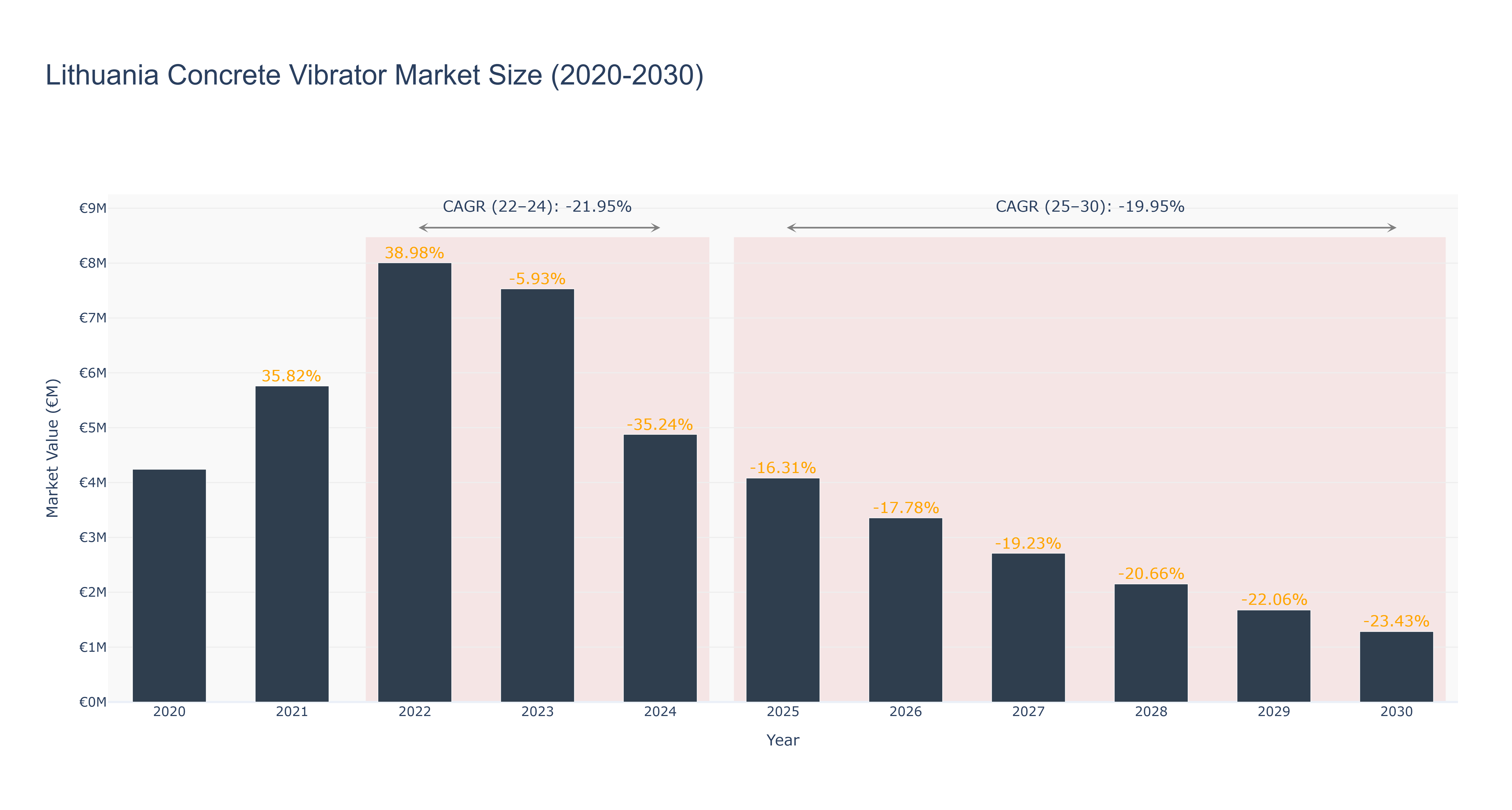
The Lithuania Concrete Vibrator Market experienced a peak market size of €8.00 million in 2022, followed by a decline to €4.88 million in 2024. The market is forecasted to continue shrinking, with a projected size of €1.28 million in 2030. The CAGR for the period 2022-24 was -21.95%, while for 2025-30 it stands at -19.95%. The downward trend can be attributed to various factors such as economic uncertainty, changing construction trends, and increasing competition. Despite the challenges, recent developments indicate a shift towards sustainable construction practices in Lithuania, with upcoming projects focusing on green building technologies and energy-efficient infrastructure. Industry drivers such as technological advancements and environmental regulations will play a crucial role in shaping the future landscape of the Lithuania Concrete Vibrator Market.
Lithuania Concrete Vibrator Market: Production & Trade Performance (2019-2025)
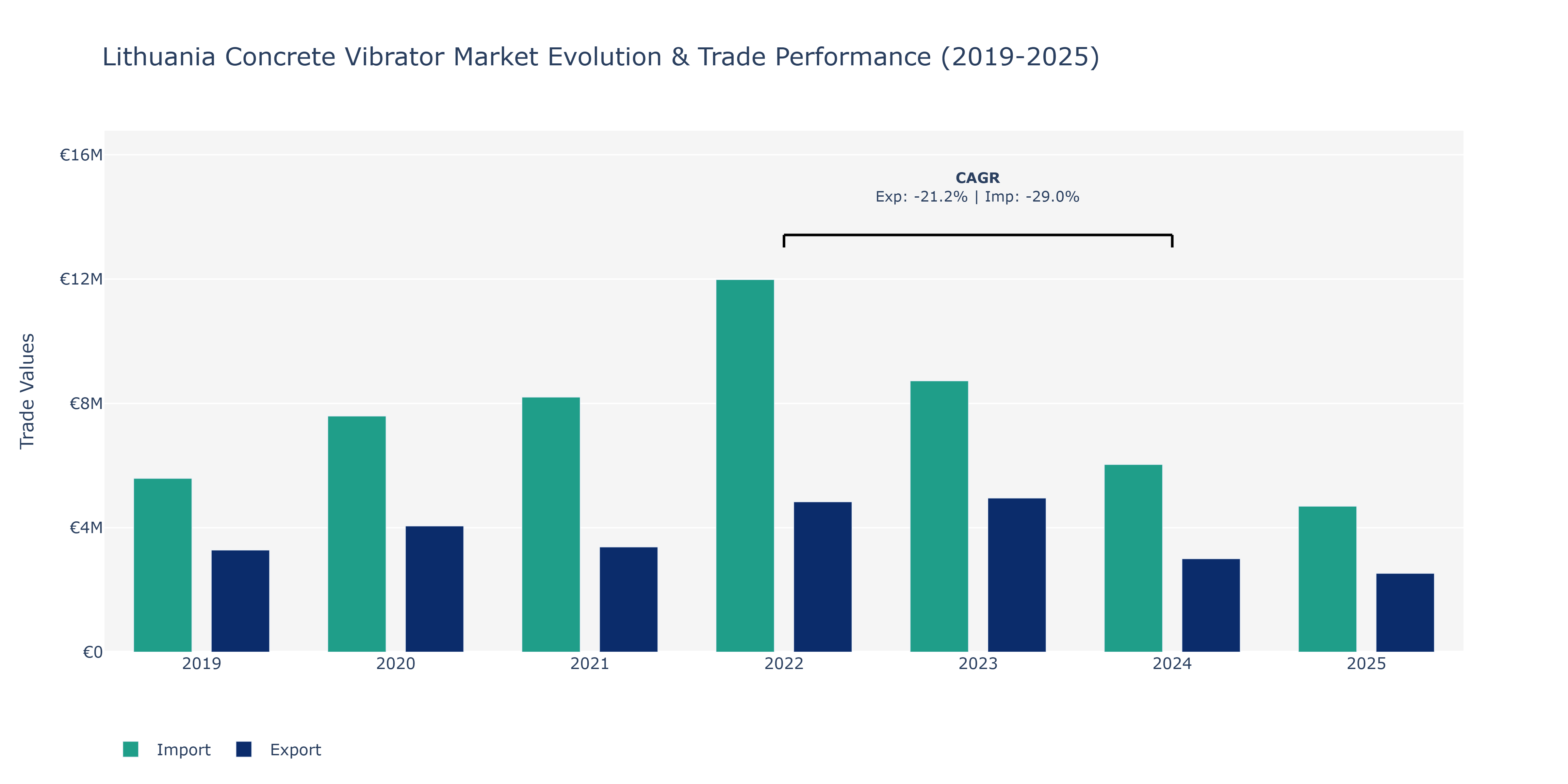
In the Lithuania Concrete Vibrator Market, both exports and imports experienced noticeable fluctuations over the years provided. Between 2019 and 2020, exports surged from €3.28 million to €4.05 million, indicating a significant uptick in demand. Conversely, imports also saw a substantial increase during the same period, rising from €5.59 million to €7.59 million. The year 2022 marked a peak for both exports and imports, with exports reaching €4.83 million and imports peaking at €11.98 million. However, by 2024, both metrics experienced a decline, with exports decreasing to €3.0 million and imports to €6.03 million. The sudden drop could be attributed to various factors such as changes in market demand, economic conditions, or shifts in trade policies impacting the concrete vibrator industry in Lithuania. The decline in imports could signal a potential slowdown in construction activity or shifts towards domestic production, while fluctuations in exports could reflect changes in international market dynamics affecting the industry.
Key Highlights of the Report:
- Lithuania Concrete Vibrator Market Outlook
- Market Size of Lithuania Concrete Vibrator Market, 2024
- Forecast of Lithuania Concrete Vibrator Market, 2031
- Historical Data and Forecast of Lithuania Concrete Vibrator Revenues & Volume for the Period 2021-2031
- Lithuania Concrete Vibrator Market Trend Evolution
- Lithuania Concrete Vibrator Market Drivers and Challenges
- Lithuania Concrete Vibrator Price Trends
- Lithuania Concrete Vibrator Porter`s Five Forces
- Lithuania Concrete Vibrator Industry Life Cycle
- Historical Data and Forecast of Lithuania Concrete Vibrator Market Revenues & Volume By Type for the Period 2021-2031
- Historical Data and Forecast of Lithuania Concrete Vibrator Market Revenues & Volume By External Vibrator for the Period 2021-2031
- Historical Data and Forecast of Lithuania Concrete Vibrator Market Revenues & Volume By Internal Vibrator for the Period 2021-2031
- Historical Data and Forecast of Lithuania Concrete Vibrator Market Revenues & Volume By Others for the Period 2021-2031
- Historical Data and Forecast of Lithuania Concrete Vibrator Market Revenues & Volume By Application for the Period 2021-2031
- Historical Data and Forecast of Lithuania Concrete Vibrator Market Revenues & Volume By Architectural Engineering for the Period 2021-2031
- Historical Data and Forecast of Lithuania Concrete Vibrator Market Revenues & Volume By Dam Engineering for the Period 2021-2031
- Historical Data and Forecast of Lithuania Concrete Vibrator Market Revenues & Volume By Mine and Well Engineering for the Period 2021-2031
- Historical Data and Forecast of Lithuania Concrete Vibrator Market Revenues & Volume By Others for the Period 2021-2031
- Lithuania Concrete Vibrator Import Export Trade Statistics
- Market Opportunity Assessment By Type
- Market Opportunity Assessment By Application
- Lithuania Concrete Vibrator Top Companies Market Share
- Lithuania Concrete Vibrator Competitive Benchmarking By Technical and Operational Parameters
- Lithuania Concrete Vibrator Company Profiles
- Lithuania Concrete Vibrator Key Strategic Recommendations






































