Lithuania Cryogenic Freezers Market Size (2020-2030)
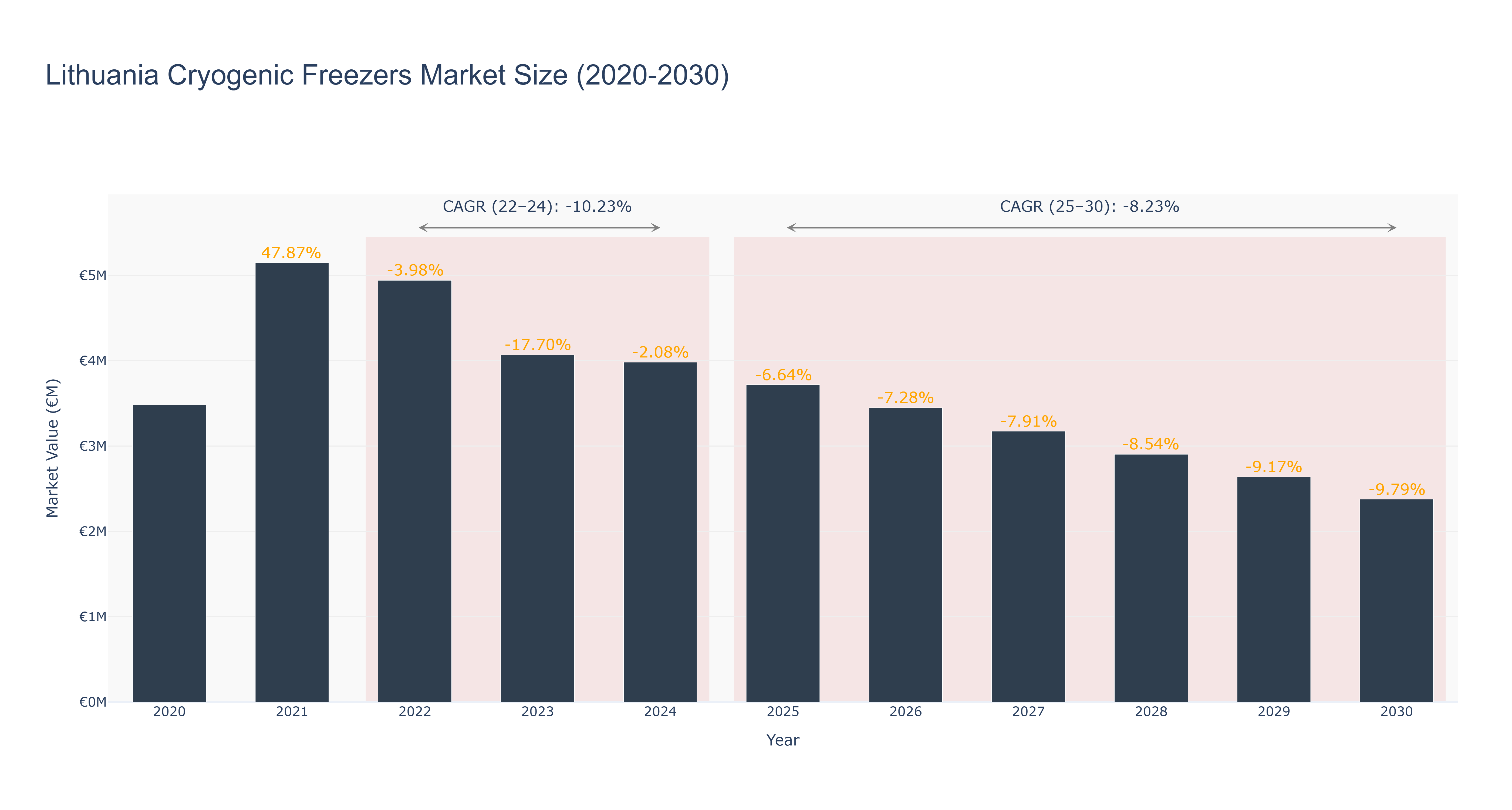
The Lithuania Cryogenic Freezers Market experienced a peak market size of €5.15 million in 2021, followed by a gradual decline to €3.45 million in 2026. The market size decreased from €3.98 million in 2024 to €3.72 million in 2025 due to a negative growth rate of -6.64%, reflecting a temporary setback. The forecasted market size is expected to further decline to €2.38 million by 2030, with a CAGR of -8.23% from 2025 to 2030. The downturn can be attributed to factors like market saturation, technological advancements leading to cost reductions, and changing consumer preferences. Despite the challenging market conditions, upcoming projects in the cryogenic technology sector in Lithuania are expected to drive innovation and potentially revitalize the market in the coming years.
Lithuania Cryogenic Freezers Market: Production & Trade Performance (2019-2025)
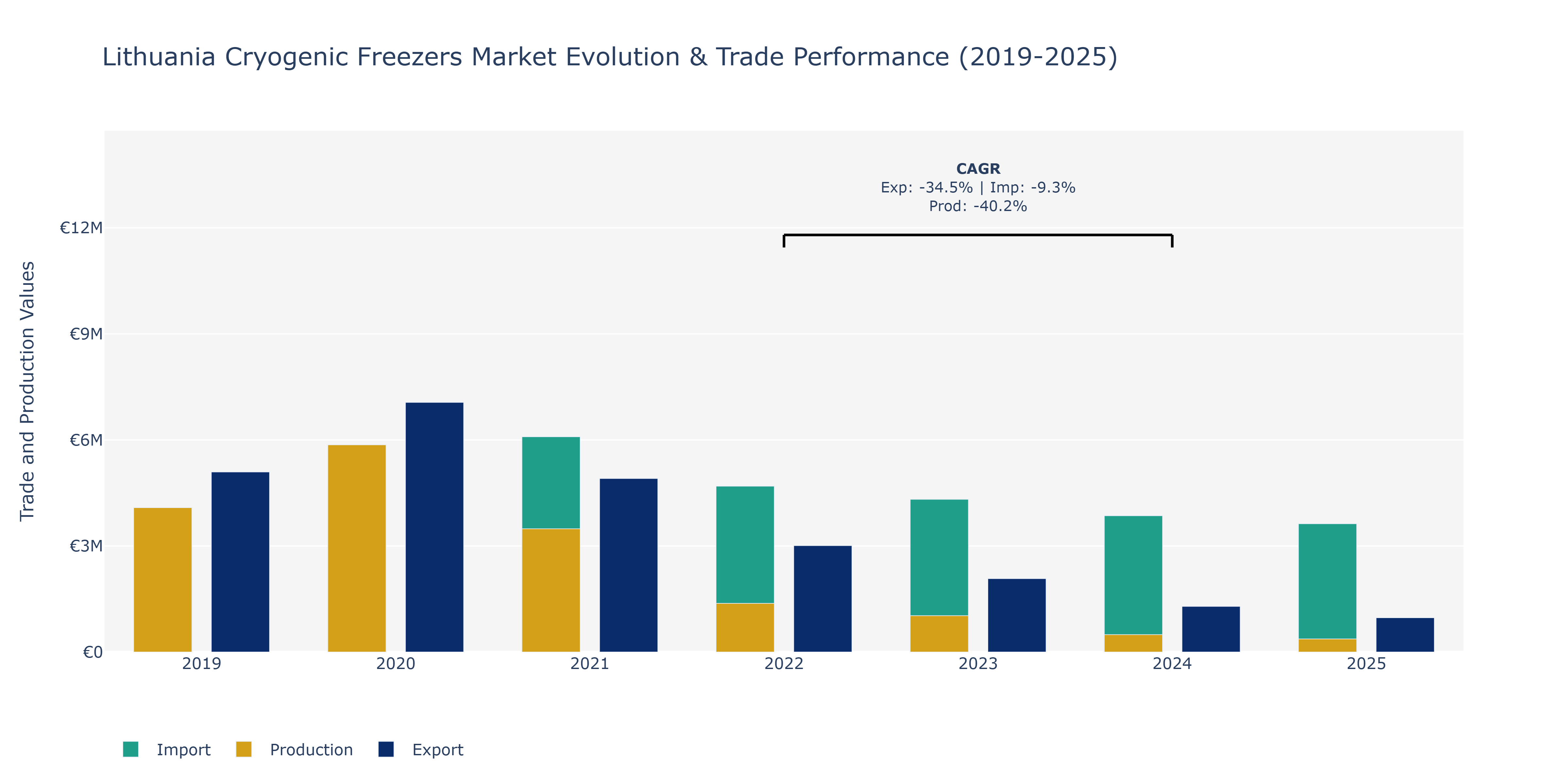
In the Lithuania Cryogenic Freezers Market, exports experienced a noticeable decline from €5.09 million in 2019 to €970.68 thousand in 2025. This downward trend can be attributed to various factors such as changes in global demand for cryogenic freezers, economic conditions affecting trade, and potentially increased competition from other market players. Imports, on the other hand, showed a fluctuating pattern, reaching a peak of €6.09 million in 2021 before decreasing to €3.63 million in 2025. This fluctuation might reflect shifts in domestic consumption patterns, changes in import regulations, or evolving supplier relationships. Meanwhile, Production value exhibited a consistent decline from €4.08 million in 2019 to €369.87 million in 2025. This substantial drop could be linked to technological advancements leading to more efficient production processes, consolidation within the industry, or changes in consumer preferences towards alternative products. Such shifts highlight the dynamic nature of the market and the need for industry players to adapt to changing conditions to remain competitive in the cryogenic freezers sector.
Lithuania Cryogenic Freezers Market Synopsis
The Lithuania Cryogenic Freezers Market is witnessing steady growth driven by increasing demand for advanced freezing technologies in various industries such as healthcare, food and beverage, and research laboratories. These freezers, which operate at extremely low temperatures, are crucial for preserving biological samples, vaccines, and perishable goods. Key market players in Lithuania are focusing on product innovations to enhance efficiency and reduce energy consumption. The market is also seeing a rise in the adoption of cryogenic freezers for medical applications, including storing stem cells and tissues. Government initiatives to promote research and development activities further contribute to market growth. Overall, the Lithuania Cryogenic Freezers Market is expected to continue expanding as industries increasingly prioritize the need for reliable and efficient cold storage solutions.
Lithuania Cryogenic Freezers Market Trends
The Lithuania Cryogenic Freezers Market is experiencing significant growth driven by increasing demand from various industries such as healthcare, food processing, and research laboratories. The market is witnessing a shift towards advanced cryogenic freezer technologies, such as liquid nitrogen freezers and ultra-low temperature freezers, to meet the growing need for long-term storage of biological samples and perishable goods. Opportunities in the market include the development of customized cryogenic freezer solutions, expansion of distribution networks, and strategic partnerships with key end-users. Additionally, the rising focus on research and development activities in pharmaceuticals and biotechnology sectors is expected to further boost the demand for cryogenic freezers in Lithuania. Overall, the market presents promising prospects for manufacturers and suppliers to capitalize on the evolving industry landscape.
Lithuania Cryogenic Freezers Market Challenges
In the Lithuania Cryogenic Freezers Market, some challenges include the high initial investment costs associated with purchasing and maintaining cryogenic freezers, as well as the need for specialized training to operate and handle these complex equipment safely. Additionally, there may be concerns regarding the environmental impact of using cryogenic technology, such as the potential release of greenhouse gases during the cooling process. Furthermore, the limited awareness and understanding of the benefits of cryogenic freezers among businesses in Lithuania could pose a challenge in driving market growth and adoption. Overall, addressing these challenges will require industry players to invest in education and training programs, develop more cost-effective solutions, and emphasize the long-term benefits of using cryogenic freezers in various applications.
Lithuania Cryogenic Freezers Market Investment Opportunities
The Lithuania Cryogenic Freezers Market is primarily driven by the increasing demand for cryopreservation in various industries such as healthcare, biotechnology, and pharmaceuticals. The growing need to store biological samples, tissues, and cells at ultra-low temperatures for research and medical purposes is fueling the adoption of cryogenic freezers. Additionally, advancements in cryopreservation techniques, such as stem cell research and assisted reproductive technology, are contributing to the market growth. Furthermore, the rising focus on preserving food quality, especially in the food and beverage sector, is driving the demand for cryogenic freezers in Lithuania. Government initiatives to promote research and development activities in life sciences and healthcare sectors are also playing a significant role in propelling the market forward.
Lithuania Cryogenic Freezers Market Government Polices
In Lithuania, the government has implemented policies to regulate the Cryogenic Freezers Market in order to ensure product safety and environmental sustainability. The Lithuanian government has set stringent standards and guidelines for the production and use of cryogenic freezers to ensure that they meet quality and safety requirements. Additionally, there are regulations in place to manage the disposal and recycling of cryogenic freezers to minimize environmental impact. The government also provides support and incentives for businesses in the Cryogenic Freezers Market to adopt sustainable practices and technologies. Overall, the government policies in Lithuania aim to promote the growth of the Cryogenic Freezers Market while ensuring compliance with safety and environmental standards.
Lithuania Cryogenic Freezers Market Future Outlook
The Lithuania Cryogenic Freezers Market is expected to witness steady growth in the coming years, driven primarily by increasing demand from the healthcare and pharmaceutical industries for storage of biological samples, vaccines, and other sensitive materials. The market is also likely to be supported by advancements in cryopreservation techniques and the growing adoption of cryogenic freezers in research and development activities. Additionally, the rising focus on food preservation and the expanding biotechnology sector are expected to further fuel market growth. However, challenges such as high initial investment costs and stringent regulations regarding the use of cryogenic freezers may hinder the market expansion to some extent. Overall, with the increasing need for efficient and reliable storage solutions, the Lithuania Cryogenic Freezers Market is anticipated to experience moderate but steady growth in the foreseeable future.
Key Highlights of the Report:
- Lithuania Cryogenic Freezers Market Outlook
- Market Size of Lithuania Cryogenic Freezers Market, 2024
- Forecast of Lithuania Cryogenic Freezers Market, 2031
- Historical Data and Forecast of Lithuania Cryogenic Freezers Revenues & Volume for the Period 2021- 2031
- Lithuania Cryogenic Freezers Market Trend Evolution
- Lithuania Cryogenic Freezers Market Drivers and Challenges
- Lithuania Cryogenic Freezers Price Trends
- Lithuania Cryogenic Freezers Porter's Five Forces
- Lithuania Cryogenic Freezers Industry Life Cycle
- Historical Data and Forecast of Lithuania Cryogenic Freezers Market Revenues & Volume By Product Type for the Period 2021- 2031
- Historical Data and Forecast of Lithuania Cryogenic Freezers Market Revenues & Volume By Tunnel Freezer for the Period 2021- 2031
- Historical Data and Forecast of Lithuania Cryogenic Freezers Market Revenues & Volume By IQF Freezer for the Period 2021- 2031
- Historical Data and Forecast of Lithuania Cryogenic Freezers Market Revenues & Volume By Immersion Freezer for the Period 2021- 2031
- Historical Data and Forecast of Lithuania Cryogenic Freezers Market Revenues & Volume By Spiral Freezer for the Period 2021- 2031
- Historical Data and Forecast of Lithuania Cryogenic Freezers Market Revenues & Volume By Others for the Period 2021- 2031
- Historical Data and Forecast of Lithuania Cryogenic Freezers Market Revenues & Volume By Application for the Period 2021- 2031
- Historical Data and Forecast of Lithuania Cryogenic Freezers Market Revenues & Volume By Corporate Laboratories for the Period 2021- 2031
- Historical Data and Forecast of Lithuania Cryogenic Freezers Market Revenues & Volume By Hospitals and Blood Centers for the Period 2021- 2031
- Historical Data and Forecast of Lithuania Cryogenic Freezers Market Revenues & Volume By Universities and Research Institutions for the Period 2021- 2031
- Historical Data and Forecast of Lithuania Cryogenic Freezers Market Revenues & Volume By Others for the Period 2021- 2031
- Historical Data and Forecast of Lithuania Cryogenic Freezers Market Revenues & Volume By End-User for the Period 2021- 2031
- Historical Data and Forecast of Lithuania Cryogenic Freezers Market Revenues & Volume By Food and Beverages for the Period 2021- 2031
- Historical Data and Forecast of Lithuania Cryogenic Freezers Market Revenues & Volume By Medical and Healthcare for the Period 2021- 2031
- Historical Data and Forecast of Lithuania Cryogenic Freezers Market Revenues & Volume By Pharmaceuticals for the Period 2021- 2031
- Historical Data and Forecast of Lithuania Cryogenic Freezers Market Revenues & Volume By Chemicals for the Period 2021- 2031
- Historical Data and Forecast of Lithuania Cryogenic Freezers Market Revenues & Volume By Others for the Period 2021- 2031
- Lithuania Cryogenic Freezers Import Export Trade Statistics
- Market Opportunity Assessment By Product Type
- Market Opportunity Assessment By Application
- Market Opportunity Assessment By End-User
- Lithuania Cryogenic Freezers Top Companies Market Share
- Lithuania Cryogenic Freezers Competitive Benchmarking By Technical and Operational Parameters
- Lithuania Cryogenic Freezers Company Profiles
- Lithuania Cryogenic Freezers Key Strategic Recommendations






































