Lithuania Edible Oil Market Size (2020-2030)
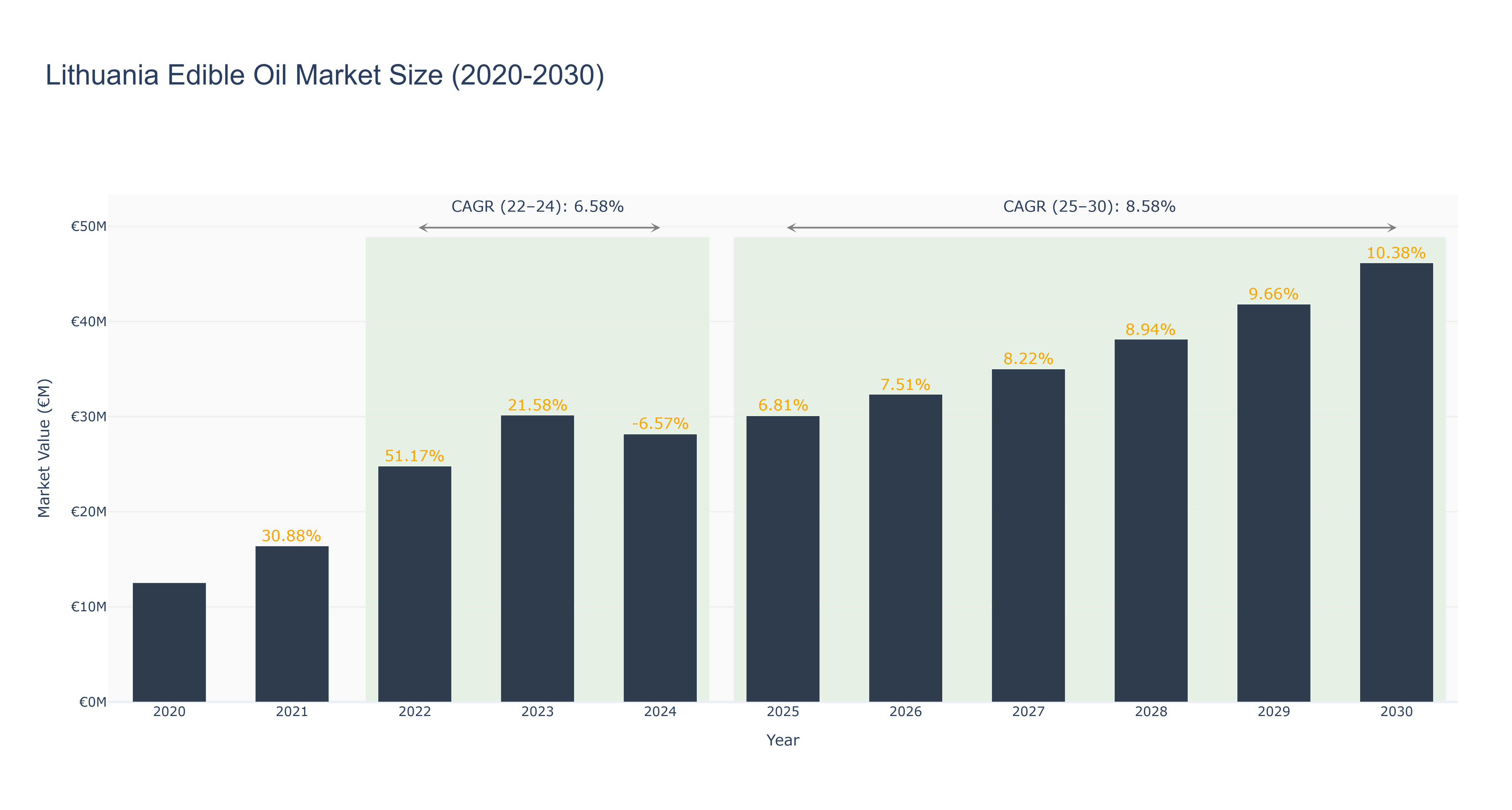
Lithuania Edible Oil Market has shown a fluctuating yet upward trend, with the market projected to reach €46.17M by 2030, growing at a CAGR of 8.58% during 2025–2030. The market recorded variable but overall positive realised performance from €12.54M in 2020 to €28.17M in 2024, despite a slight dip in 2024 due to economic pressures affecting consumer demand. Growth has been supported by increasing consumption driven by rising disposable incomes and a shift toward healthier dietary habits. Additionally, growing awareness of the nutritional benefits of edible oils has further strengthened demand. Looking ahead, the market is forecasted to maintain steady expansion, supported by advancements in sustainable production practices and improved supply chain efficiency. Government initiatives promoting domestic agriculture and ongoing product innovation are expected to further enhance market growth and align with evolving consumer and environmental preferences.
Lithuania Edible Oil Market: Production & Trade Performance (2019-2025)
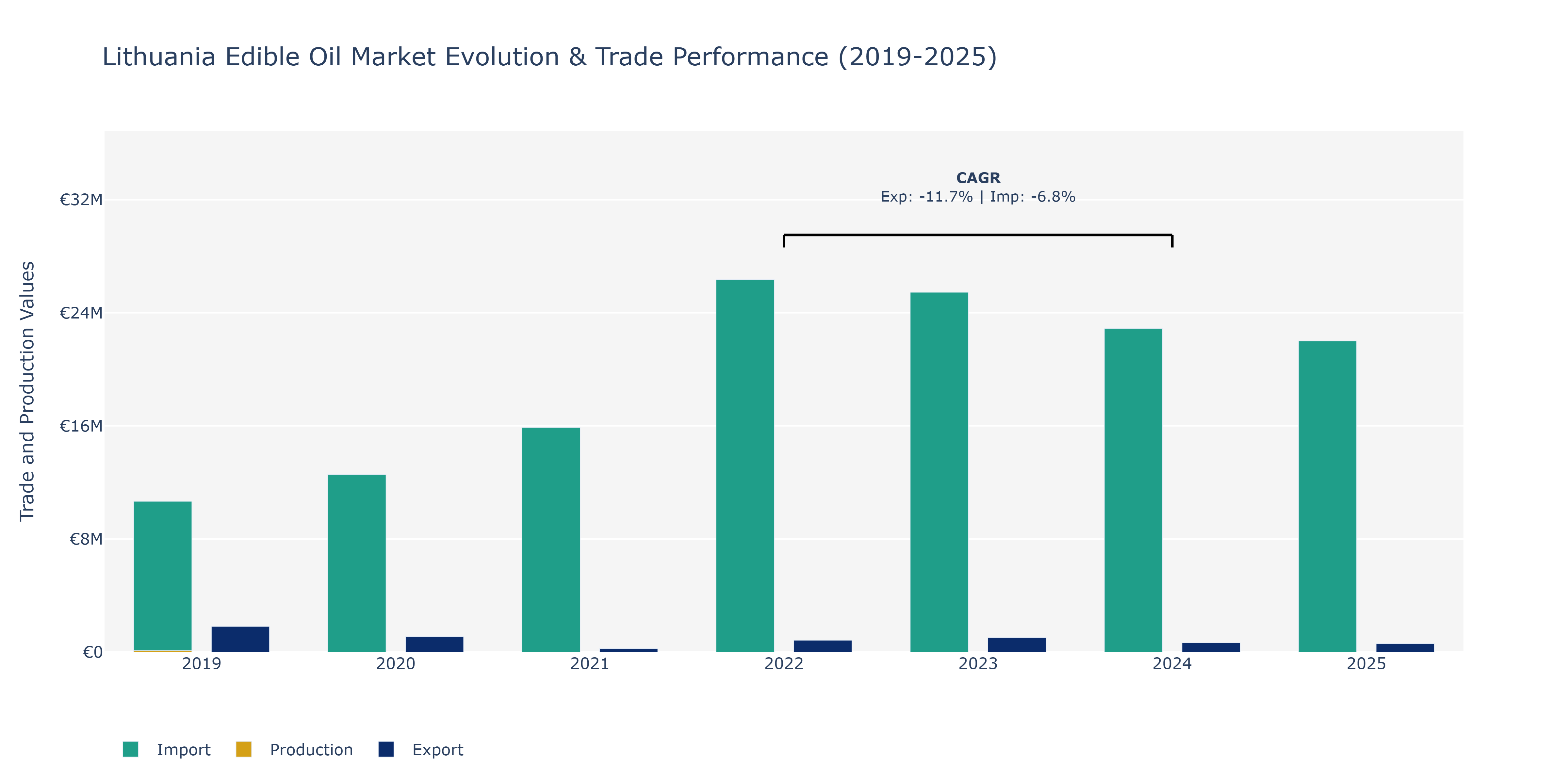
Between 2019 and 2025, Lithuania's Edible Oil Market witnessed varying trends in Exports, Imports, and Production. In 2019, Exports stood at approximately €1.81 million and gradually declined to around €603.43 thousand in 2025, showing a notable decrease. Conversely, Imports surged from about €10.67 million in 2019 to roughly €22.01 million in 2025, indicating a consistent upward trajectory. Production value fluctuated significantly, starting at around €90.38 million in 2019, dipping sharply to €2.39 million in 2020. The decrease in exports can be attributed to shifting consumer preferences towards healthier alternatives or increased competition from other markets. The rise in imports may be due to the demand for a diverse range of edible oil products or strategic trade agreements facilitating increased imports. Such trends in the Lithuanian Edible Oil market reflect evolving consumer behaviors and international trade dynamics, necessitating market players to adapt their strategies to stay competitive.
Key Highlights of the Report:
- Lithuania Edible Oil Market Outlook
- Market Size of Lithuania Edible Oil Market, 2025
- Forecast of Lithuania Edible Oil Market, 2032
- Historical Data and Forecast of Lithuania Edible Oil Revenues & Volume for the Period 2022 - 2032F
- Lithuania Edible Oil Market Trend Evolution
- Lithuania Edible Oil Market Drivers and Challenges
- Lithuania Edible Oil Price Trends
- Lithuania Edible Oil Porter`s Five Forces
- Lithuania Edible Oil Industry Life Cycle
- Historical Data and Forecast of Lithuania Edible Oil Market Revenues & Volume By Type for the Period 2022 - 2032F
- Historical Data and Forecast of Lithuania Edible Oil Market Revenues & Volume By Palm Oil for the Period 2022 - 2032F
- Historical Data and Forecast of Lithuania Edible Oil Market Revenues & Volume By Soybean Oil for the Period 2022 - 2032F
- Historical Data and Forecast of Lithuania Edible Oil Market Revenues & Volume By Mustard Oil for the Period 2022 - 2032F
- Historical Data and Forecast of Lithuania Edible Oil Market Revenues & Volume By Sunflower Oil for the Period 2022 - 2032F
- Historical Data and Forecast of Lithuania Edible Oil Market Revenues & Volume By Others for the Period 2022 - 2032F
- Historical Data and Forecast of Lithuania Edible Oil Market Revenues & Volume By for the Period 2022 - 2032F
- Historical Data and Forecast of Lithuania Edible Oil Market Revenues & Volume By Packaging Type for the Period 2022 - 2032F
- Historical Data and Forecast of Lithuania Edible Oil Market Revenues & Volume By Pouches for the Period 2022 - 2032F
- Historical Data and Forecast of Lithuania Edible Oil Market Revenues & Volume By Jars for the Period 2022 - 2032F
- Historical Data and Forecast of Lithuania Edible Oil Market Revenues & Volume By Cans for the Period 2022 - 2032F
- Historical Data and Forecast of Lithuania Edible Oil Market Revenues & Volume By Bottles for the Period 2022 - 2032F
- Historical Data and Forecast of Lithuania Edible Oil Market Revenues & Volume By for the Period 2022 - 2032F
- Historical Data and Forecast of Lithuania Edible Oil Market Revenues & Volume By Pack Size for the Period 2022 - 2032F
- Historical Data and Forecast of Lithuania Edible Oil Market Revenues & Volume By Less than 1 Litres for the Period 2022 - 2032F
- Historical Data and Forecast of Lithuania Edible Oil Market Revenues & Volume By 1 Litres for the Period 2022 - 2032F
- Historical Data and Forecast of Lithuania Edible Oil Market Revenues & Volume By 1 Litres - 5 litres for the Period 2022 - 2032F
- Historical Data and Forecast of Lithuania Edible Oil Market Revenues & Volume By 5 Litres - 10 Litres for the Period 2022 - 2032F
- Historical Data and Forecast of Lithuania Edible Oil Market Revenues & Volume By 10 Litres and Above for the Period 2022 - 2032F
- Historical Data and Forecast of Lithuania Edible Oil Market Revenues & Volume By for the Period 2022 - 2032F
- Historical Data and Forecast of Lithuania Edible Oil Market Revenues & Volume By Packaging Material for the Period 2022 - 2032F
- Historical Data and Forecast of Lithuania Edible Oil Market Revenues & Volume By Metal for the Period 2022 - 2032F
- Historical Data and Forecast of Lithuania Edible Oil Market Revenues & Volume By Plastic for the Period 2022 - 2032F
- Historical Data and Forecast of Lithuania Edible Oil Market Revenues & Volume By Paper for the Period 2022 - 2032F
- Historical Data and Forecast of Lithuania Edible Oil Market Revenues & Volume By Others for the Period 2022 - 2032F
- Historical Data and Forecast of Lithuania Edible Oil Market Revenues & Volume By Application for the Period 2022 - 2032F
- Historical Data and Forecast of Lithuania Edible Oil Market Revenues & Volume By HoReCa for the Period 2022 - 2032F
- Historical Data and Forecast of Lithuania Edible Oil Market Revenues & Volume By Home Users for the Period 2022 - 2032F
- Historical Data and Forecast of Lithuania Edible Oil Market Revenues & Volume By Food Processing Industry for the Period 2022 - 2032F
- Historical Data and Forecast of Lithuania Edible Oil Market Revenues & Volume By for the Period 2022 - 2032F
- Historical Data and Forecast of Lithuania Edible Oil Market Revenues & Volume By Distribution Channel for the Period 2022 - 2032F
- Historical Data and Forecast of Lithuania Edible Oil Market Revenues & Volume By Direct/Institutional Sales for the Period 2022 - 2032F
- Historical Data and Forecast of Lithuania Edible Oil Market Revenues & Volume By Supermarkets and Hypermarkets for the Period 2022 - 2032F
- Historical Data and Forecast of Lithuania Edible Oil Market Revenues & Volume By Convenience Stores for the Period 2022 - 2032F
- Historical Data and Forecast of Lithuania Edible Oil Market Revenues & Volume By Online for the Period 2022 - 2032F
- Historical Data and Forecast of Lithuania Edible Oil Market Revenues & Volume By Others for the Period 2022 - 2032F
- Lithuania Edible Oil Import Export Trade Statistics
- Market Opportunity Assessment By Type
- Market Opportunity Assessment By Packaging Type
- Market Opportunity Assessment By Pack Size
- Market Opportunity Assessment By Packaging Material
- Market Opportunity Assessment By Application
- Market Opportunity Assessment By Distribution Channel
- Lithuania Edible Oil Top Companies Market Share
- Lithuania Edible Oil Competitive Benchmarking By Technical and Operational Parameters
- Lithuania Edible Oil Company Profiles
- Lithuania Edible Oil Key Strategic Recommendations






































