Lithuania Flanges Market Size (2020-2030)
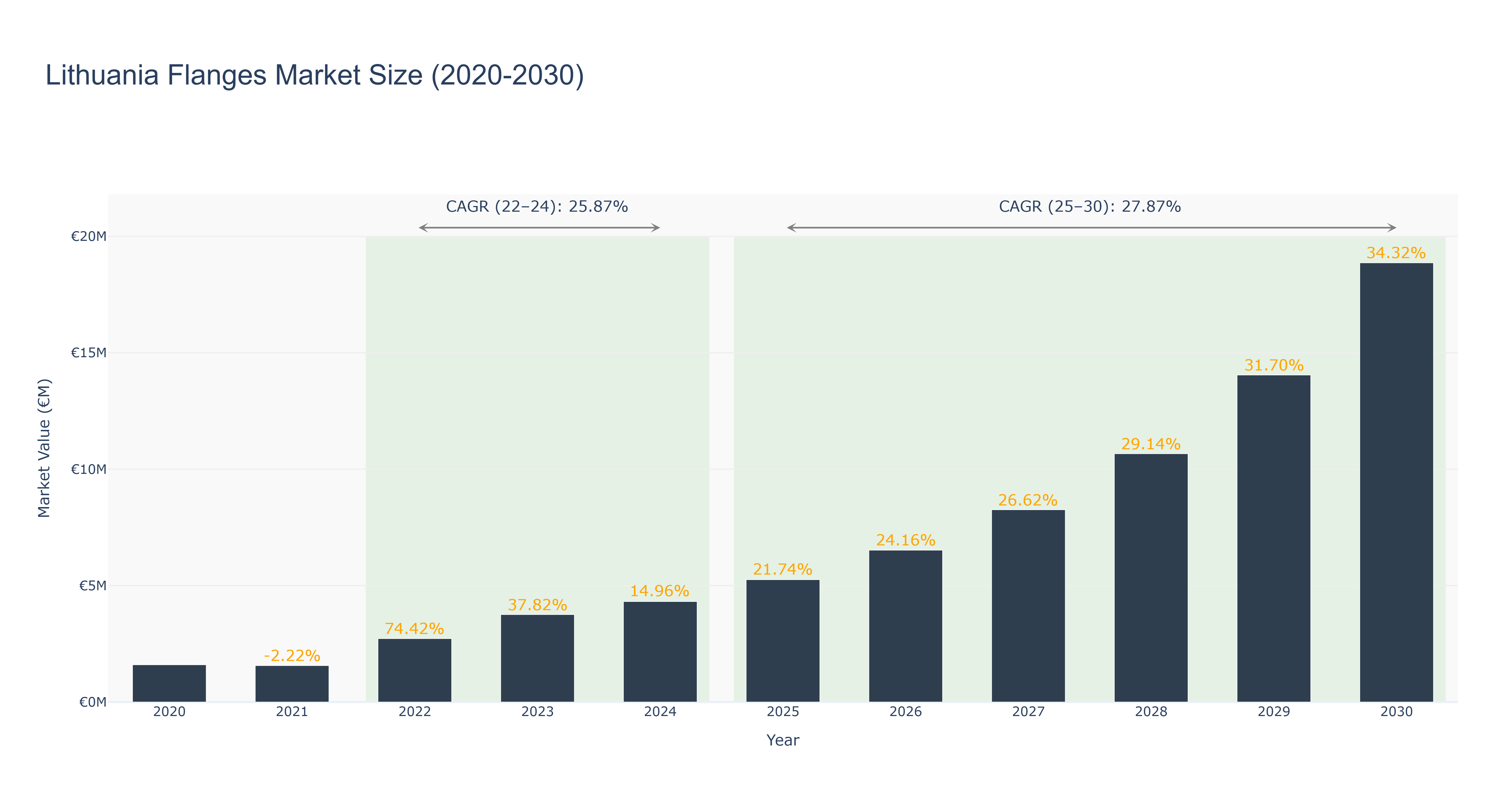
Lithuania Flanges Market has shown a remarkable growth trajectory over the years. The peak market size of €18.86 million in 2030 reflects a steady upward trend. From 2020 to 2024, the market size increased from €1.60 million to €4.31 million, driven by a series of strategic investments and technological advancements. The forecasted market size from 2025 to 2030 is expected to reach €18.86 million, with a CAGR of 27.87%. The market experienced a significant growth spurt in 2026, reaching €6.52 million, showcasing a robust 24.16% increase. This growth can be attributed to increasing demand for flanges in various industries such as oil and gas, construction, and manufacturing. Looking ahead, Lithuania is set to embark on a major infrastructure development project that will further boost the demand for flanges in the country, ensuring a positive outlook for the market in the coming years.
Lithuania Flanges Market: Production & Trade Performance (2019-2025)
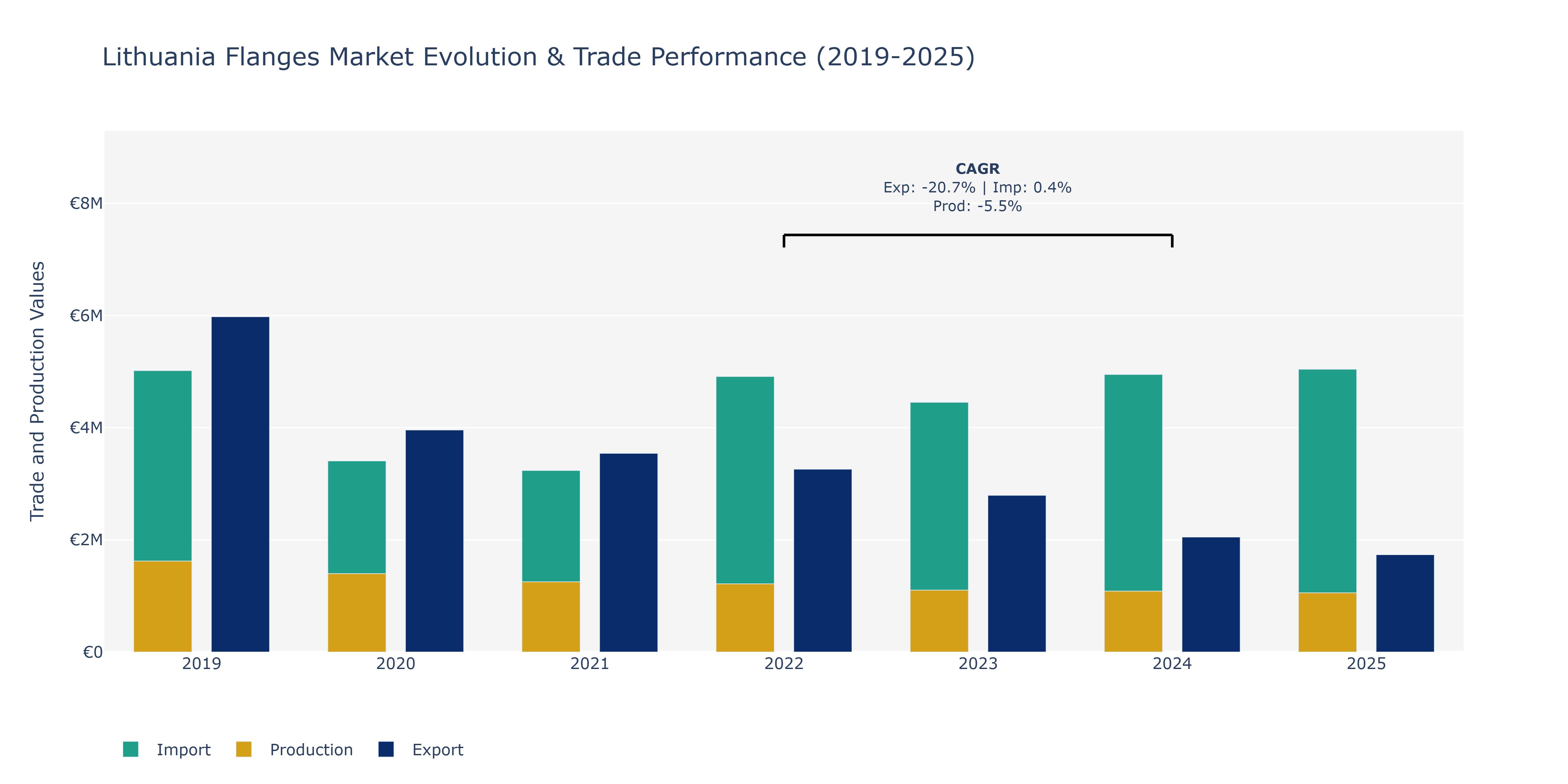
In the Lithuania Flanges Market, from 2019 to 2025, exports saw a consistent decline from €5.98 million to around €1.74 million. This substantial drop can be attributed to various factors such as global economic slowdowns impacting demand, increased competition from other markets, and fluctuations in currency exchange rates affecting pricing competitiveness. Imports, on the other hand, fluctuated throughout the years, reaching a peak of €5.04 million in 2025 after a slight decline post-2022. This rise could indicate growing domestic consumption or a shift in sourcing strategies. Production levels decreased steadily from €1.62 million in 2019 to approximately €1.06 million in 2025. The decline in production might be due to increasing manufacturing costs, stringent regulations impacting production efficiencies, or technological shifts in the industry leading to production consolidation. These trends highlight the evolving landscape of the Lithuania Flanges Market, emphasizing the need for market players to adapt to changing dynamics and consumer preferences to sustain growth.
Key Highlights of the Report:
- Lithuania Flanges Market Outlook
- Market Size of Lithuania Flanges Market, 2025
- Forecast of Lithuania Flanges Market, 2032
- Historical Data and Forecast of Lithuania Flanges Revenues & Volume for the Period 2022 - 2032F
- Lithuania Flanges Market Trend Evolution
- Lithuania Flanges Market Drivers and Challenges
- Lithuania Flanges Price Trends
- Lithuania Flanges Porter`s Five Forces
- Lithuania Flanges Industry Life Cycle
- Historical Data and Forecast of Lithuania Flanges Market Revenues & Volume By Type for the Period 2022 - 2032F
- Historical Data and Forecast of Lithuania Flanges Market Revenues & Volume By Welding Neck for the Period 2022 - 2032F
- Historical Data and Forecast of Lithuania Flanges Market Revenues & Volume By Long Welding Neck for the Period 2022 - 2032F
- Historical Data and Forecast of Lithuania Flanges Market Revenues & Volume By Slip-On for the Period 2022 - 2032F
- Historical Data and Forecast of Lithuania Flanges Market Revenues & Volume By Socket Weld for the Period 2022 - 2032F
- Historical Data and Forecast of Lithuania Flanges Market Revenues & Volume By Lap Joint for the Period 2022 - 2032F
- Historical Data and Forecast of Lithuania Flanges Market Revenues & Volume By Others for the Period 2022 - 2032F
- Historical Data and Forecast of Lithuania Flanges Market Revenues & Volume By Material for the Period 2022 - 2032F
- Historical Data and Forecast of Lithuania Flanges Market Revenues & Volume By Carbon Steel for the Period 2022 - 2032F
- Historical Data and Forecast of Lithuania Flanges Market Revenues & Volume By Stainless Steel for the Period 2022 - 2032F
- Historical Data and Forecast of Lithuania Flanges Market Revenues & Volume By Aluminum for the Period 2022 - 2032F
- Historical Data and Forecast of Lithuania Flanges Market Revenues & Volume By Polymer for the Period 2022 - 2032F
- Historical Data and Forecast of Lithuania Flanges Market Revenues & Volume By Others for the Period 2022 - 2032F
- Historical Data and Forecast of Lithuania Flanges Market Revenues & Volume By End Use Industry for the Period 2022 - 2032F
- Historical Data and Forecast of Lithuania Flanges Market Revenues & Volume By Aviation and Aerospace for the Period 2022 - 2032F
- Historical Data and Forecast of Lithuania Flanges Market Revenues & Volume By Petrochemical for the Period 2022 - 2032F
- Historical Data and Forecast of Lithuania Flanges Market Revenues & Volume By Architectural Decoration for the Period 2022 - 2032F
- Historical Data and Forecast of Lithuania Flanges Market Revenues & Volume By Food & Beverages Processing for the Period 2022 - 2032F
- Historical Data and Forecast of Lithuania Flanges Market Revenues & Volume By Construction for the Period 2022 - 2032F
- Lithuania Flanges Import Export Trade Statistics
- Market Opportunity Assessment By Type
- Market Opportunity Assessment By Material
- Market Opportunity Assessment By End Use Industry
- Lithuania Flanges Top Companies Market Share
- Lithuania Flanges Competitive Benchmarking By Technical and Operational Parameters
- Lithuania Flanges Company Profiles
- Lithuania Flanges Key Strategic Recommendations






































