Lithuania Flexible Foam Market Top 5 Importing Countries and Market Competition (HHI) Analysis
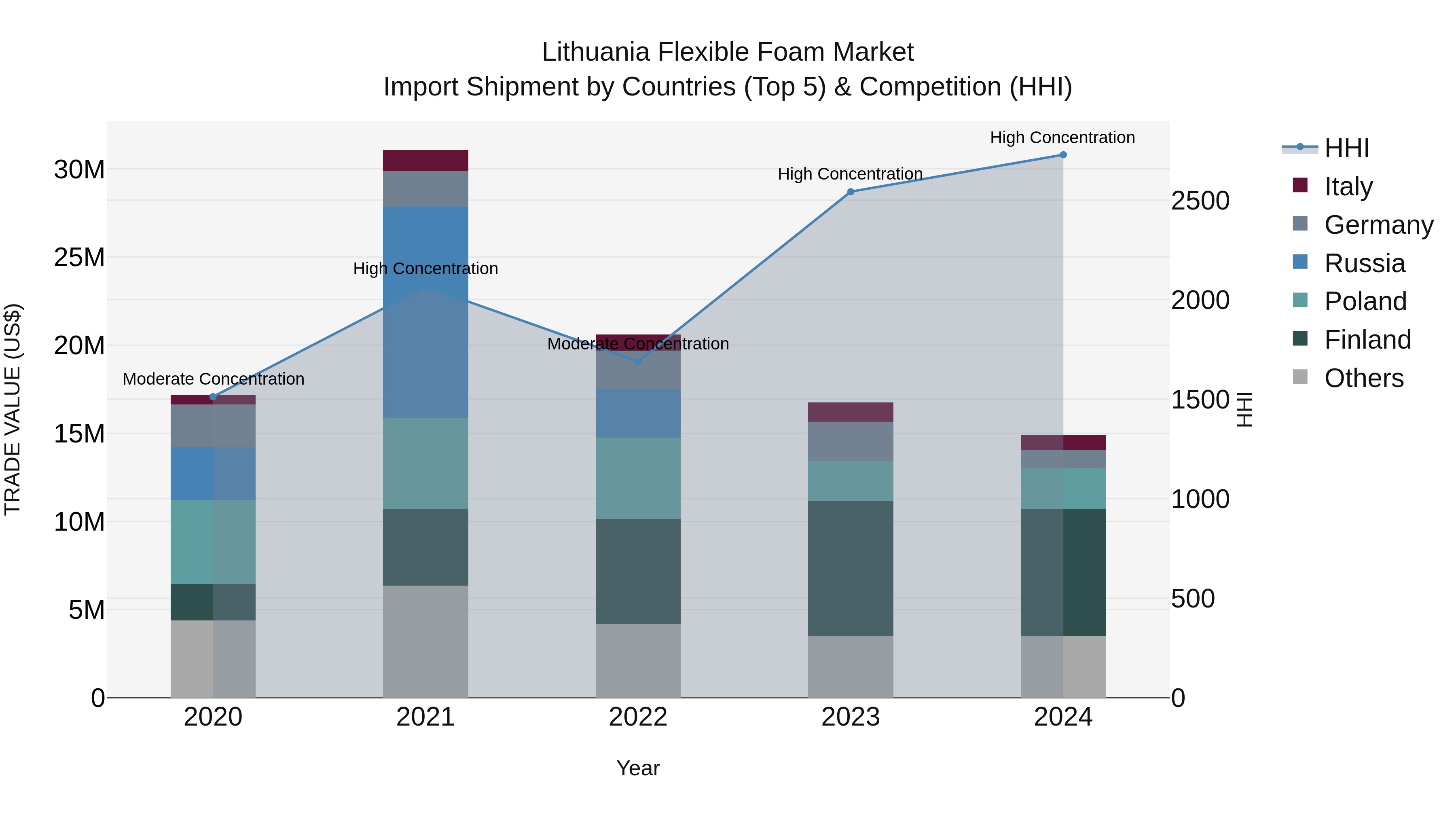
In 2024, Lithuania continued to see significant imports of flexible foam, with top exporting countries including Finland, Poland, Germany, Italy, and Sweden. Despite a challenging CAGR of -3.53% from 2020 to 2024 and a sharp decline in growth rate of -11.14% from 2023 to 2024, the market remained highly concentrated, as reflected by the high HHI. This suggests a competitive landscape with dominant players driving the import market for flexible foam in Lithuania. Monitoring shifts in supplier dynamics and market trends will be crucial for industry players in navigating this challenging environment.
Key Highlights of the Report:
- Lithuania Flexible Foam Market Outlook
- Market Size of Lithuania Flexible Foam Market, 2025
- Forecast of Lithuania Flexible Foam Market, 2032
- Historical Data and Forecast of Lithuania Flexible Foam Revenues & Volume for the Period 2022 - 2032F
- Lithuania Flexible Foam Market Trend Evolution
- Lithuania Flexible Foam Market Drivers and Challenges
- Lithuania Flexible Foam Price Trends
- Lithuania Flexible Foam Porter`s Five Forces
- Lithuania Flexible Foam Industry Life Cycle
- Historical Data and Forecast of Lithuania Flexible Foam Market Revenues & Volume By Type for the Period 2022 - 2032F
- Historical Data and Forecast of Lithuania Flexible Foam Market Revenues & Volume By Polyurethane for the Period 2022 - 2032F
- Historical Data and Forecast of Lithuania Flexible Foam Market Revenues & Volume By Polyethylene for the Period 2022 - 2032F
- Historical Data and Forecast of Lithuania Flexible Foam Market Revenues & Volume By Polypropylene for the Period 2022 - 2032F
- Historical Data and Forecast of Lithuania Flexible Foam Market Revenues & Volume By Application for the Period 2022 - 2032F
- Historical Data and Forecast of Lithuania Flexible Foam Market Revenues & Volume By Furniture & Bedding for the Period 2022 - 2032F
- Historical Data and Forecast of Lithuania Flexible Foam Market Revenues & Volume By Transportation for the Period 2022 - 2032F
- Historical Data and Forecast of Lithuania Flexible Foam Market Revenues & Volume By Packaging for the Period 2022 - 2032F
- Lithuania Flexible Foam Import Export Trade Statistics
- Market Opportunity Assessment By Type
- Market Opportunity Assessment By Application
- Lithuania Flexible Foam Top Companies Market Share
- Lithuania Flexible Foam Competitive Benchmarking By Technical and Operational Parameters
- Lithuania Flexible Foam Company Profiles
- Lithuania Flexible Foam Key Strategic Recommendations






































