Lithuania Float Glass Market Size (2020-2030)
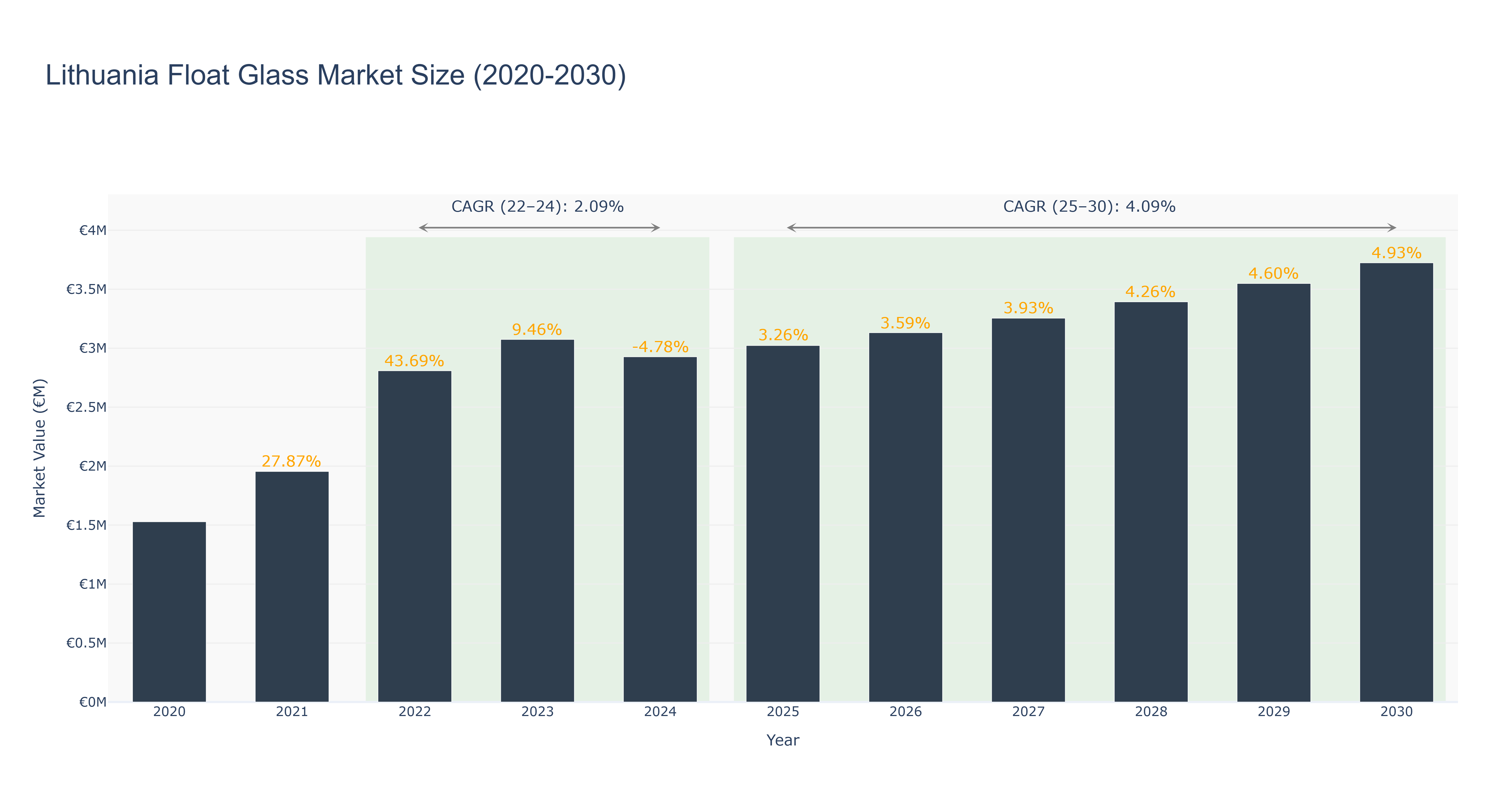
The Lithuania Float Glass Market has shown a steady growth trajectory over the years. The peak market size of €3.72 million is forecasted for 2030, with a CAGR of 4.093810971% from 2025 to 2030. The market experienced a slight decline from 2022 to 2024, with a CAGR of 2.093810971%, attributed to external economic factors impacting demand. However, from 2025 onwards, the market has regained momentum driven by increased construction activities and demand for sustainable building materials. Looking ahead, Lithuania's float glass market is poised for further growth with upcoming investments in energy-efficient glass manufacturing technologies. These advancements align with the country's focus on sustainability and innovation in the construction sector, indicating a positive outlook for the market's future expansion.
Lithuania Float Glass Market: Production & Trade Performance (2019-2025)
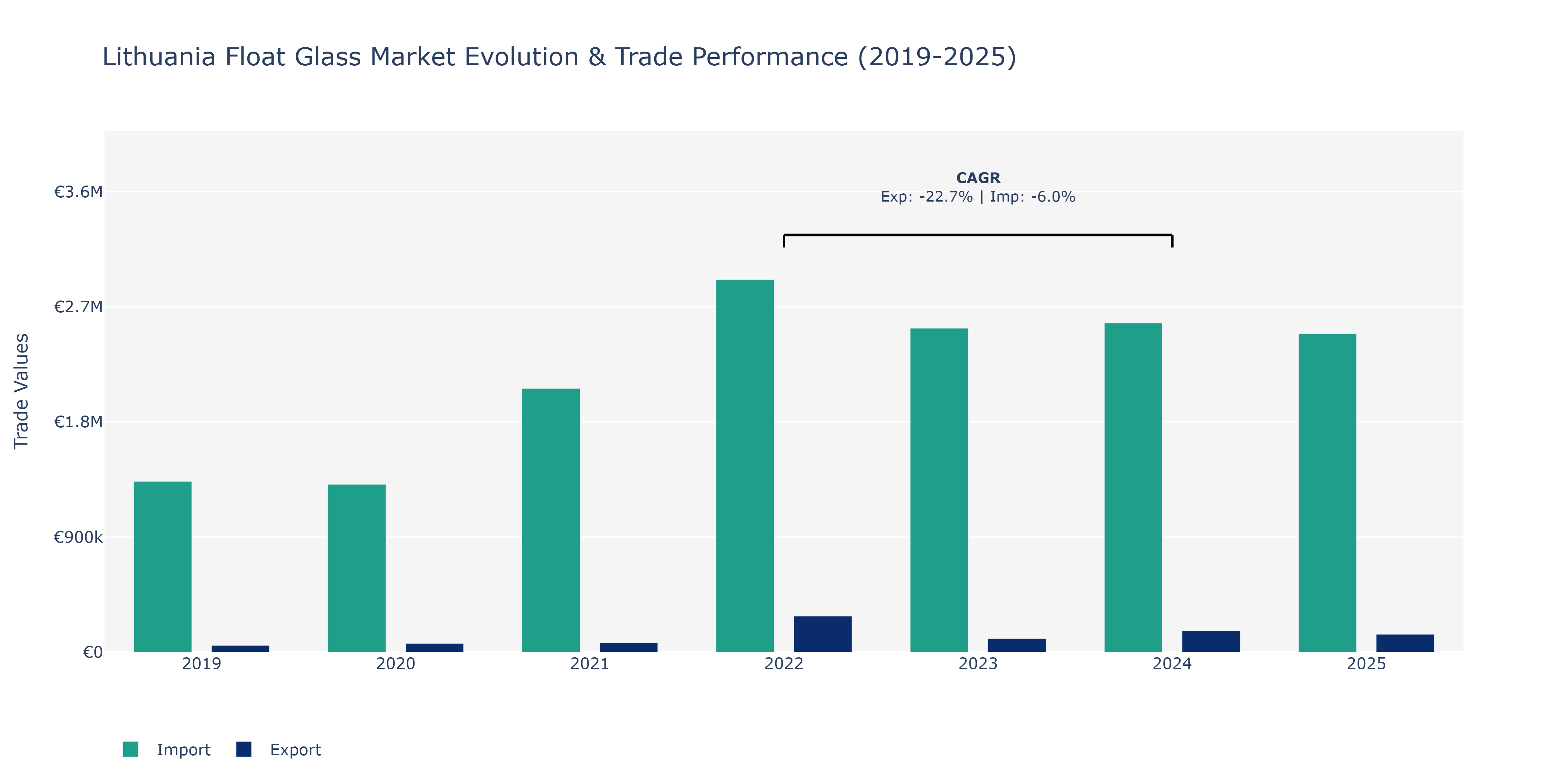
Between 2019 and 2025, Lithuania's Float Glass Market witnessed varying trends in exports and imports. In 2019, exports stood at €52.24 thousand while imports reached €1.34 million. By 2022, exports surged to €281.09 thousand, a substantial increase attributed to potential market demand or production capacity expansions. In contrast, imports grew steadily to €2.91 million in the same year, indicating a consistent need for foreign float glass products. Subsequently, both exports and imports experienced a decline in 2023, possibly due to economic factors affecting demand or trade policies. However, by 2024, exports rebounded to €167.81 thousand, showcasing market resilience, while imports continued to rise, reaching €2.57 million. The slight decrease in imports CAGR may reflect efficiency improvements in domestic production or changes in supplier relationships. In 2025, while exports decreased to €139.34 thousand, imports remained high at €2.49 million, possibly due to global supply chain disruptions or shifts in consumer preferences towards imported float glass variants. This market behavior highlights the importance of monitoring both domestic and international factors influencing Lithuania's float glass trade ecosystem.
Key Highlights of the Report:
- Lithuania FLOAT GLASS Market Outlook
- Market Size of Lithuania FLOAT GLASS Market, 2025
- Forecast of Lithuania FLOAT GLASS Market, 2032
- Historical Data and Forecast of Lithuania FLOAT GLASS Revenues & Volume for the Period 2022 - 2032
- Lithuania FLOAT GLASS Market Trend Evolution
- Lithuania FLOAT GLASS Market Drivers and Challenges
- Lithuania FLOAT GLASS Price Trends
- Lithuania FLOAT GLASS Porter's Five Forces
- Lithuania FLOAT GLASS Industry Life Cycle
- Historical Data and Forecast of Lithuania FLOAT GLASS Market Revenues & Volume By Raw Material for the Period 2022 - 2032
- Historical Data and Forecast of Lithuania FLOAT GLASS Market Revenues & Volume By Sand for the Period 2022 - 2032
- Historical Data and Forecast of Lithuania FLOAT GLASS Market Revenues & Volume By Limestone for the Period 2022 - 2032
- Historical Data and Forecast of Lithuania FLOAT GLASS Market Revenues & Volume By Soda Ash for the Period 2022 - 2032
- Historical Data and Forecast of Lithuania FLOAT GLASS Market Revenues & Volume By Dolomite for the Period 2022 - 2032
- Historical Data and Forecast of Lithuania FLOAT GLASS Market Revenues & Volume By Type for the Period 2022 - 2032
- Historical Data and Forecast of Lithuania FLOAT GLASS Market Revenues & Volume By Clear for the Period 2022 - 2032
- Historical Data and Forecast of Lithuania FLOAT GLASS Market Revenues & Volume By Tinted for the Period 2022 - 2032
- Historical Data and Forecast of Lithuania FLOAT GLASS Market Revenues & Volume By Patterned for the Period 2022 - 2032
- Historical Data and Forecast of Lithuania FLOAT GLASS Market Revenues & Volume By Wired for the Period 2022 - 2032
- Historical Data and Forecast of Lithuania FLOAT GLASS Market Revenues & Volume By Extra Clear/Low Ferrous Floated for the Period 2022 - 2032
- Historical Data and Forecast of Lithuania FLOAT GLASS Market Revenues & Volume By Application for the Period 2022 - 2032
- Historical Data and Forecast of Lithuania FLOAT GLASS Market Revenues & Volume By Building and Construction for the Period 2022 - 2032
- Historical Data and Forecast of Lithuania FLOAT GLASS Market Revenues & Volume By Automotive for the Period 2022 - 2032
- Historical Data and Forecast of Lithuania FLOAT GLASS Market Revenues & Volume By Solar Glass for the Period 2022 - 2032
- Lithuania FLOAT GLASS Import Export Trade Statistics
- Market Opportunity Assessment By Raw Material
- Market Opportunity Assessment By Type
- Market Opportunity Assessment By Application
- Lithuania FLOAT GLASS Top Companies Market Share
- Lithuania FLOAT GLASS Competitive Benchmarking By Technical and Operational Parameters
- Lithuania FLOAT GLASS Company Profiles
- Lithuania FLOAT GLASS Key Strategic Recommendations






































