Lithuania Hair Color Market Size (2020-2030)
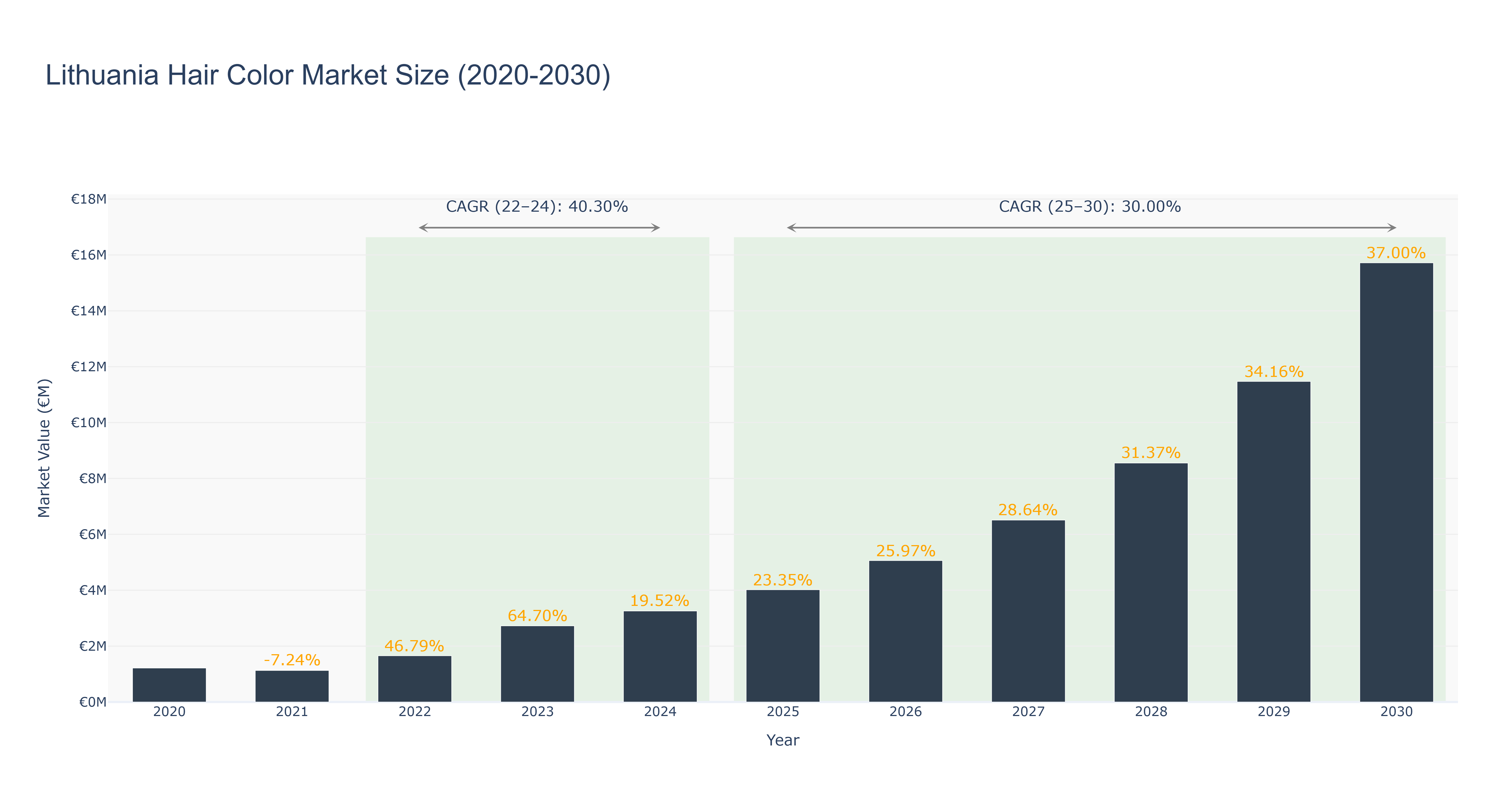
Lithuania Hair Color Market has shown a remarkable growth trajectory over the years. The peak market size of €15.72 million is projected for 2030, with a steady increase from €1.21 million in 2020. The market experienced significant growth from 2022 to 2024, with a CAGR of 40.30%, followed by a slightly lower CAGR of 30.0% from 2025 to 2030. The market's expansion can be attributed to increasing consumer demand for hair color products, driven by evolving fashion trends and growing beauty consciousness among the population. Looking ahead, Lithuania's Hair Color Market is set to witness continued growth, with upcoming initiatives focusing on sustainable and natural hair color solutions to meet consumer preferences for eco-friendly products in the beauty industry.
Lithuania Hair Color Market: Production & Trade Performance (2019-2025)
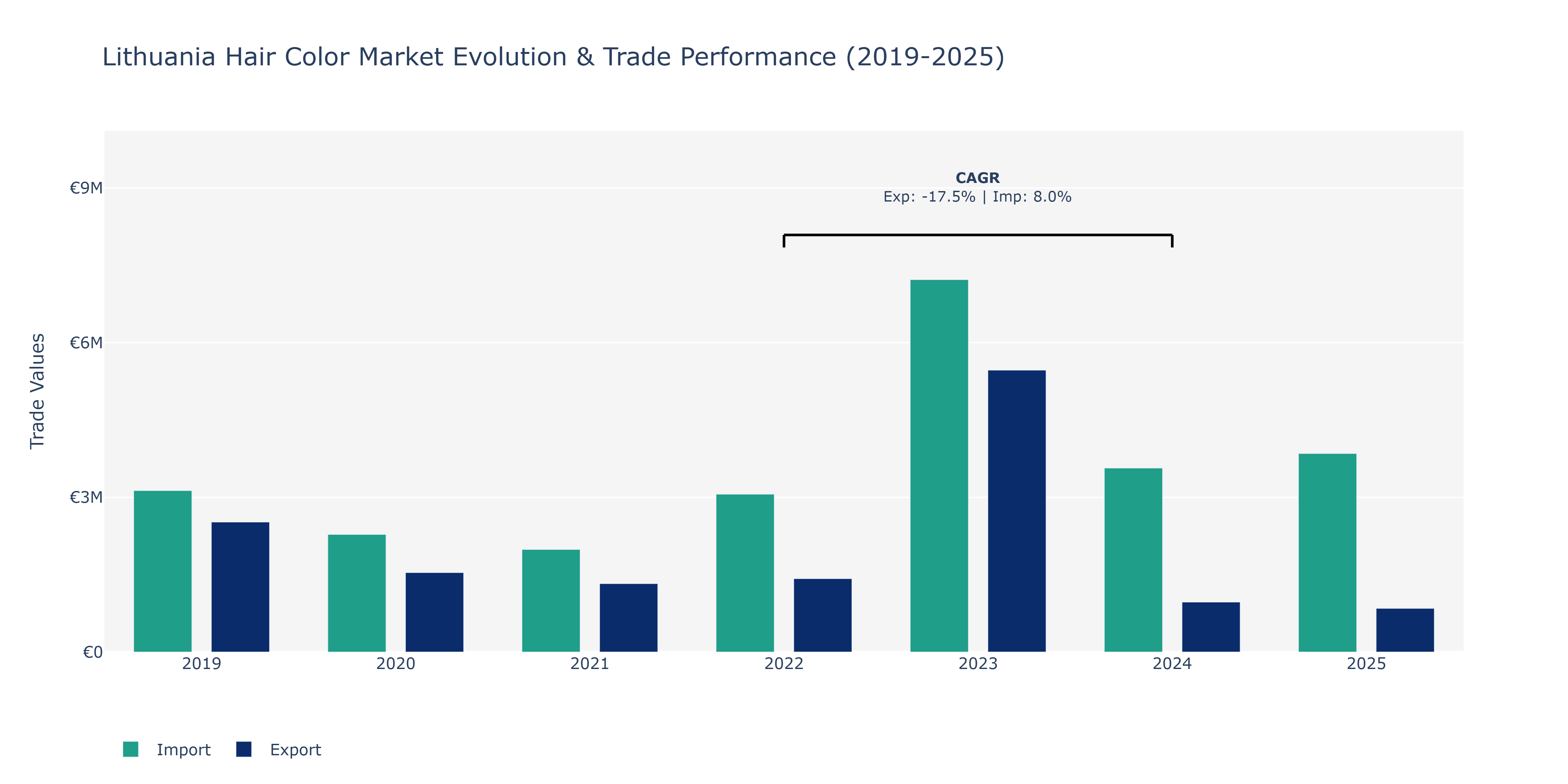
Between 2019 and 2025, Lithuania's Hair Color Market witnessed fluctuations in both exports and imports. In 2019, exports stood at €2.52 million and imports at €3.13 million, with a gradual decline observed in subsequent years. The year 2020 saw a notable decrease in both exports, which dropped to €1.54 million, and imports, which declined to €2.28 million. However, there was a slight recovery in 2021 before experiencing a significant surge in 2023, with exports skyrocketing to €5.47 million and imports to €7.22 million. The market saw a substantial drop in 2024, with exports amounting to €969.51 thousand and imports reaching €3.57 million. By 2025, exports decreased further to around €847.39 thousand, while imports remained relatively stable at approximately €3.85 million. These fluctuations can be attributed to various factors such as changes in consumer preferences, economic conditions, and international trade dynamics affecting the hair color industry in Lithuania. The market's resilience in the face of economic challenges, coupled with evolving consumer trends towards self-care and cosmetic products, has likely influenced these shifts in exports and imports.
Key Highlights of the Report:
- Lithuania Hair color Market Outlook
- Market Size of Lithuania Hair color Market, 2025
- Forecast of Lithuania Hair color Market, 2032
- Historical Data and Forecast of Lithuania Hair color Revenues & Volume for the Period 2022 - 2032F
- Lithuania Hair color Market Trend Evolution
- Lithuania Hair color Market Drivers and Challenges
- Lithuania Hair color Price Trends
- Lithuania Hair color Porter`s Five Forces
- Lithuania Hair color Industry Life Cycle
- Historical Data and Forecast of Lithuania Hair color Market Revenues & Volume By Productfor the Period 2022 - 2032F
- Historical Data and Forecast of Lithuania Hair color Market Revenues & Volume By Permanent Hair Color for the Period 2022 - 2032F
- Historical Data and Forecast of Lithuania Hair color Market Revenues & Volume By Semi-permanent Hair Color for the Period 2022 - 2032F
- Historical Data and Forecast of Lithuania Hair color Market Revenues & Volume By Demi-permanent Hair Color for the Period 2022 - 2032F
- Historical Data and Forecast of Lithuania Hair color Market Revenues & Volume By Bleach-highlights for the Period 2022 - 2032F
- Historical Data and Forecast of Lithuania Hair color Market Revenues & Volume By Temporary Hair Color for the Period 2022 - 2032F
- Historical Data and Forecast of Lithuania Hair color Market Revenues & Volume By Nature for the Period 2022 - 2032F
- Historical Data and Forecast of Lithuania Hair color Market Revenues & Volume By Natural Hair Color for the Period 2022 - 2032F
- Historical Data and Forecast of Lithuania Hair color Market Revenues & Volume By Chemical Hair Color for the Period 2022 - 2032F
- Historical Data and Forecast of Lithuania Hair color Market Revenues & Volume By Gender for the Period 2022 - 2032F
- Historical Data and Forecast of Lithuania Hair color Market Revenues & Volume By Hair Color for Males for the Period 2022 - 2032F
- Historical Data and Forecast of Lithuania Hair color Market Revenues & Volume By Hair Color for Females for the Period 2022 - 2032F
- Historical Data and Forecast of Lithuania Hair color Market Revenues & Volume By Unisex Hair Color for the Period 2022 - 2032F
- Historical Data and Forecast of Lithuania Hair color Market Revenues & Volume By Distribution Channel for the Period 2022 - 2032F
- Historical Data and Forecast of Lithuania Hair color Market Revenues & Volume By Online Sales of Hair Color for the Period 2022 - 2032F
- Historical Data and Forecast of Lithuania Hair color Market Revenues & Volume By Hair Color Sold at Specialty Stores for the Period 2022 - 2032F
- Historical Data and Forecast of Lithuania Hair color Market Revenues & Volume By Hair Color Sold at Departmental Stores for the Period 2022 - 2032F
- Historical Data and Forecast of Lithuania Hair color Market Revenues & Volume By Hair Color Sold at Hypermarkets, Supermarkets, and Convenience Stores for the Period 2022 - 2032F
- Historical Data and Forecast of Lithuania Hair color Market Revenues & Volume By Hair Color Sold at Salons for the Period 2022 - 2032F
- Historical Data and Forecast of Lithuania Hair color Market Revenues & Volume By Others for the Period 2022 - 2032F
- Lithuania Hair color Import Export Trade Statistics
- Market Opportunity Assessment By Product
- Market Opportunity Assessment By Nature
- Market Opportunity Assessment By Gender
- Market Opportunity Assessment By Distribution Channel
- Lithuania Hair color Top Companies Market Share
- Lithuania Hair color Competitive Benchmarking By Technical and Operational Parameters
- Lithuania Hair color Company Profiles
- Lithuania Hair color Key Strategic Recommendations






































