Lithuania Hams Market Size (2020-2030)
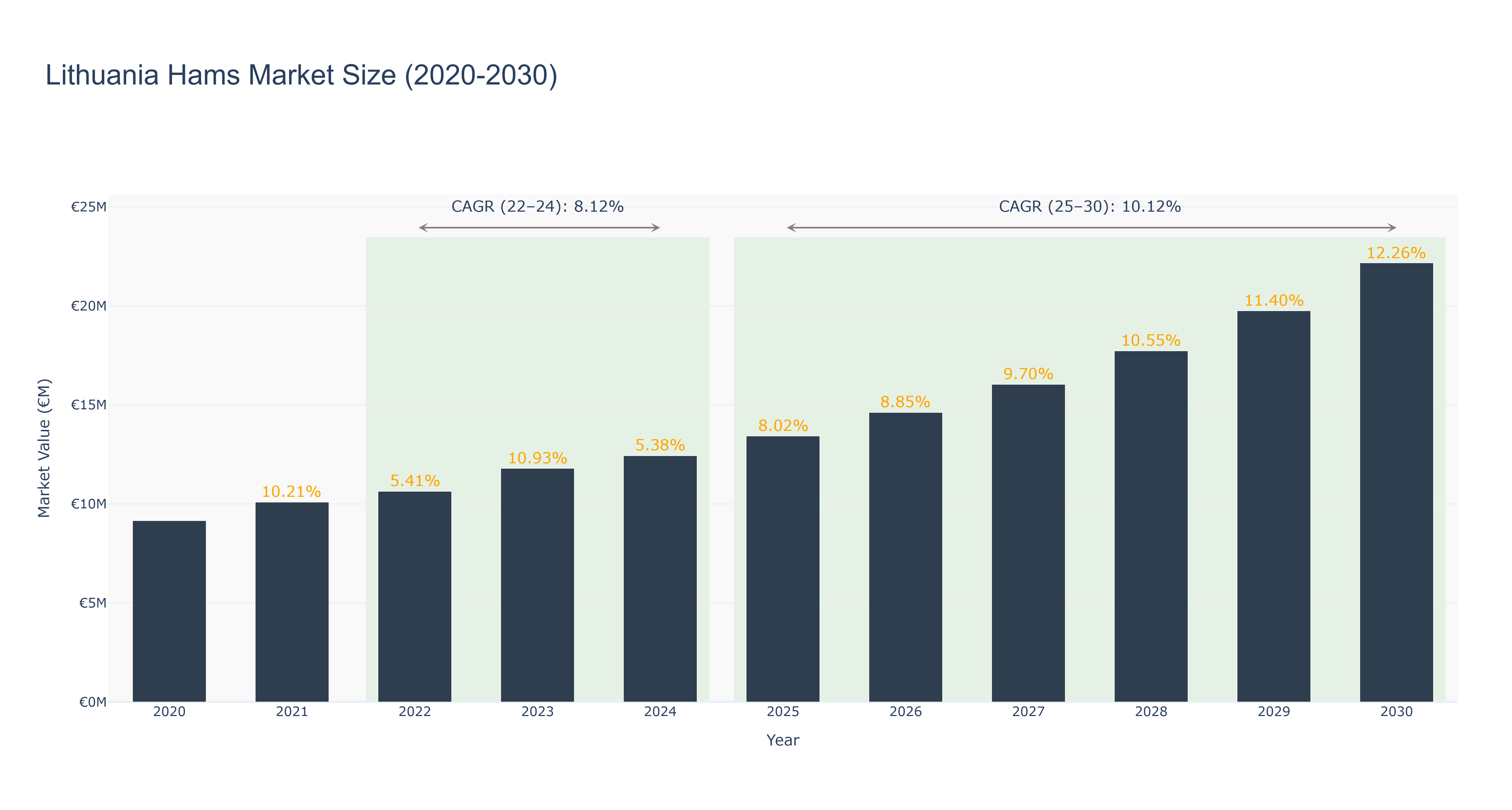
The Lithuania Hams Market has shown a steady growth trajectory over the years. The peak market size of €22.17 million is forecasted for 2030, with consistent growth rates. From 2020 to 2024, the market size increased from €9.16 million to €12.43 million, driven by increasing consumer demand and product innovation. Notable CAGR values include 8.12% for the period 2022-24 and 10.12% for 2025-30, indicating sustained growth potential. The market's growth can be attributed to factors such as changing consumer preferences towards premium food products and the rise in disposable income levels. Looking ahead, Lithuania's Hams Market is poised for further expansion with upcoming investments in modernizing production facilities and expanding distribution networks to cater to a wider audience. These developments are expected to enhance product quality and market reach, solidifying the market's position in the region.
Lithuania Hams Market: Production & Trade Performance (2019-2025)
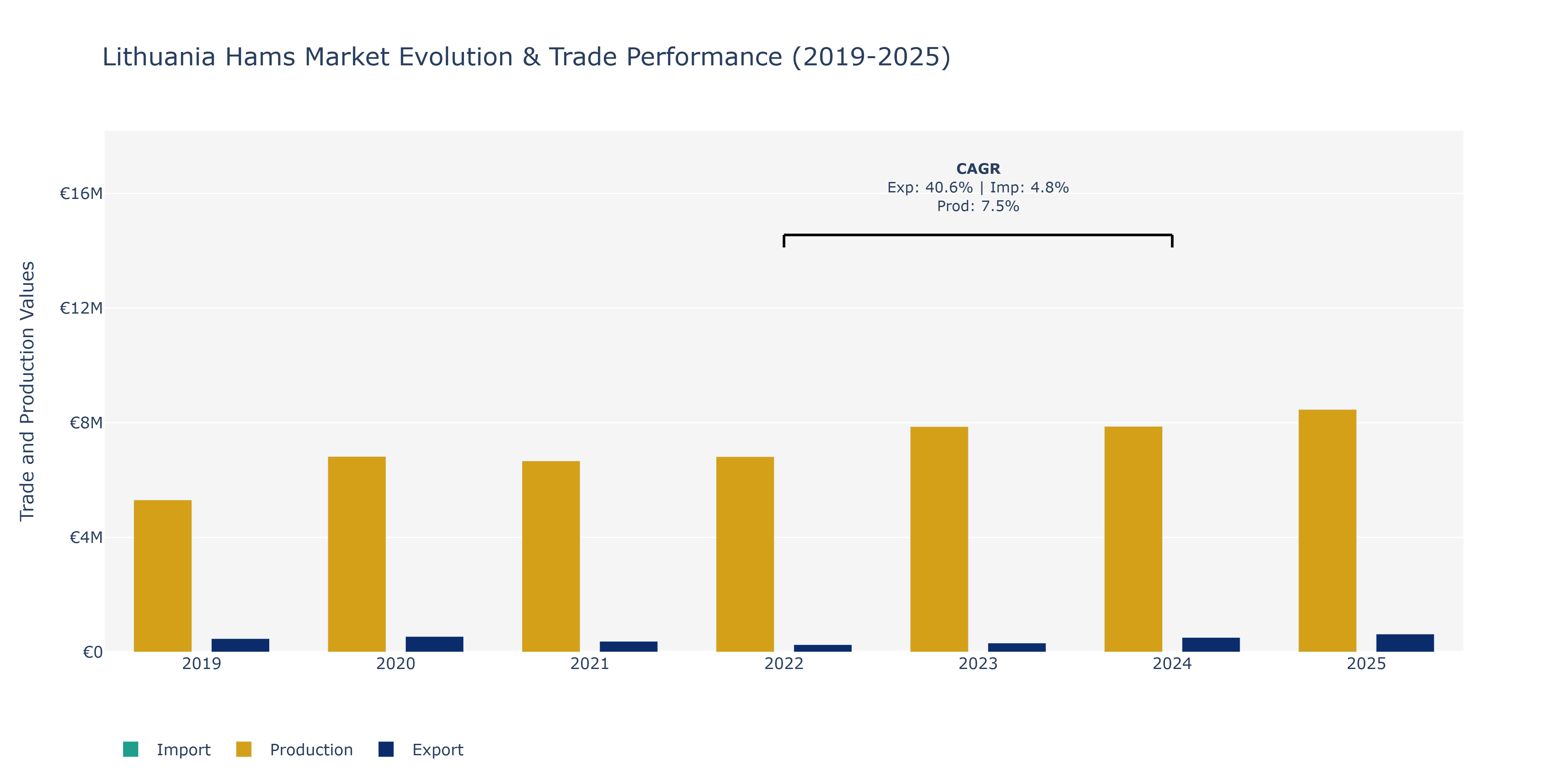
Between 2019 and 2025, Lithuania's Hams market saw fluctuations in Exports, Imports, and Production. Starting in 2019, Exports were at €469.62 thousand, experiencing a notable increase to €629.20 thousand by 2025, showcasing a steady upward trend over the years. Imports, on the other hand, began at €2.77 million in 2019, with a slight dip in 2022 before rising to €4.53 million in 2025. In contrast, Production value started at €5.31 million in 2019, reaching a peak of €8.46 million by 2025, showing consistent growth. The surge in Exports can be attributed to increasing demand for Lithuanian hams in international markets due to their quality and unique flavors. Rising Imports may be linked to technology upgrades and expanded distribution networks, allowing for more imports to meet domestic demand. The growing Production reflects investments in modernizing production facilities and processes, enhancing efficiency and output in the sector.
Key Highlights of the Report:
- Lithuania Hams Market Outlook
- Market Size of Lithuania Hams Market, 2025
- Forecast of Lithuania Hams Market, 2032
- Historical Data and Forecast of Lithuania Hams Revenues & Volume for the Period 2022 - 2032F
- Lithuania Hams Market Trend Evolution
- Lithuania Hams Market Drivers and Challenges
- Lithuania Hams Price Trends
- Lithuania Hams Porter`s Five Forces
- Lithuania Hams Industry Life Cycle
- Historical Data and Forecast of Lithuania Hams Market Revenues & Volume By Type for the Period 2022 - 2032F
- Historical Data and Forecast of Lithuania Hams Market Revenues & Volume By Air Dried Cured Hams for the Period 2022 - 2032F
- Historical Data and Forecast of Lithuania Hams Market Revenues & Volume By Smoked Hams for the Period 2022 - 2032F
- Historical Data and Forecast of Lithuania Hams Market Revenues & Volume By Applications for the Period 2022 - 2032F
- Historical Data and Forecast of Lithuania Hams Market Revenues & Volume By Supermarkets and Hypermarkets for the Period 2022 - 2032F
- Historical Data and Forecast of Lithuania Hams Market Revenues & Volume By Independent Retailers for the Period 2022 - 2032F
- Historical Data and Forecast of Lithuania Hams Market Revenues & Volume By Convenience Stores for the Period 2022 - 2032F
- Historical Data and Forecast of Lithuania Hams Market Revenues & Volume By Specialist Retailers for the Period 2022 - 2032F
- Historical Data and Forecast of Lithuania Hams Market Revenues & Volume By Online Retailers for the Period 2022 - 2032F
- Lithuania Hams Import Export Trade Statistics
- Market Opportunity Assessment By Type
- Market Opportunity Assessment By Applications
- Lithuania Hams Top Companies Market Share
- Lithuania Hams Competitive Benchmarking By Technical and Operational Parameters
- Lithuania Hams Company Profiles
- Lithuania Hams Key Strategic Recommendations






































