Lithuania Home Appliances Market Top 5 Importing Countries and Market Competition (HHI) Analysis
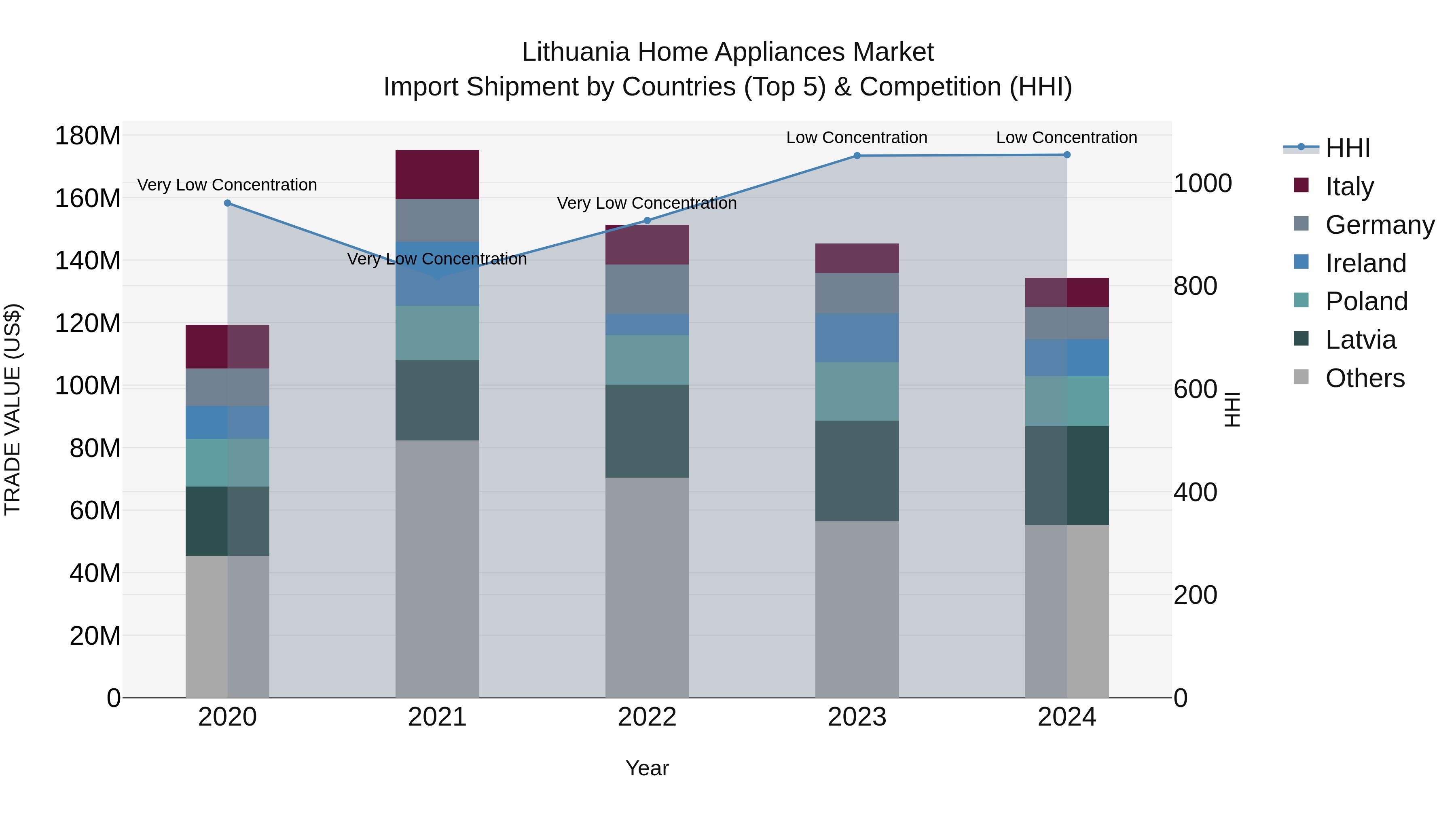
In 2024, Lithuania`s home appliances import market saw diverse sources, with Latvia, Poland, Ireland, China, and Germany leading the pack. Despite the varied sources, the market maintained low concentration, indicating a competitive landscape. The compound annual growth rate (CAGR) from 2020 to 2024 stood at a steady 3.02%, showcasing consistent growth. However, a slight downturn was observed in the growth rate from 2023 to 2024 at -7.57%, possibly influenced by external factors. Overall, the market presents opportunities for both domestic retailers and international suppliers to capitalize on this growing sector.
Key Highlights of the Report:
- Lithuania Home Appliances Market Outlook
- Market Size of Lithuania Home Appliances Market, 2025
- Forecast of Lithuania Home Appliances Market, 2032
- Historical Data and Forecast of Lithuania Home Appliances Revenues & Volume for the Period 2022 - 2032F
- Lithuania Home Appliances Market Trend Evolution
- Lithuania Home Appliances Market Drivers and Challenges
- Lithuania Home Appliances Price Trends
- Lithuania Home Appliances Porter`s Five Forces
- Lithuania Home Appliances Industry Life Cycle
- Historical Data and Forecast of Lithuania Home Appliances Market Revenues & Volume By Product Types for the Period 2022 - 2032F
- Historical Data and Forecast of Lithuania Home Appliances Market Revenues & Volume By Kitchen Appliances for the Period 2022 - 2032F
- Historical Data and Forecast of Lithuania Home Appliances Market Revenues & Volume By Washing Appliances for the Period 2022 - 2032F
- Historical Data and Forecast of Lithuania Home Appliances Market Revenues & Volume By Entertainment Appliances for the Period 2022 - 2032F
- Historical Data and Forecast of Lithuania Home Appliances Market Revenues & Volume By Air Conditioner for the Period 2022 - 2032F
- Historical Data and Forecast of Lithuania Home Appliances Market Revenues & Volume By Others for the Period 2022 - 2032F
- Historical Data and Forecast of Lithuania Home Appliances Market Revenues & Volume By Technology for the Period 2022 - 2032F
- Historical Data and Forecast of Lithuania Home Appliances Market Revenues & Volume By Wi-Fi for the Period 2022 - 2032F
- Historical Data and Forecast of Lithuania Home Appliances Market Revenues & Volume By Bluetooth for the Period 2022 - 2032F
- Historical Data and Forecast of Lithuania Home Appliances Market Revenues & Volume By ZigBee for the Period 2022 - 2032F
- Historical Data and Forecast of Lithuania Home Appliances Market Revenues & Volume By Radio Frequency Identification for the Period 2022 - 2032F
- Historical Data and Forecast of Lithuania Home Appliances Market Revenues & Volume By Cellular Technology for the Period 2022 - 2032F
- Historical Data and Forecast of Lithuania Home Appliances Market Revenues & Volume By IoT for the Period 2022 - 2032F
- Historical Data and Forecast of Lithuania Home Appliances Market Revenues & Volume By Distribution Channel for the Period 2022 - 2032F
- Historical Data and Forecast of Lithuania Home Appliances Market Revenues & Volume By Retail for the Period 2022 - 2032F
- Historical Data and Forecast of Lithuania Home Appliances Market Revenues & Volume By E-commerce for the Period 2022 - 2032F
- Historical Data and Forecast of Lithuania Home Appliances Market Revenues & Volume By Others for the Period 2022 - 2032F
- Lithuania Home Appliances Import Export Trade Statistics
- Market Opportunity Assessment By Product Types
- Market Opportunity Assessment By Technology
- Market Opportunity Assessment By Distribution Channel
- Lithuania Home Appliances Top Companies Market Share
- Lithuania Home Appliances Competitive Benchmarking By Technical and Operational Parameters
- Lithuania Home Appliances Company Profiles
- Lithuania Home Appliances Key Strategic Recommendations






































