Lithuania Induction Motor Market Size (2020-2030)
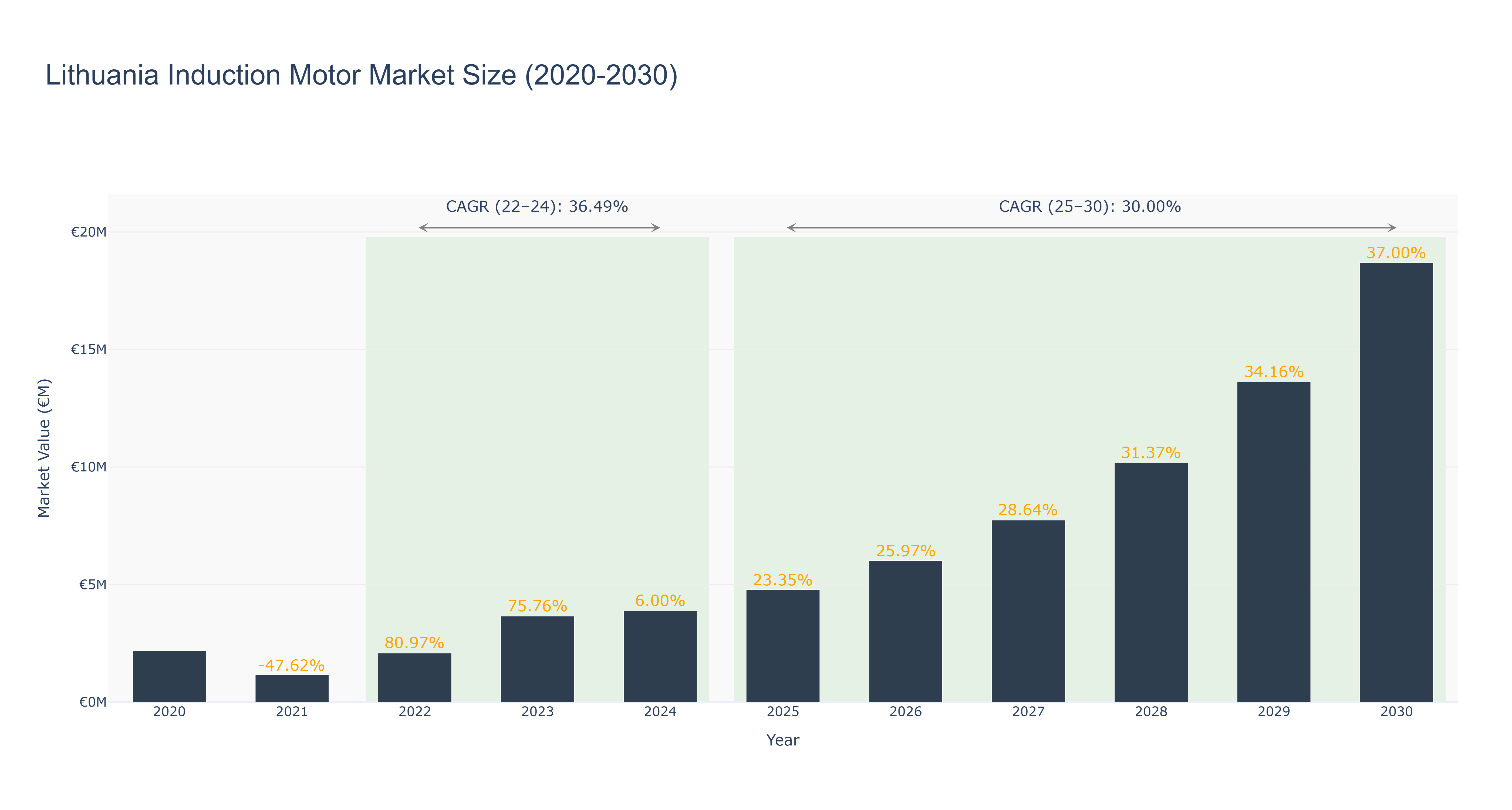
The Lithuania Induction Motor Market has demonstrated significant volatility in recent years, peaking at €3.65 million in 2023, following a robust recovery from a low of €1.15 million in 2021. The actual market growth from 2022 to 2024 is anticipated to be strong, with a compound annual growth rate (CAGR) of 36.49%, driven by increasing industrial automation and the demand for energy-efficient solutions. Looking ahead, the forecasted period from 2025 to 2030 projects continued expansion, with a CAGR of 30.00%, culminating in a market size of €18.69 million by 2030. This growth is likely to be fueled by advancements in technology and the adoption of sustainable practices across various sectors. As Lithuania continues to invest in infrastructure and renewable energy projects, the induction motor market is poised for further development, reflecting broader economic trends and the shift towards greener technologies.
Lithuania Induction Motor Market: Production & Trade Performance (2019-2025)
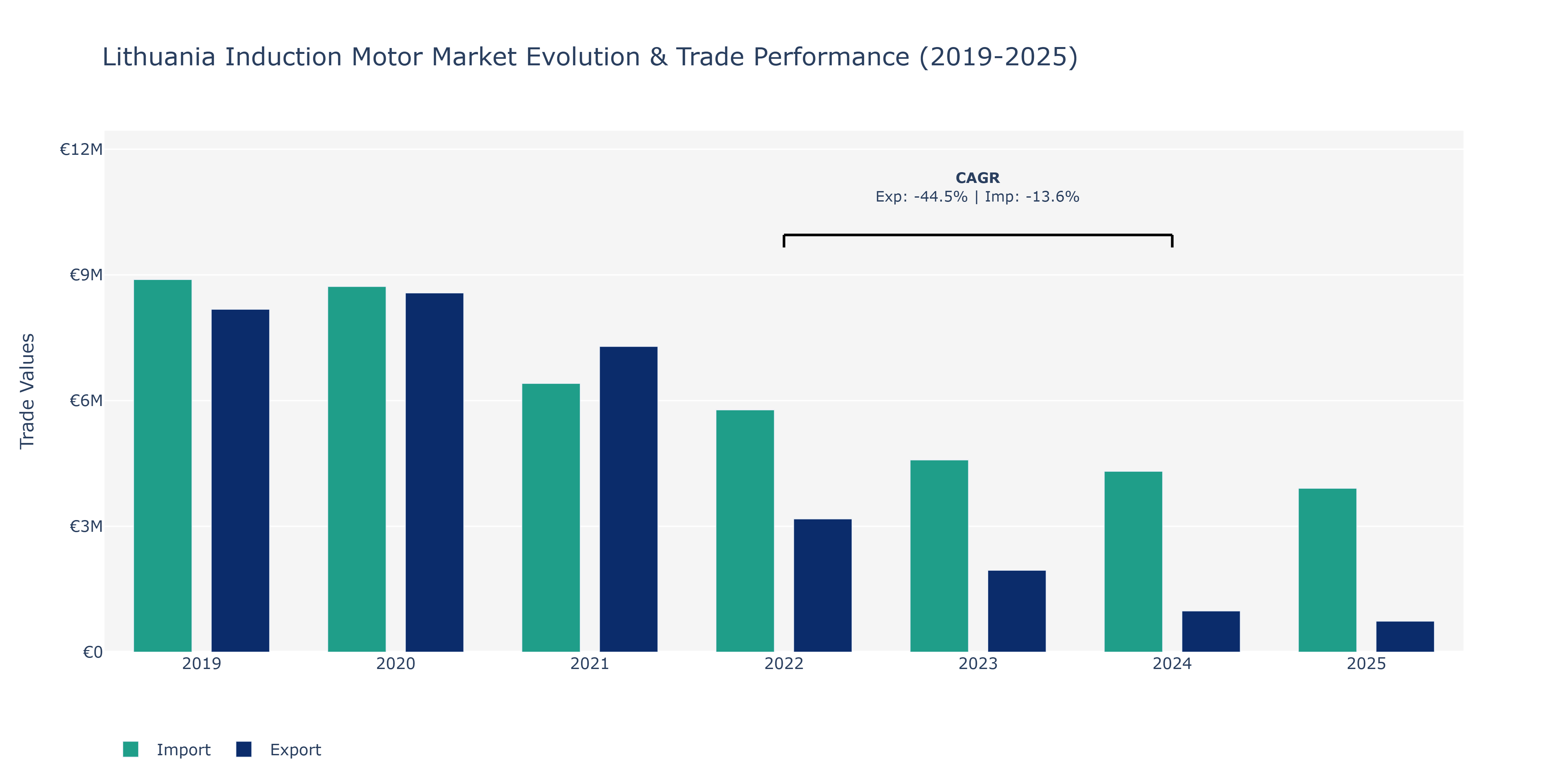
Between 2019 and 2025, Lithuania's Induction Motor Market experienced varying trends in both Exports and Imports. Exports started at €8.18 million in 2019, peaking at €8.57 million in 2020, before progressively declining to €0.74 million in 2025. This decline can be attributed to a shift in global demand patterns, technological advancements reducing the need for traditional induction motors, and potentially increased competition from other markets. On the other hand, Imports began at €8.89 million in 2019, dropped slightly in 2020 to €8.72 million, and then fluctuated until 2025 when they reached €3.91 million. The fluctuation in Imports may be linked to changes in domestic manufacturing capacities, trade agreements impacting the cost of imports, and efforts to promote local production for cost efficiencies and supply chain resilience. These shifts highlight the importance of market flexibility and adaptation to changing industry landscapes.
Key Highlights of the Report:
- Lithuania Induction Motor Market Outlook
- Market Size of Lithuania Induction Motor Market, 2025
- Forecast of Lithuania Induction Motor Market, 2032
- Historical Data and Forecast of Lithuania Induction Motor Revenues & Volume for the Period 2022 - 2032F
- Lithuania Induction Motor Market Trend Evolution
- Lithuania Induction Motor Market Drivers and Challenges
- Lithuania Induction Motor Price Trends
- Lithuania Induction Motor Porter`s Five Forces
- Lithuania Induction Motor Industry Life Cycle
- Historical Data and Forecast of Lithuania Induction Motor Market Revenues & Volume By Type for the Period 2022 - 2032F
- Historical Data and Forecast of Lithuania Induction Motor Market Revenues & Volume By Single Phase for the Period 2022 - 2032F
- Historical Data and Forecast of Lithuania Induction Motor Market Revenues & Volume By Three Phase for the Period 2022 - 2032F
- Historical Data and Forecast of Lithuania Induction Motor Market Revenues & Volume By Application for the Period 2022 - 2032F
- Historical Data and Forecast of Lithuania Induction Motor Market Revenues & Volume By Residential for the Period 2022 - 2032F
- Historical Data and Forecast of Lithuania Induction Motor Market Revenues & Volume By Industrial for the Period 2022 - 2032F
- Historical Data and Forecast of Lithuania Induction Motor Market Revenues & Volume By Commercial for the Period 2022 - 2032F
- Historical Data and Forecast of Lithuania Induction Motor Market Revenues & Volume By Transportation for the Period 2022 - 2032F
- Historical Data and Forecast of Lithuania Induction Motor Market Revenues & Volume By Others for the Period 2022 - 2032F
- Lithuania Induction Motor Import Export Trade Statistics
- Market Opportunity Assessment By Type
- Market Opportunity Assessment By Application
- Lithuania Induction Motor Top Companies Market Share
- Lithuania Induction Motor Competitive Benchmarking By Technical and Operational Parameters
- Lithuania Induction Motor Company Profiles
- Lithuania Induction Motor Key Strategic Recommendations






































