Lithuania Insulated Glass Market Top 5 Importing Countries and Market Competition (HHI) Analysis
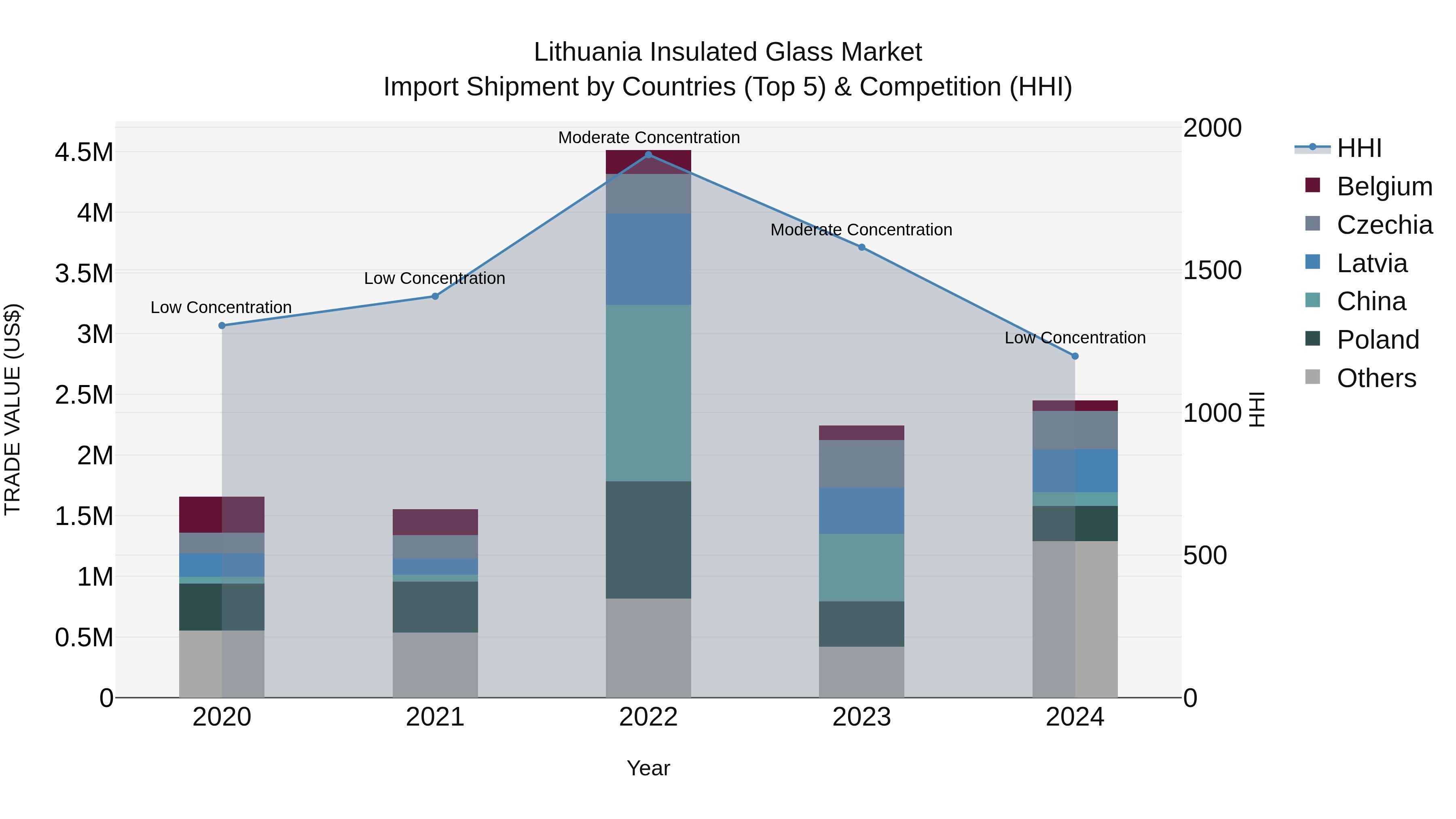
Lithuania`s insulated glass import market continues to show steady growth, with a notable increase in shipments from various European countries such as Latvia, Czechia, and Poland. The market concentration, as measured by the HHI index, has decreased from moderate to low in 2024, indicating a more diverse import landscape. The impressive compound annual growth rate (CAGR) of 10.28% from 2020 to 2024 reflects a robust demand for insulated glass in Lithuania. Moreover, the growth rate of 9.18% in 2024 highlights the ongoing expansion of the market and the attractiveness of importing insulated glass products to meet the country`s needs.
Key Highlights of the Report:
- Lithuania Insulated Glass Market Outlook
- Market Size of Lithuania Insulated Glass Market, 2025
- Forecast of Lithuania Insulated Glass Market, 2032
- Historical Data and Forecast of Lithuania Insulated Glass Revenues & Volume for the Period 2022 - 2032F
- Lithuania Insulated Glass Market Trend Evolution
- Lithuania Insulated Glass Market Drivers and Challenges
- Lithuania Insulated Glass Price Trends
- Lithuania Insulated Glass Porter`s Five Forces
- Lithuania Insulated Glass Industry Life Cycle
- Historical Data and Forecast of Lithuania Insulated Glass Market Revenues & Volume By Type for the Period 2022 - 2032F
- Historical Data and Forecast of Lithuania Insulated Glass Market Revenues & Volume By Heated Insulating Glass for the Period 2022 - 2032F
- Historical Data and Forecast of Lithuania Insulated Glass Market Revenues & Volume By Tempering Insulating Glass for the Period 2022 - 2032F
- Historical Data and Forecast of Lithuania Insulated Glass Market Revenues & Volume By Custom Insulated Glass for the Period 2022 - 2032F
- Historical Data and Forecast of Lithuania Insulated Glass Market Revenues & Volume By Other Glasses for the Period 2022 - 2032F
- Historical Data and Forecast of Lithuania Insulated Glass Market Revenues & Volume By Application for the Period 2022 - 2032F
- Historical Data and Forecast of Lithuania Insulated Glass Market Revenues & Volume By Doors & Partitions for the Period 2022 - 2032F
- Historical Data and Forecast of Lithuania Insulated Glass Market Revenues & Volume By Kitchen Appliances & Cabinets for the Period 2022 - 2032F
- Historical Data and Forecast of Lithuania Insulated Glass Market Revenues & Volume By Floors & Ceilings for the Period 2022 - 2032F
- Historical Data and Forecast of Lithuania Insulated Glass Market Revenues & Volume By Furniture & Curtain Walls for the Period 2022 - 2032F
- Historical Data and Forecast of Lithuania Insulated Glass Market Revenues & Volume By Railings & Bolted Structures for the Period 2022 - 2032F
- Historical Data and Forecast of Lithuania Insulated Glass Market Revenues & Volume By Automotive Glasses for the Period 2022 - 2032F
- Historical Data and Forecast of Lithuania Insulated Glass Market Revenues & Volume By End User for the Period 2022 - 2032F
- Historical Data and Forecast of Lithuania Insulated Glass Market Revenues & Volume By Residential Buildings for the Period 2022 - 2032F
- Historical Data and Forecast of Lithuania Insulated Glass Market Revenues & Volume By Commercial & Institutional Buildings for the Period 2022 - 2032F
- Historical Data and Forecast of Lithuania Insulated Glass Market Revenues & Volume By Industrial Users for the Period 2022 - 2032F
- Lithuania Insulated Glass Import Export Trade Statistics
- Market Opportunity Assessment By Type
- Market Opportunity Assessment By Application
- Market Opportunity Assessment By End User
- Lithuania Insulated Glass Top Companies Market Share
- Lithuania Insulated Glass Competitive Benchmarking By Technical and Operational Parameters
- Lithuania Insulated Glass Company Profiles
- Lithuania Insulated Glass Key Strategic Recommendations






































