Lithuania Lead Alloy Market Size (2020-2030)
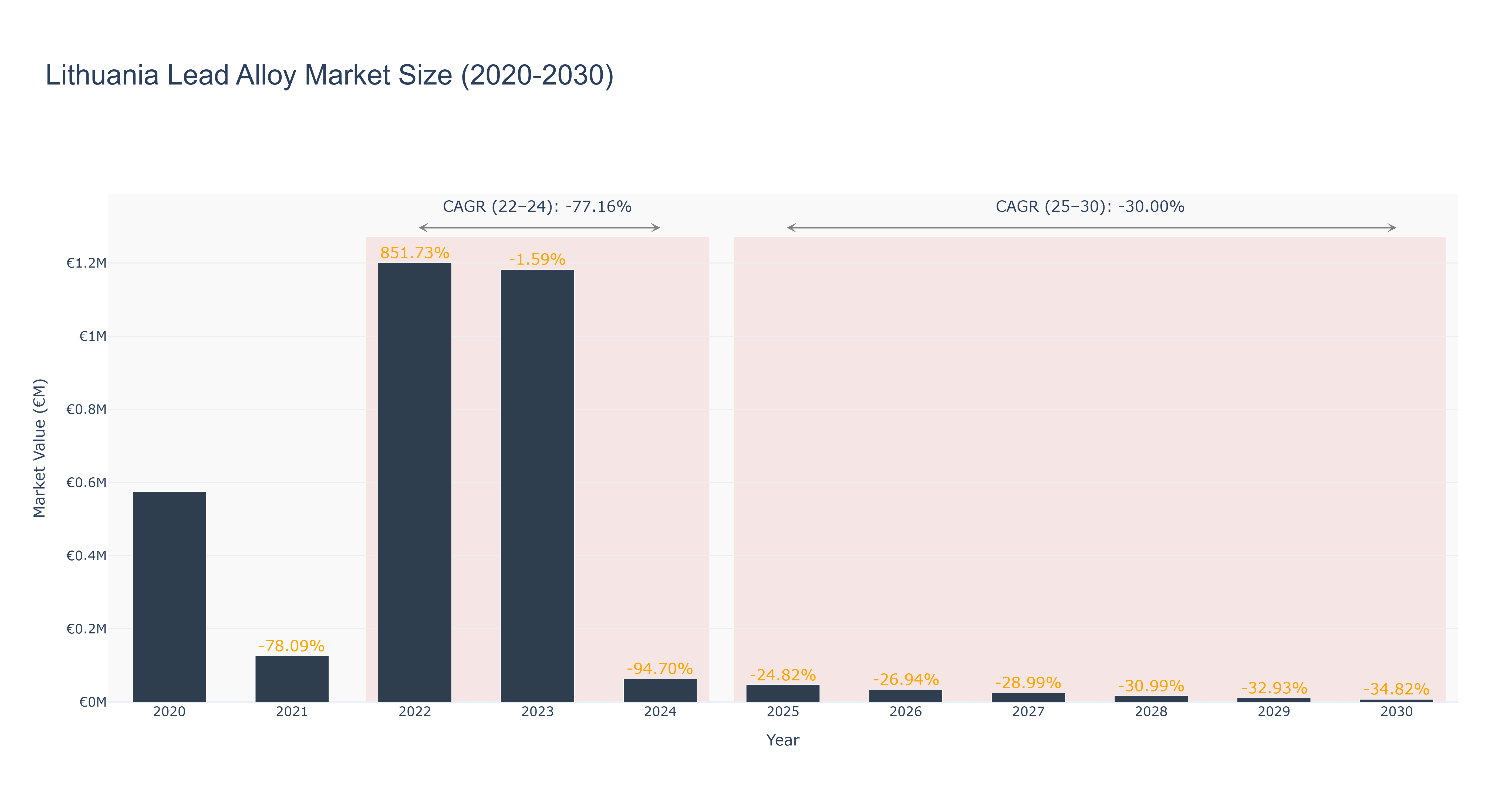
The Lithuania Lead Alloy Market experienced a peak market size of €1.20 million in 2022, followed by a significant decline to €0.06 million in 2024. The market is forecasted to continue shrinking, with a projected size of €0.01 million by 2030. The CAGR for the period 2022-24 was -77.16%, reflecting the sharp downturn during those years. Subsequently, the CAGR for 2025-30 is expected to be -30.0%, indicating a more moderate decline. The market's contraction can be attributed to factors such as evolving environmental regulations and shifting consumer preferences towards alternative materials. Looking ahead, Lithuania is expected to focus on sustainable lead management practices and explore opportunities in recycling technologies to mitigate the market's decline. Industry drivers for the Lithuania Lead Alloy Market include stringent environmental policies, technological advancements in lead recycling, and growing awareness about the environmental impact of lead usage. In the near future, Lithuania is set to implement initiatives promoting lead recycling and invest in research and development for sustainable lead production methods.
Lithuania Lead Alloy Market: Production & Trade Performance (2019-2025)
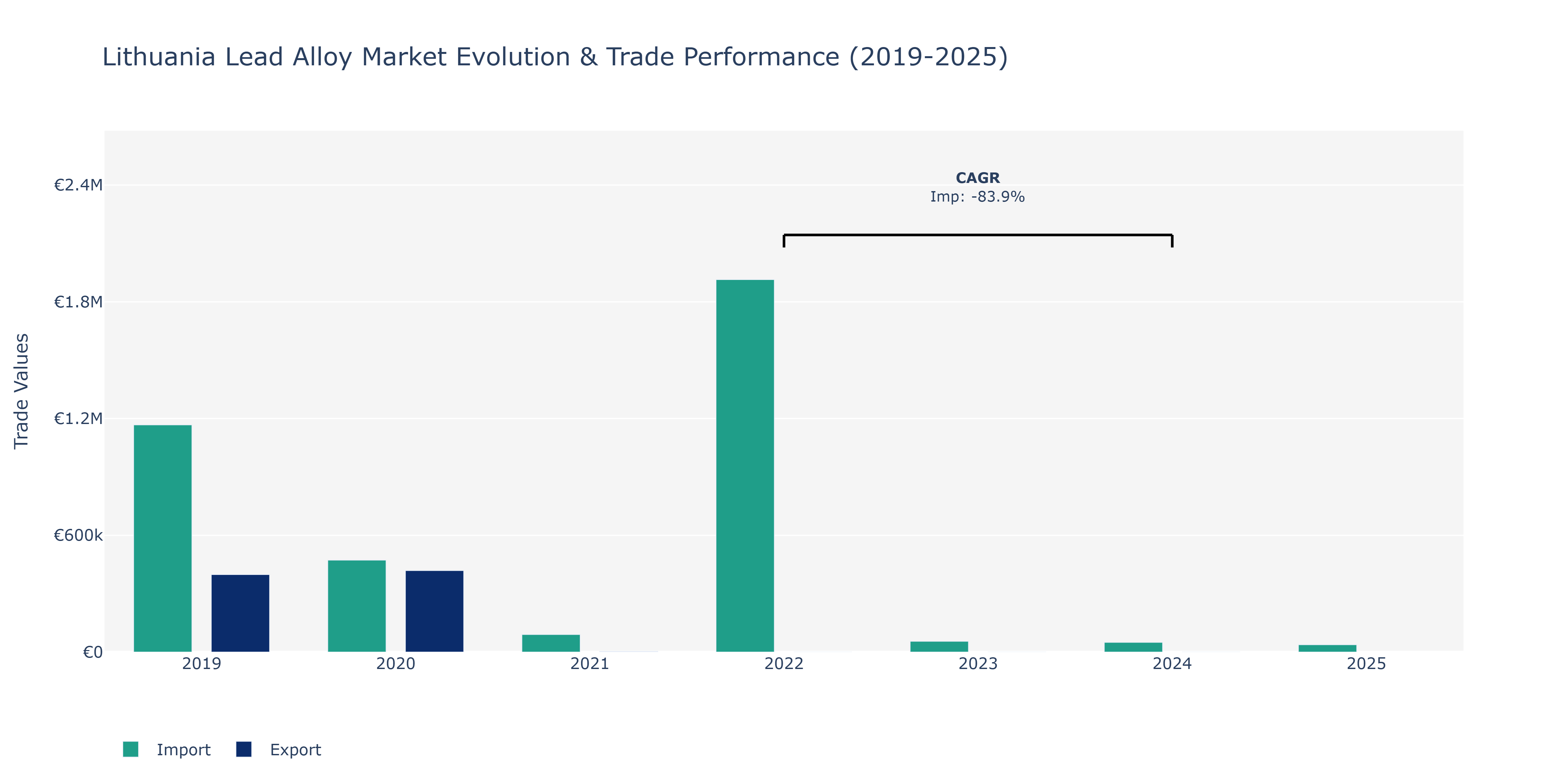
In the Lithuania Lead Alloy Market, exports and imports experienced notable fluctuations over the years. In 2019, exports stood at €397.7 thousand, showing a slight increase to €418.46 thousand in 2020 before plummeting to €3.59 thousand in 2021. On the other hand, imports were €1.17 million in 2019, dropped to €472.29 thousand in 2020, then surged to €1.91 million in 2022, witnessing a sharp decline to €49.58 thousand in 2024. The import volume continued to decrease to €37.27 thousand in 2025. The significant decline in imports in 2024 could be attributed to various factors such as changes in trade policies, global market conditions, or shifts in domestic production capabilities. This decline might have prompted market players to reassess their sourcing strategies and adapt to the changing landscape, possibly leading to the observed decrease in imports.
Key Highlights of the Report:
- Lithuania Lead Alloy Market Outlook
- Market Size of Lithuania Lead Alloy Market, 2024
- Forecast of Lithuania Lead Alloy Market, 2031
- Historical Data and Forecast of Lithuania Lead Alloy Revenues & Volume for the Period 2021-2031
- Lithuania Lead Alloy Market Trend Evolution
- Lithuania Lead Alloy Market Drivers and Challenges
- Lithuania Lead Alloy Price Trends
- Lithuania Lead Alloy Porter`s Five Forces
- Lithuania Lead Alloy Industry Life Cycle
- Historical Data and Forecast of Lithuania Lead Alloy Market Revenues & Volume By Type for the Period 2021-2031
- Historical Data and Forecast of Lithuania Lead Alloy Market Revenues & Volume By Lead Antimony Alloys for the Period 2021-2031
- Historical Data and Forecast of Lithuania Lead Alloy Market Revenues & Volume By Lead Tin Alloys for the Period 2021-2031
- Historical Data and Forecast of Lithuania Lead Alloy Market Revenues & Volume By Lead Arsenic Alloys for the Period 2021-2031
- Historical Data and Forecast of Lithuania Lead Alloy Market Revenues & Volume By Lead Calcium Alloys for the Period 2021-2031
- Historical Data and Forecast of Lithuania Lead Alloy Market Revenues & Volume By Others for the Period 2021-2031
- Historical Data and Forecast of Lithuania Lead Alloy Market Revenues & Volume By Application for the Period 2021-2031
- Historical Data and Forecast of Lithuania Lead Alloy Market Revenues & Volume By Battery Grids for the Period 2021-2031
- Historical Data and Forecast of Lithuania Lead Alloy Market Revenues & Volume By Metals for the Period 2021-2031
- Historical Data and Forecast of Lithuania Lead Alloy Market Revenues & Volume By Cable Sheathing for the Period 2021-2031
- Historical Data and Forecast of Lithuania Lead Alloy Market Revenues & Volume By Lead Sheet for the Period 2021-2031
- Historical Data and Forecast of Lithuania Lead Alloy Market Revenues & Volume By Seamless Pipe for the Period 2021-2031
- Historical Data and Forecast of Lithuania Lead Alloy Market Revenues & Volume By Others for the Period 2021-2031
- Lithuania Lead Alloy Import Export Trade Statistics
- Market Opportunity Assessment By Type
- Market Opportunity Assessment By Application
- Lithuania Lead Alloy Top Companies Market Share
- Lithuania Lead Alloy Competitive Benchmarking By Technical and Operational Parameters
- Lithuania Lead Alloy Company Profiles
- Lithuania Lead Alloy Key Strategic Recommendations






































