Lithuania Magnetic Separator Market Top 5 Importing Countries and Market Competition (HHI) Analysis
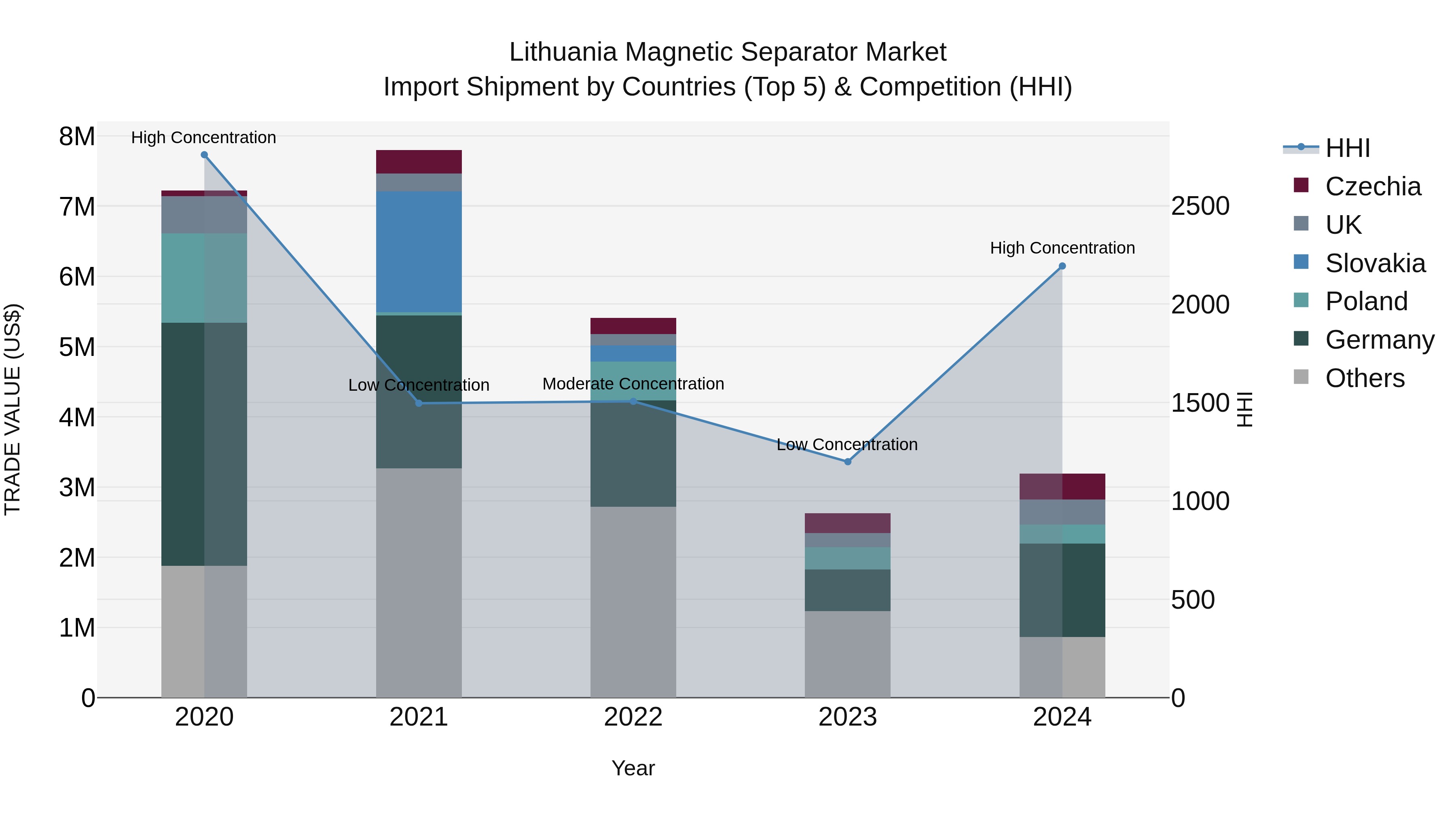
The magnetic separator import market in Lithuania experienced a notable shift in 2024, with top exporters such as Germany, Czechia, UK, Poland, and Denmark dominating the landscape. The Herfindahl-Hirschman Index (HHI) shifted from low to high concentration within a year, indicating a more competitive market. Despite a challenging compound annual growth rate (CAGR) of -18.47% from 2020 to 2024, the market showed a promising growth rate of 21.62% from 2023 to 2024. This suggests a potential turnaround and increased activity in the Lithuanian magnetic separator import market.
Lithuania Magnetic Separator Market Synopsis
The Lithuania Magnetic Separator market is witnessing steady growth driven by various industries such as mining, recycling, and food processing. The key factors contributing to the market growth include increasing demand for efficient separation of ferrous materials, rising emphasis on environmental protection, and stringent regulations regarding waste management. The market is characterized by the presence of both domestic manufacturers and international players offering a wide range of magnetic separators catering to different applications. Technological advancements such as the development of high-intensity magnetic separators and automation in magnetic separation processes are further fueling market expansion. The demand for magnetic separators in Lithuania is expected to continue growing as industries focus on enhancing operational efficiency and reducing production costs through effective material separation solutions.
Lithuania Magnetic Separator Market Trends
The Lithuania Magnetic Separator Market is witnessing a steady growth trajectory driven by the increasing demand from various industries such as mining, recycling, and food processing. The market is experiencing a shift towards technologically advanced magnetic separators that offer higher efficiency and performance. Additionally, the growing emphasis on environmental sustainability and regulations related to waste management are creating opportunities for the adoption of magnetic separators in Lithuania. With the increasing focus on improving operational efficiency and reducing production costs, there is a rising demand for customized magnetic separator solutions tailored to specific industry requirements. Overall, the market is poised for further expansion as industries seek innovative solutions to streamline their processes and enhance productivity.
Lithuania Magnetic Separator Market Challenges
In the Lithuania Magnetic Separator Market, one of the main challenges faced is the limited awareness and understanding of the benefits and applications of magnetic separators among potential end users. This lack of awareness often leads to a reluctance to invest in magnetic separation technology, resulting in slower market adoption rates. Additionally, the presence of competing technologies and alternative methods for material separation further complicates the market landscape. In this context, manufacturers and suppliers need to focus on educating the market about the advantages of magnetic separators in terms of efficiency, cost-effectiveness, and environmental impact to overcome these challenges and drive market growth. Additionally, issues related to regulatory compliance, technological advancements, and pricing pressures are also factors that contribute to the complexity of the market in Lithuania.
Lithuania Magnetic Separator Market Investment Opportunities
The Lithuania Magnetic Separator Market is primarily driven by the increasing demand for efficient and cost-effective separation solutions across various industries such as mining, recycling, food processing, and manufacturing. The growing emphasis on environmental sustainability and regulations pertaining to waste management also boosts the market as magnetic separators help in removing ferrous contaminants from materials, reducing waste and improving product quality. Additionally, advancements in magnetic separator technologies, such as high-intensity magnetic fields and automation, are further driving market growth by enhancing efficiency and performance. The rising focus on improving operational efficiency, reducing downtime, and minimizing maintenance costs is prompting industries in Lithuania to adopt magnetic separators for their material processing needs, fueling market expansion.
Lithuania Magnetic Separator Market Government Polices
Government policies related to the Lithuania Magnetic Separator Market primarily focus on ensuring compliance with environmental regulations and promoting sustainable practices in the industry. The Lithuanian government has implemented strict guidelines for waste management and pollution control, encouraging companies to adopt eco-friendly technologies and processes in their operations. Additionally, there are incentives and subsidies available for businesses that invest in clean energy solutions and resource-efficient practices. Import and export regulations also play a significant role in shaping the market dynamics, with customs duties and tariffs affecting the flow of magnetic separators in and out of the country. Overall, government policies in Lithuania aim to foster a competitive and environmentally conscious market environment for magnetic separator manufacturers and users.
Lithuania Magnetic Separator Market Future Outlook
The Lithuania Magnetic Separator Market is expected to witness steady growth in the coming years due to increasing demand from industries such as mining, recycling, and food processing. The market is likely to be driven by the growing emphasis on environmental sustainability and the need for efficient separation and purification processes. Additionally, advancements in magnetic separator technology, such as the development of high-intensity magnetic separators and automation capabilities, are anticipated to further fuel market growth. The market is also expected to benefit from government initiatives promoting the use of magnetic separators for waste management and resource recovery. Overall, the Lithuania Magnetic Separator Market is poised for expansion, with a focus on innovation and sustainability driving its future outlook.
Key Highlights of the Report:
- Lithuania Magnetic Separator Market Outlook
- Market Size of Lithuania Magnetic Separator Market, 2024
- Forecast of Lithuania Magnetic Separator Market, 2031
- Historical Data and Forecast of Lithuania Magnetic Separator Revenues & Volume for the Period 2021-2031
- Lithuania Magnetic Separator Market Trend Evolution
- Lithuania Magnetic Separator Market Drivers and Challenges
- Lithuania Magnetic Separator Price Trends
- Lithuania Magnetic Separator Porter`s Five Forces
- Lithuania Magnetic Separator Industry Life Cycle
- Historical Data and Forecast of Lithuania Magnetic Separator Market Revenues & Volume By Type for the Period 2021-2031
- Historical Data and Forecast of Lithuania Magnetic Separator Market Revenues & Volume By Drum for the Period 2021-2031
- Historical Data and Forecast of Lithuania Magnetic Separator Market Revenues & Volume By Overb for the Period 2021-2031
- Historical Data and Forecast of Lithuania Magnetic Separator Market Revenues & Volume By Magnet Type for the Period 2021-2031
- Historical Data and Forecast of Lithuania Magnetic Separator Market Revenues & Volume By Permanent Magnets for the Period 2021-2031
- Historical Data and Forecast of Lithuania Magnetic Separator Market Revenues & Volume By Electromagnets for the Period 2021-2031
- Historical Data and Forecast of Lithuania Magnetic Separator Market Revenues & Volume By Industry for the Period 2021-2031
- Historical Data and Forecast of Lithuania Magnetic Separator Market Revenues & Volume By Mining for the Period 2021-2031
- Historical Data and Forecast of Lithuania Magnetic Separator Market Revenues & Volume By Recycling for the Period 2021-2031
- Historical Data and Forecast of Lithuania Magnetic Separator Market Revenues & Volume By Food & Beverages for the Period 2021-2031
- Lithuania Magnetic Separator Import Export Trade Statistics
- Market Opportunity Assessment By Type
- Market Opportunity Assessment By Magnet Type
- Market Opportunity Assessment By Industry
- Lithuania Magnetic Separator Top Companies Market Share
- Lithuania Magnetic Separator Competitive Benchmarking By Technical and Operational Parameters
- Lithuania Magnetic Separator Company Profiles
- Lithuania Magnetic Separator Key Strategic Recommendations






































