Lithuania Non-woven Abrasives Market Top 5 Importing Countries and Market Competition (HHI) Analysis
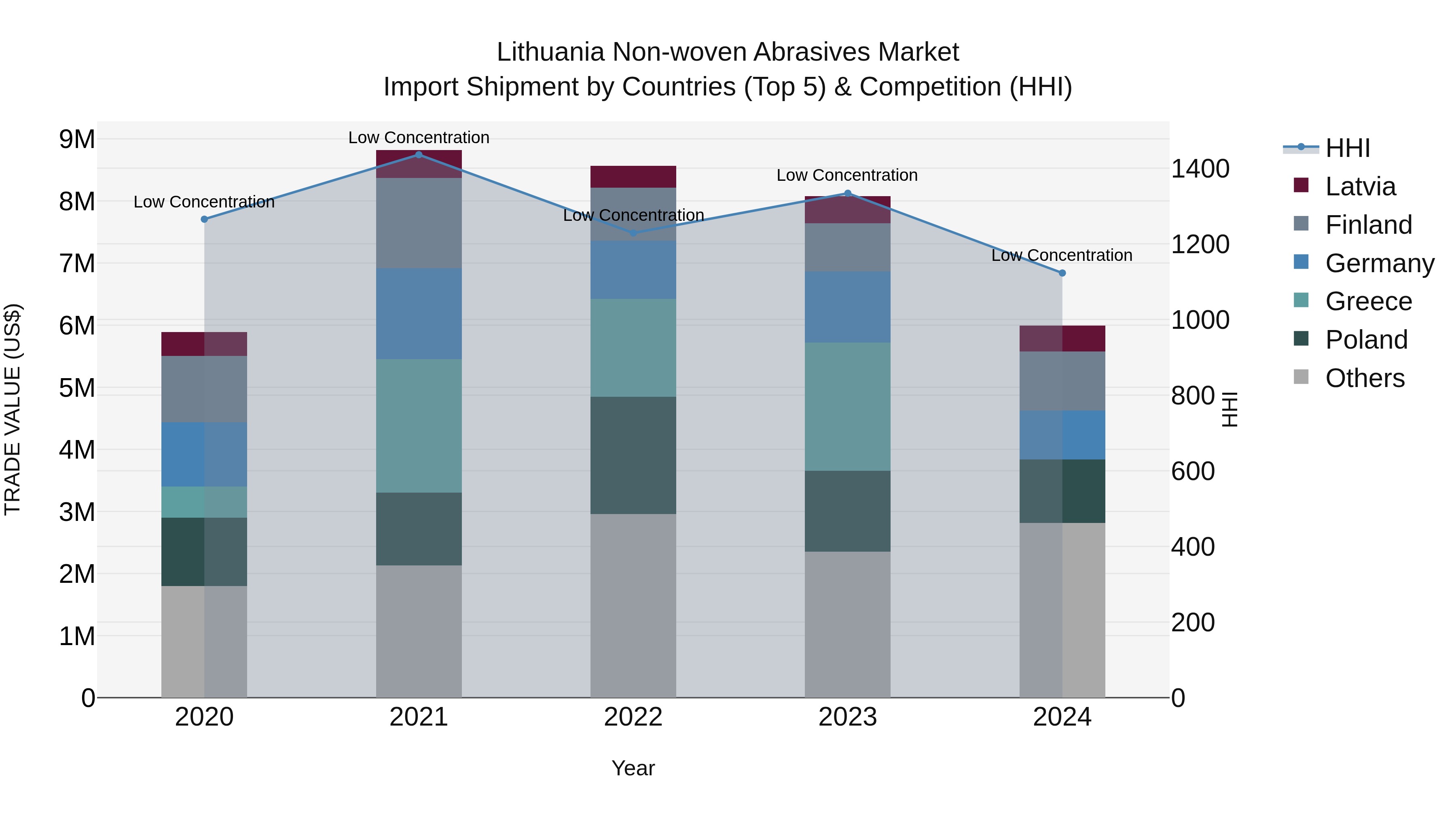
In 2024, Lithuania`s non-woven abrasives import market saw diverse sources, with top exporters being Poland, Other Europe, Finland, Germany, and Latvia. The market displayed low concentration, as indicated by the Herfindahl-Hirschman Index (HHI). Despite a modest compound annual growth rate (CAGR) of 0.43% from 2020 to 2024, there was a significant decline in growth from 2023 to 2024, with a rate of -25.84%. This fluctuation suggests potential shifts in market dynamics and highlights the importance of monitoring trends to adapt to changing conditions.
Key Highlights of the Report:
- Lithuania Non-Woven Abrasives Market Outlook
- Market Size of Lithuania Non-Woven Abrasives Market, 2025
- Forecast of Lithuania Non-Woven Abrasives Market, 2032
- Historical Data and Forecast of Lithuania Non-Woven Abrasives Revenues & Volume for the Period 2022 - 2032F
- Lithuania Non-Woven Abrasives Market Trend Evolution
- Lithuania Non-Woven Abrasives Market Drivers and Challenges
- Lithuania Non-Woven Abrasives Price Trends
- Lithuania Non-Woven Abrasives Porter's Five Forces
- Lithuania Non-Woven Abrasives Industry Life Cycle
- Historical Data and Forecast of Lithuania Non-Woven Abrasives Market Revenues & Volume By Product Type for the Period 2022 - 2032F
- Historical Data and Forecast of Lithuania Non-Woven Abrasives Market Revenues & Volume By Hand Pads for the Period 2022 - 2032F
- Historical Data and Forecast of Lithuania Non-Woven Abrasives Market Revenues & Volume By Rolls for the Period 2022 - 2032F
- Historical Data and Forecast of Lithuania Non-Woven Abrasives Market Revenues & Volume By Belts for the Period 2022 - 2032F
- Historical Data and Forecast of Lithuania Non-Woven Abrasives Market Revenues & Volume By Discs for the Period 2022 - 2032F
- Historical Data and Forecast of Lithuania Non-Woven Abrasives Market Revenues & Volume By Application Area for the Period 2022 - 2032F
- Historical Data and Forecast of Lithuania Non-Woven Abrasives Market Revenues & Volume By Surface Cleaning for the Period 2022 - 2032F
- Historical Data and Forecast of Lithuania Non-Woven Abrasives Market Revenues & Volume By Metal Finishing for the Period 2022 - 2032F
- Historical Data and Forecast of Lithuania Non-Woven Abrasives Market Revenues & Volume By Woodworking for the Period 2022 - 2032F
- Historical Data and Forecast of Lithuania Non-Woven Abrasives Market Revenues & Volume By Automotive Refinishing for the Period 2022 - 2032F
- Historical Data and Forecast of Lithuania Non-Woven Abrasives Market Revenues & Volume By End User for the Period 2022 - 2032F
- Historical Data and Forecast of Lithuania Non-Woven Abrasives Market Revenues & Volume By Household Users for the Period 2022 - 2032F
- Historical Data and Forecast of Lithuania Non-Woven Abrasives Market Revenues & Volume By Industrial Manufacturers for the Period 2022 - 2032F
- Historical Data and Forecast of Lithuania Non-Woven Abrasives Market Revenues & Volume By Furniture Manufacturers for the Period 2022 - 2032F
- Historical Data and Forecast of Lithuania Non-Woven Abrasives Market Revenues & Volume By Automotive Workshops for the Period 2022 - 2032F
- Historical Data and Forecast of Lithuania Non-Woven Abrasives Market Revenues & Volume By Material Type for the Period 2022 - 2032F
- Historical Data and Forecast of Lithuania Non-Woven Abrasives Market Revenues & Volume By Aluminum Oxide for the Period 2022 - 2032F
- Historical Data and Forecast of Lithuania Non-Woven Abrasives Market Revenues & Volume By Silicon Carbide for the Period 2022 - 2032F
- Historical Data and Forecast of Lithuania Non-Woven Abrasives Market Revenues & Volume By Zirconia Alumina for the Period 2022 - 2032F
- Historical Data and Forecast of Lithuania Non-Woven Abrasives Market Revenues & Volume By Ceramic Grain for the Period 2022 - 2032F
- Lithuania Non-Woven Abrasives Import Export Trade Statistics
- Market Opportunity Assessment By Product Type
- Market Opportunity Assessment By Application Area
- Market Opportunity Assessment By End User
- Market Opportunity Assessment By Material Type
- Lithuania Non-Woven Abrasives Top Companies Market Share
- Lithuania Non-Woven Abrasives Competitive Benchmarking By Technical and Operational Parameters
- Lithuania Non-Woven Abrasives Company Profiles
- Lithuania Non-Woven Abrasives Key Strategic Recommendations






































