Lithuania Offshore Pipeline Market Top 5 Importing Countries and Market Competition (HHI) Analysis
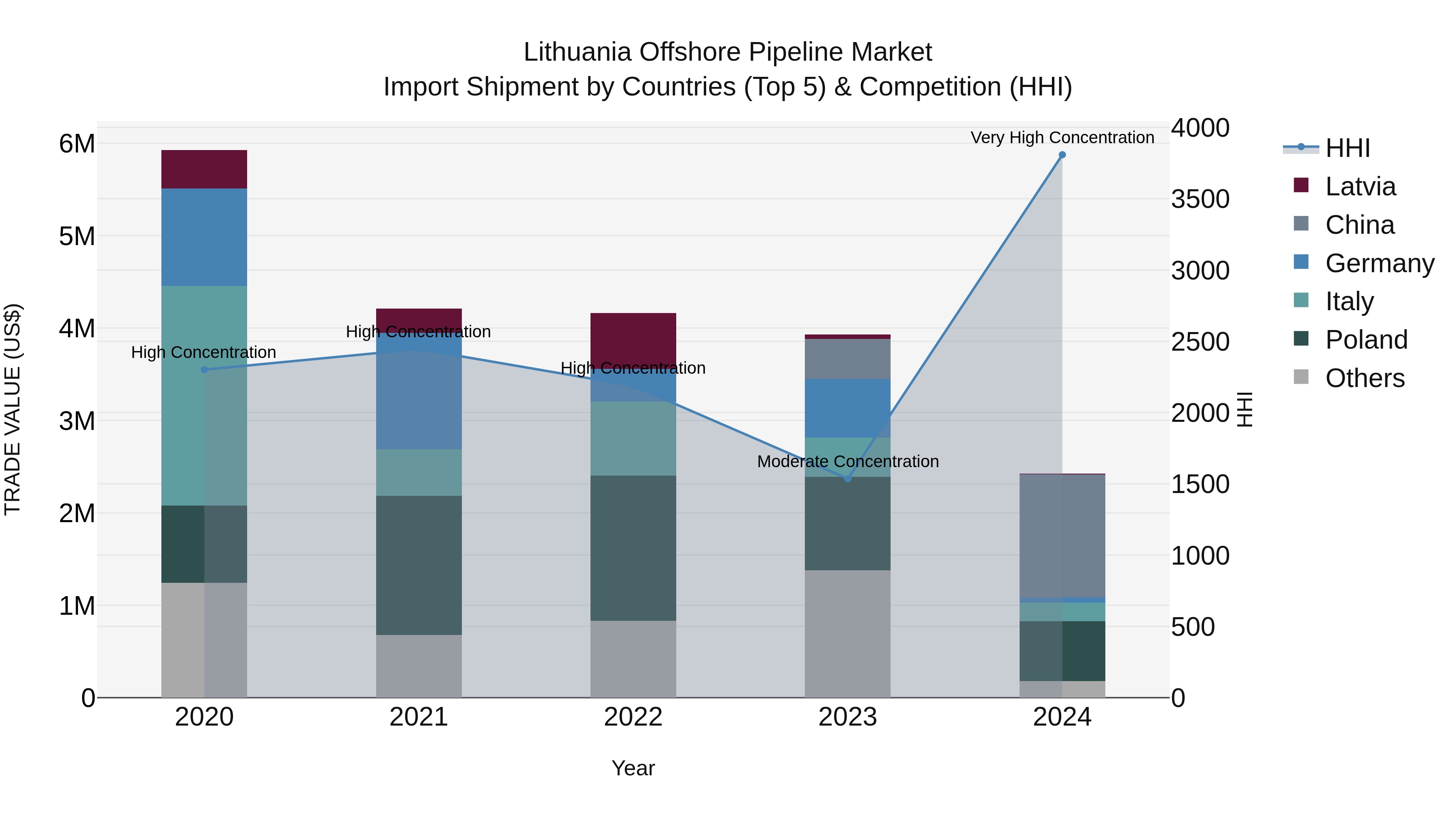
In 2024, Lithuania saw a significant increase in the concentration of its offshore pipeline import shipments, with top exporters being China, Poland, Italy, Slovakia, and Germany. This shift towards higher concentration likely indicates a more dominant presence of these key exporting countries in the Lithuanian market. The negative CAGR and growth rate suggest a decline in import shipments, reflecting potential challenges or changing dynamics in the offshore pipeline industry. Monitoring these trends and understanding the factors driving them will be crucial for stakeholders in the market to make informed decisions and strategize for the future.
Key Highlights of the Report:
- Lithuania Offshore Pipeline Market Outlook
- Market Size of Lithuania Offshore Pipeline Market, 2025
- Forecast of Lithuania Offshore Pipeline Market, 2032
- Historical Data and Forecast of Lithuania Offshore Pipeline Revenues & Volume for the Period 2022 - 2032F
- Lithuania Offshore Pipeline Market Trend Evolution
- Lithuania Offshore Pipeline Market Drivers and Challenges
- Lithuania Offshore Pipeline Price Trends
- Lithuania Offshore Pipeline Porter`s Five Forces
- Lithuania Offshore Pipeline Industry Life Cycle
- Historical Data and Forecast of Lithuania Offshore Pipeline Market Revenues & Volume By Diameter for the Period 2022 - 2032F
- Historical Data and Forecast of Lithuania Offshore Pipeline Market Revenues & Volume By Below 24 inches for the Period 2022 - 2032F
- Historical Data and Forecast of Lithuania Offshore Pipeline Market Revenues & Volume By Greater than 24 inches for the Period 2022 - 2032F
- Historical Data and Forecast of Lithuania Offshore Pipeline Market Revenues & Volume By Product for the Period 2022 - 2032F
- Historical Data and Forecast of Lithuania Offshore Pipeline Market Revenues & Volume By Oil for the Period 2022 - 2032F
- Historical Data and Forecast of Lithuania Offshore Pipeline Market Revenues & Volume By Gas for the Period 2022 - 2032F
- Historical Data and Forecast of Lithuania Offshore Pipeline Market Revenues & Volume By Refined Products for the Period 2022 - 2032F
- Historical Data and Forecast of Lithuania Offshore Pipeline Market Revenues & Volume By Line Type for the Period 2022 - 2032F
- Historical Data and Forecast of Lithuania Offshore Pipeline Market Revenues & Volume By Transport Lines for the Period 2022 - 2032F
- Historical Data and Forecast of Lithuania Offshore Pipeline Market Revenues & Volume By Export Lines for the Period 2022 - 2032F
- Historical Data and Forecast of Lithuania Offshore Pipeline Market Revenues & Volume By Installation Type for the Period 2022 - 2032F
- Historical Data and Forecast of Lithuania Offshore Pipeline Market Revenues & Volume By S LAY for the Period 2022 - 2032F
- Historical Data and Forecast of Lithuania Offshore Pipeline Market Revenues & Volume By J LAY for the Period 2022 - 2032F
- Historical Data and Forecast of Lithuania Offshore Pipeline Market Revenues & Volume By TOW IN for the Period 2022 - 2032F
- Historical Data and Forecast of Lithuania Offshore Pipeline Market Revenues & Volume By Depth of Operation for the Period 2022 - 2032F
- Historical Data and Forecast of Lithuania Offshore Pipeline Market Revenues & Volume By Shallow water for the Period 2022 - 2032F
- Historical Data and Forecast of Lithuania Offshore Pipeline Market Revenues & Volume By Deepwater for the Period 2022 - 2032F
- Lithuania Offshore Pipeline Import Export Trade Statistics
- Market Opportunity Assessment By Diameter
- Market Opportunity Assessment By Product
- Market Opportunity Assessment By Line Type
- Market Opportunity Assessment By Installation Type
- Market Opportunity Assessment By Depth of Operation
- Lithuania Offshore Pipeline Top Companies Market Share
- Lithuania Offshore Pipeline Competitive Benchmarking By Technical and Operational Parameters
- Lithuania Offshore Pipeline Company Profiles
- Lithuania Offshore Pipeline Key Strategic Recommendations






































