Lithuania Organic Personal Care Ingredients Market Top 5 Importing Countries and Market Competition (HHI) Analysis
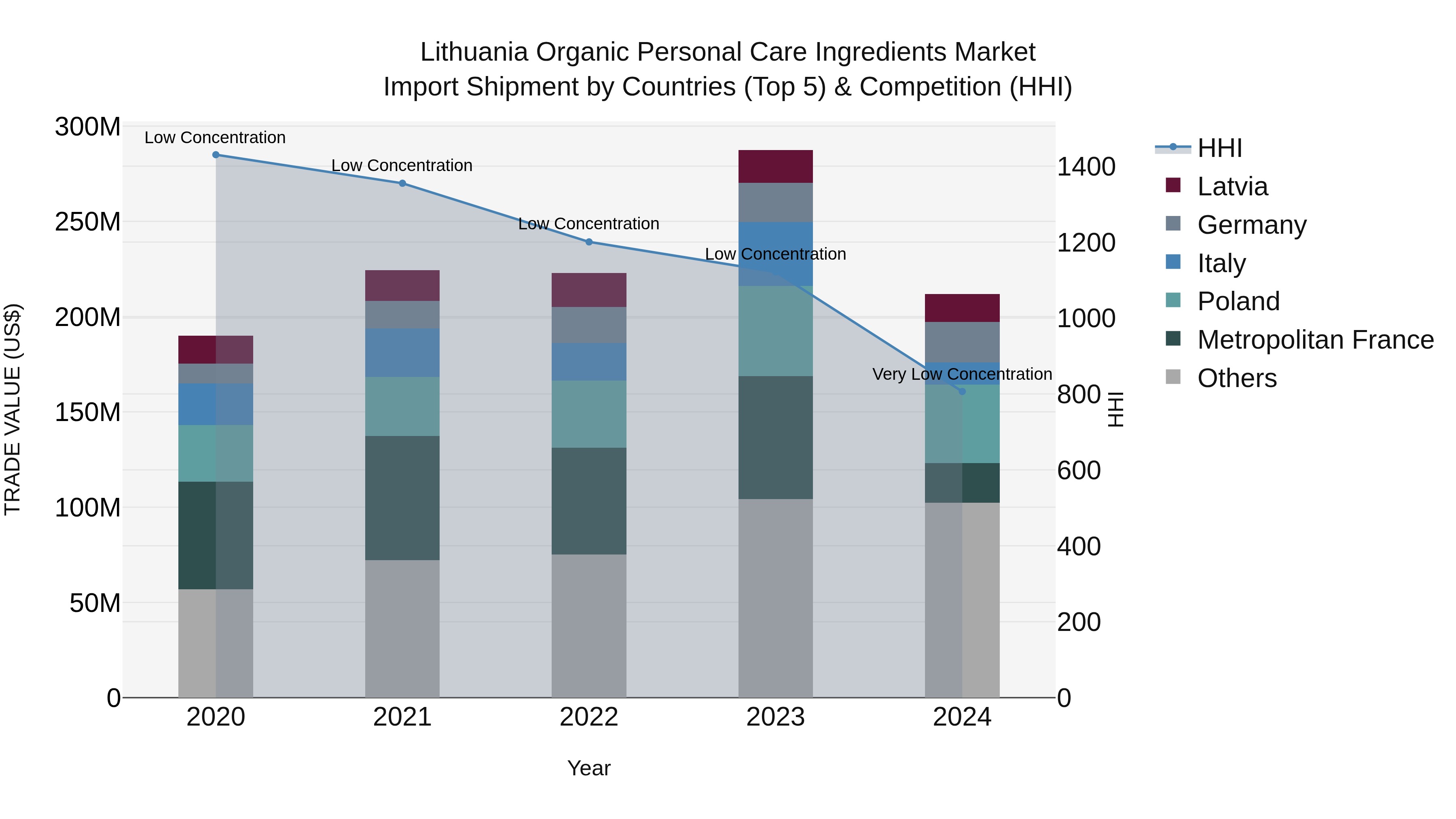
Despite the significant decrease in growth rate from 2023 to 2024, Lithuania continues to show steady growth in organic personal care ingredients imports. The low concentration of Herfindahl-Hirschman Index (HHI) indicates a competitive market with a diverse range of suppliers, including top exporters Poland, Germany, Metropolitan France, Latvia, and Italy. With a compound annual growth rate (CAGR) of 2.75% from 2020 to 2024, Lithuania`s demand for organic personal care ingredients is expected to remain stable, presenting opportunities for both domestic and international suppliers to capitalize on this growing market.
Lithuania Organic Personal Care Ingredients Market Overview
The Lithuania Organic Personal Care Ingredients Market is witnessing steady growth attributed to increasing consumer awareness regarding the benefits of organic products and a growing preference for natural ingredients in personal care products. The market is driven by factors such as rising disposable incomes, a shift towards sustainable and eco-friendly products, and a growing demand for chemical-free cosmetics. Key players in the market are focusing on expanding their product portfolios with organic ingredients to cater to the evolving consumer preferences. The market is characterized by the presence of both domestic and international manufacturers offering a wide range of organic personal care ingredients including plant-based extracts, essential oils, and natural preservatives. Continuous innovation, product development, and strategic partnerships are expected to further drive the growth of the Lithuania Organic Personal Care Ingredients Market in the coming years.
Lithuania Organic Personal Care Ingredients Market Trends and Opportunities
The Lithuania Organic Personal Care Ingredients Market is experiencing steady growth driven by increasing consumer awareness of health and wellness, as well as a rise in demand for natural and organic products. Consumers are becoming more conscious of the ingredients used in personal care products, leading to a shift towards products that are free from harmful chemicals and artificial additives. This trend presents opportunities for manufacturers and suppliers of organic personal care ingredients to expand their product offerings in the Lithuanian market. Key growth drivers include the growing popularity of natural skincare and haircare products, as well as the increasing availability of organic ingredients sourced sustainably. To capitalize on this trend, companies can focus on developing innovative formulations, enhancing product efficacy, and promoting the benefits of organic ingredients to target consumers seeking clean and green beauty solutions.
Lithuania Organic Personal Care Ingredients Market Challenges
In the Lithuania Organic Personal Care Ingredients Market, challenges primarily include limited consumer awareness and education about the benefits of organic personal care products. This leads to a smaller market size and slower adoption rate compared to conventional products. Another challenge is the high cost associated with organic ingredients, which can deter price-sensitive consumers from purchasing these products. Additionally, the regulatory environment and certification process for organic products can be complex and time-consuming, posing a barrier for companies looking to enter the market or expand their product offerings. Overall, overcoming these challenges requires targeted marketing strategies, investment in consumer education, and efforts to streamline certification processes to drive growth in the Lithuania Organic Personal Care Ingredients Market.
Lithuania Organic Personal Care Ingredients Market Drivers
The Lithuania Organic Personal Care Ingredients Market is primarily driven by increasing consumer awareness and preference for natural and organic products as they seek safer, healthier alternatives to traditional personal care items. Growing concerns regarding the harmful effects of synthetic chemicals on health and the environment have propelled the demand for organic ingredients in skincare, haircare, and other personal care products. Additionally, the rising trend of clean beauty and sustainability practices is influencing manufacturers to incorporate organic ingredients in their formulations. Moreover, the government initiatives promoting organic agriculture and the presence of a well-established organic farming sector in Lithuania are further boosting the market for organic personal care ingredients in the country.
Lithuania Organic Personal Care Ingredients Market Government Policies
In Lithuania, the organic personal care ingredients market is governed by regulations set by the European Union, which Lithuania is a part of. The EU`s regulations on organic products, including personal care ingredients, are outlined in the European Commission`s Regulation (EC) No 834/2007 and Regulation (EC) No 889/2008. These regulations establish rules for the production, labeling, and marketing of organic products, ensuring they meet specific standards and criteria. Additionally, Lithuania has its own legislation that aligns with EU regulations to oversee the organic personal care ingredients market. This includes requirements for certification, traceability, and compliance with organic farming practices. Adherence to these policies is crucial for companies operating in the organic personal care ingredients market in Lithuania to maintain consumer trust and access European markets.
Lithuania Organic Personal Care Ingredients Market Future Outlook
The Lithuania Organic Personal Care Ingredients Market is projected to witness steady growth in the coming years. The increasing awareness among consumers regarding the benefits of organic and natural ingredients in personal care products is driving the demand for organic personal care ingredients in Lithuania. Factors such as rising disposable income, growing preference for chemical-free products, and the shift towards sustainable and eco-friendly choices are expected to further boost market growth. Key players in the industry are focusing on product innovation, expanding their organic ingredient offerings, and strengthening distribution channels to cater to the evolving consumer preferences. With a growing emphasis on health and wellness, the Lithuania Organic Personal Care Ingredients Market is poised for continued expansion and is likely to present opportunities for new market entrants and existing players to capitalize on this growing trend.
Key Highlights of the Report:
- Lithuania Organic Personal Care Ingredients Market Outlook
- Market Size of Lithuania Organic Personal Care Ingredients Market, 2024
- Forecast of Lithuania Organic Personal Care Ingredients Market, 2031
- Historical Data and Forecast of Lithuania Organic Personal Care Ingredients Revenues & Volume for the Period 2021- 2031
- Lithuania Organic Personal Care Ingredients Market Trend Evolution
- Lithuania Organic Personal Care Ingredients Market Drivers and Challenges
- Lithuania Organic Personal Care Ingredients Price Trends
- Lithuania Organic Personal Care Ingredients Porter's Five Forces
- Lithuania Organic Personal Care Ingredients Industry Life Cycle
- Historical Data and Forecast of Lithuania Organic Personal Care Ingredients Market Revenues & Volume By Type for the Period 2021- 2031
- Historical Data and Forecast of Lithuania Organic Personal Care Ingredients Market Revenues & Volume By Organic for the Period 2021- 2031
- Historical Data and Forecast of Lithuania Organic Personal Care Ingredients Market Revenues & Volume By Natural for the Period 2021- 2031
- Historical Data and Forecast of Lithuania Organic Personal Care Ingredients Market Revenues & Volume By Product for the Period 2021- 2031
- Historical Data and Forecast of Lithuania Organic Personal Care Ingredients Market Revenues & Volume By Natural surfactants for the Period 2021- 2031
- Historical Data and Forecast of Lithuania Organic Personal Care Ingredients Market Revenues & Volume By Emollients for the Period 2021- 2031
- Historical Data and Forecast of Lithuania Organic Personal Care Ingredients Market Revenues & Volume By Active ingredients for the Period 2021- 2031
- Historical Data and Forecast of Lithuania Organic Personal Care Ingredients Market Revenues & Volume By Sugar polymers for the Period 2021- 2031
- Historical Data and Forecast of Lithuania Organic Personal Care Ingredients Market Revenues & Volume By Natural preservatives for the Period 2021- 2031
- Historical Data and Forecast of Lithuania Organic Personal Care Ingredients Market Revenues & Volume By Others for the Period 2021- 2031
- Historical Data and Forecast of Lithuania Organic Personal Care Ingredients Market Revenues & Volume By Application for the Period 2021- 2031
- Historical Data and Forecast of Lithuania Organic Personal Care Ingredients Market Revenues & Volume By Skin care for the Period 2021- 2031
- Historical Data and Forecast of Lithuania Organic Personal Care Ingredients Market Revenues & Volume By Hair care for the Period 2021- 2031
- Historical Data and Forecast of Lithuania Organic Personal Care Ingredients Market Revenues & Volume By Oral care for the Period 2021- 2031
- Historical Data and Forecast of Lithuania Organic Personal Care Ingredients Market Revenues & Volume By Cosmetics for the Period 2021- 2031
- Historical Data and Forecast of Lithuania Organic Personal Care Ingredients Market Revenues & Volume By Others for the Period 2021- 2031
- Lithuania Organic Personal Care Ingredients Import Export Trade Statistics
- Market Opportunity Assessment By Type
- Market Opportunity Assessment By Product
- Market Opportunity Assessment By Application
- Lithuania Organic Personal Care Ingredients Top Companies Market Share
- Lithuania Organic Personal Care Ingredients Competitive Benchmarking By Technical and Operational Parameters
- Lithuania Organic Personal Care Ingredients Company Profiles
- Lithuania Organic Personal Care Ingredients Key Strategic Recommendations






































