Lithuania Textile Auxiliaries Market Size (2020-2030)
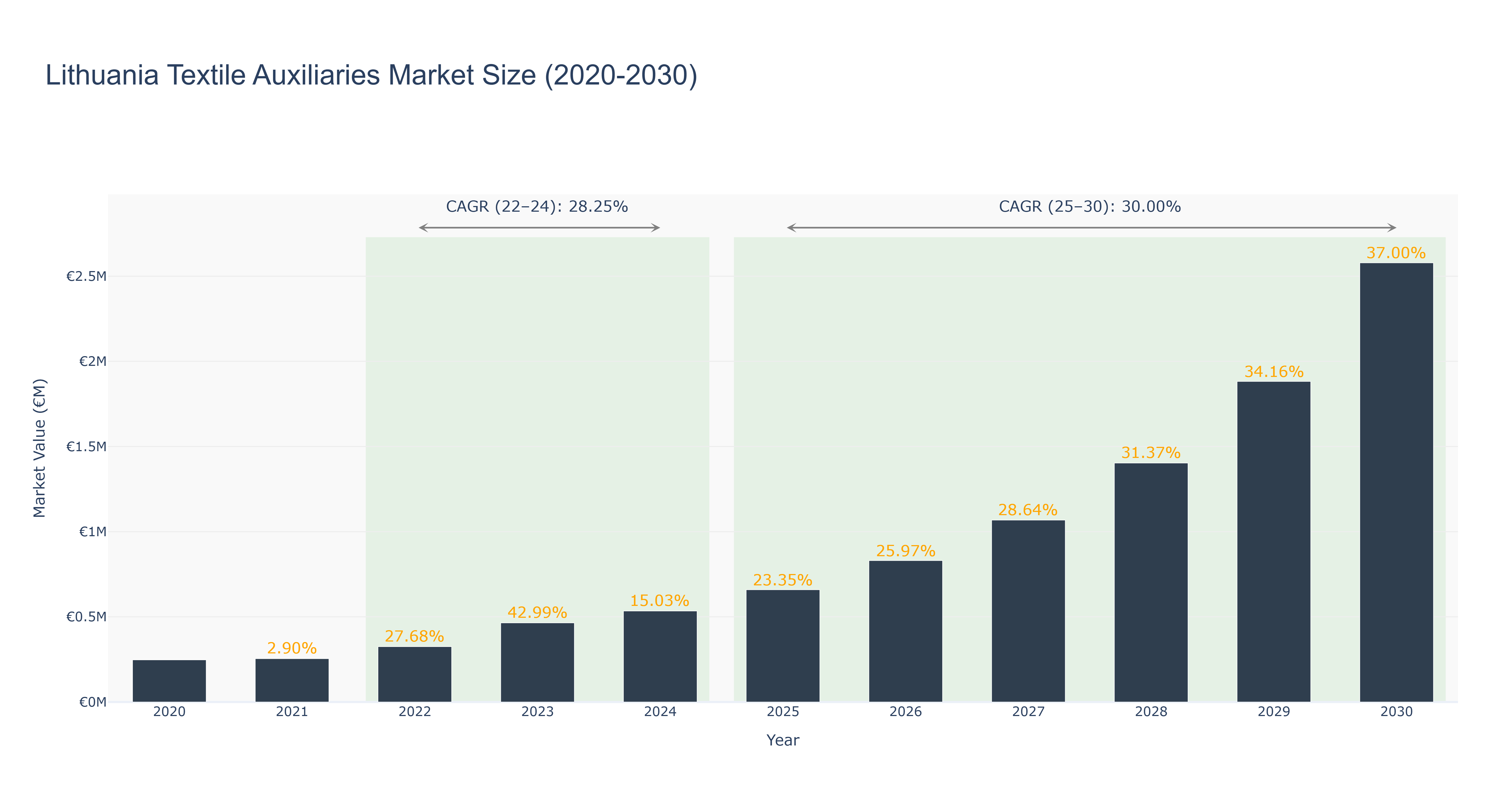
The Lithuania Textile Auxiliaries Market has demonstrated significant growth, peaking at €534.18 thousand in 2024, after experiencing an impressive 42.99% increase in 2023. The actual market sizes from 2022 to 2024 reflect a robust compound annual growth rate (CAGR) of 28.25%, driven by increasing demand for sustainable and innovative textile solutions. As we look towards the forecasted period of 2025 to 2030, the market is projected to continue its upward trajectory, with a CAGR of 30.00%, reaching approximately €2.58 million by 2030. This anticipated growth is fueled by the rising focus on eco-friendly production processes and technological advancements in textile auxiliaries. Additionally, the ongoing investments in research and development, as well as the expansion of manufacturing capabilities, are expected to further propel market expansion. Overall, the Lithuanian market is well-positioned for sustained growth driven by both domestic and international trends.
Lithuania Textile Auxiliaries Market: Production & Trade Performance (2019-2025)
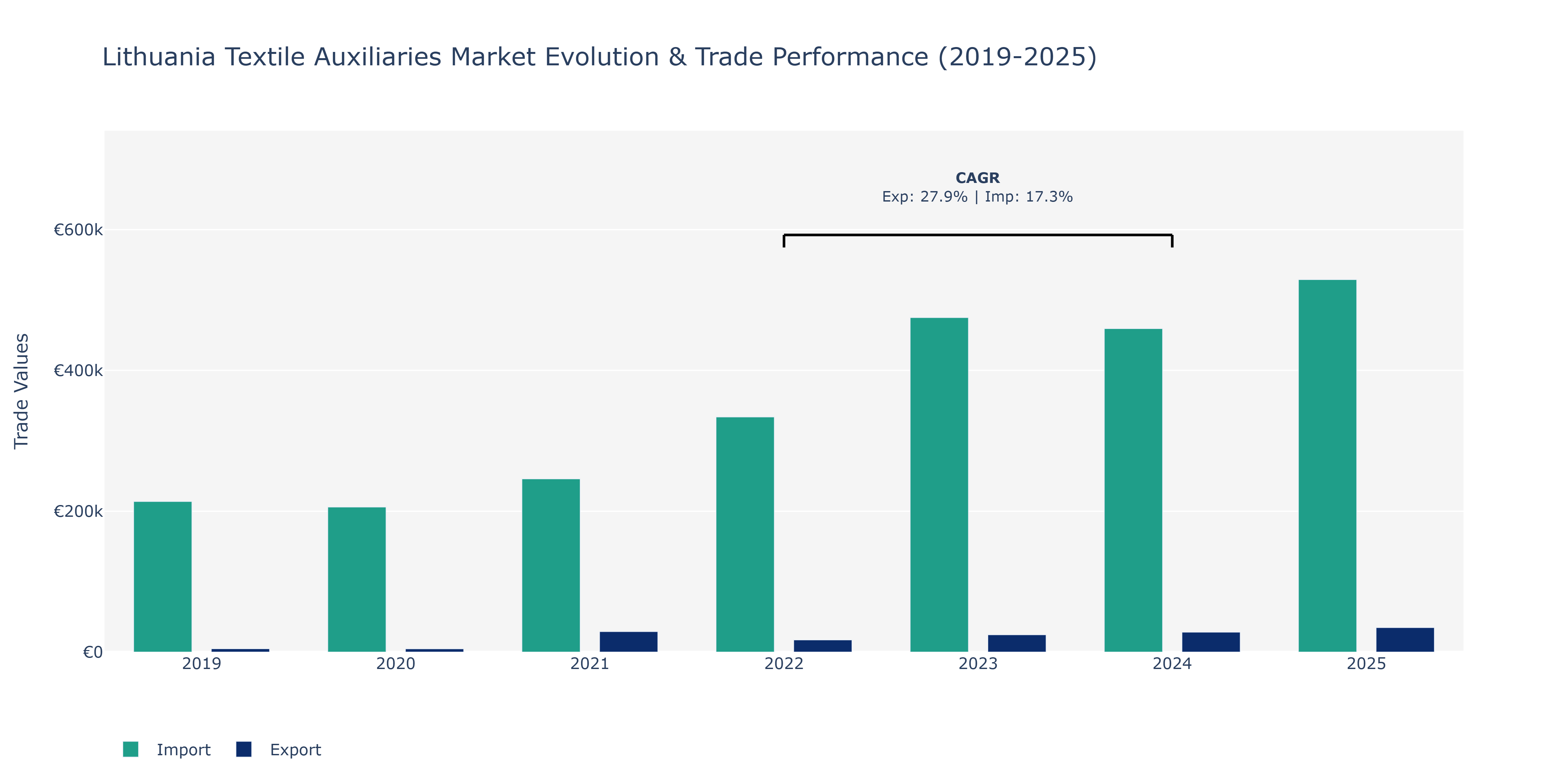
From 2019 to 2025, Lithuania's Textile Auxiliaries Market saw fluctuations in both exports and imports. In 2021, exports significantly increased to €28.96 thousand, possibly due to enhanced production capacity or new market opportunities. Conversely, imports also rose to €245.94 thousand, indicating a growing demand for foreign textile auxiliaries. The peak in imports continued in 2023, reaching €474.93 thousand, possibly driven by technological advancements or changes in consumer preferences. The following year, exports peaked at €28.16 thousand, suggesting a competitive market or successful marketing strategies. The growth in exports in 2025 to €34.7 thousand might reflect increased global demand for Lithuania's textile products, potentially driven by quality enhancements or strategic partnerships in the industry. These trends indicate a dynamic market with evolving trade patterns and potential opportunities for market expansion.
Key Highlights of the Report:
- Lithuania Textile Auxiliaries Market Outlook
- Market Size of Lithuania Textile Auxiliaries Market, 2025
- Forecast of Lithuania Textile Auxiliaries Market, 2032
- Historical Data and Forecast of Lithuania Textile Auxiliaries Revenues & Volume for the Period 2022 - 2032F
- Lithuania Textile Auxiliaries Market Trend Evolution
- Lithuania Textile Auxiliaries Market Drivers and Challenges
- Lithuania Textile Auxiliaries Price Trends
- Lithuania Textile Auxiliaries Porter`s Five Forces
- Lithuania Textile Auxiliaries Industry Life Cycle
- Historical Data and Forecast of Lithuania Textile Auxiliaries Market Revenues & Volume By Product for the Period 2022 - 2032F
- Historical Data and Forecast of Lithuania Textile Auxiliaries Market Revenues & Volume By Finishing Agents for the Period 2022 - 2032F
- Historical Data and Forecast of Lithuania Textile Auxiliaries Market Revenues & Volume By Dyeing and Printing Agents for the Period 2022 - 2032F
- Historical Data and Forecast of Lithuania Textile Auxiliaries Market Revenues & Volume By Spin Finish for the Period 2022 - 2032F
- Historical Data and Forecast of Lithuania Textile Auxiliaries Market Revenues & Volume By Knitting and Weaving for the Period 2022 - 2032F
- Historical Data and Forecast of Lithuania Textile Auxiliaries Market Revenues & Volume By Other Auxiliaries for the Period 2022 - 2032F
- Historical Data and Forecast of Lithuania Textile Auxiliaries Market Revenues & Volume By Applications for the Period 2022 - 2032F
- Historical Data and Forecast of Lithuania Textile Auxiliaries Market Revenues & Volume By Automotive Textiles for the Period 2022 - 2032F
- Historical Data and Forecast of Lithuania Textile Auxiliaries Market Revenues & Volume By Home Furnishing for the Period 2022 - 2032F
- Historical Data and Forecast of Lithuania Textile Auxiliaries Market Revenues & Volume By Apparel for the Period 2022 - 2032F
- Historical Data and Forecast of Lithuania Textile Auxiliaries Market Revenues & Volume By Digital Printing for the Period 2022 - 2032F
- Historical Data and Forecast of Lithuania Textile Auxiliaries Market Revenues & Volume By Others for the Period 2022 - 2032F
- Lithuania Textile Auxiliaries Import Export Trade Statistics
- Market Opportunity Assessment By Product
- Market Opportunity Assessment By Applications
- Lithuania Textile Auxiliaries Top Companies Market Share
- Lithuania Textile Auxiliaries Competitive Benchmarking By Technical and Operational Parameters
- Lithuania Textile Auxiliaries Company Profiles
- Lithuania Textile Auxiliaries Key Strategic Recommendations






































