Lithuania Tobacco Market Size (2020-2030)
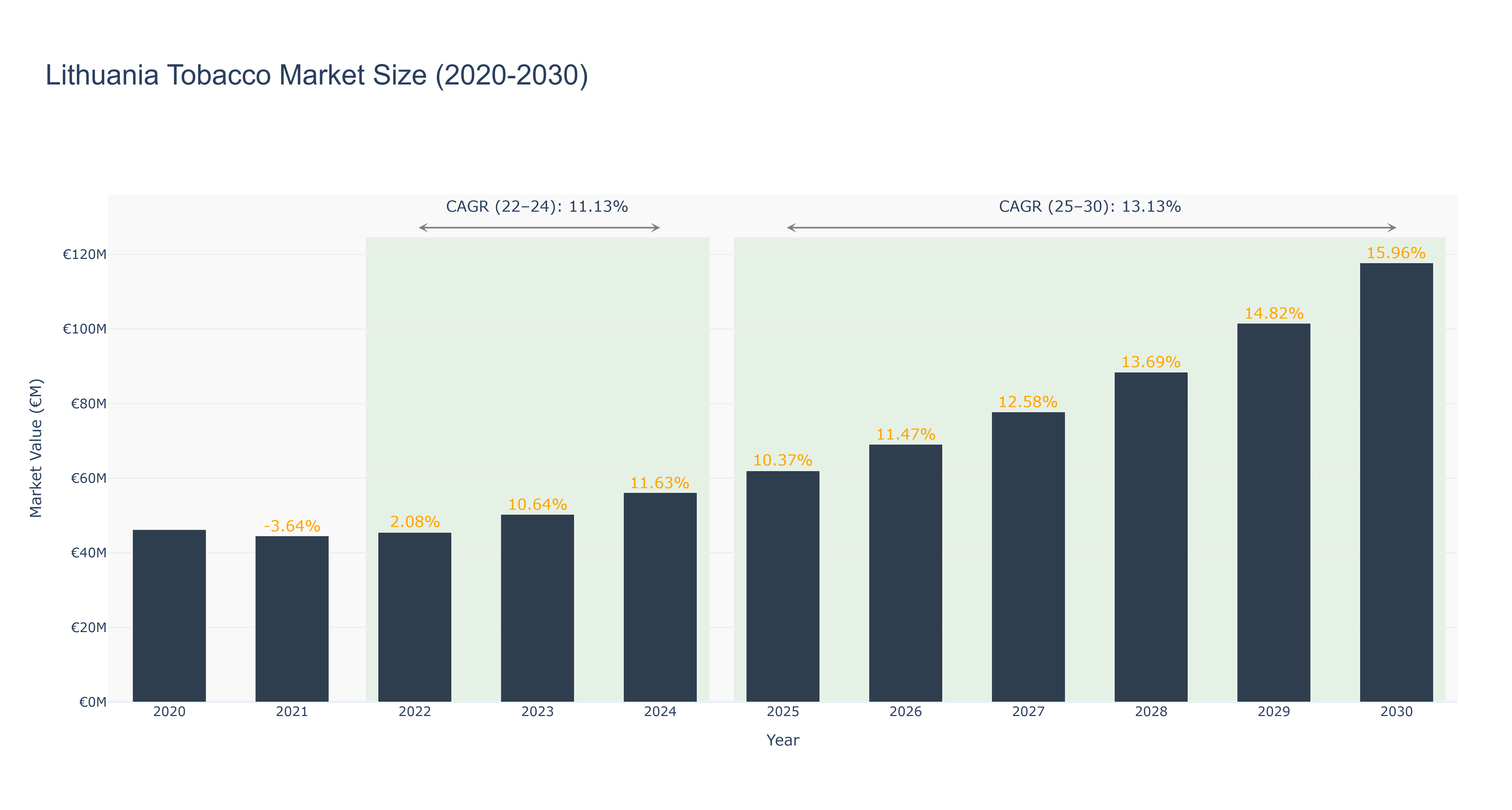
The Lithuania Tobacco Market has exhibited a dynamic trajectory from 2020 to 2024, with the peak market size recorded in 2024 at €56.16 million, following a decline in 2021 to €44.54 million. This period (2022-2024) demonstrates an actual CAGR of 11.13%, driven by increasing consumer demand and the introduction of innovative products. Transitioning into the forecasted period from 2025 to 2030, the market size is projected to escalate significantly, reaching €117.74 million by 2030, with a robust CAGR of 13.13%. This growth is anticipated to be fueled by evolving consumer preferences towards premium tobacco products and potential regulatory changes that may stimulate market expansion. Furthermore, anticipated investments in product diversification and marketing strategies are expected to enhance market competitiveness. Overall, the Lithuania Tobacco Market appears poised for substantial growth, reflecting broader trends in consumer behavior and regulatory environments.
Lithuania Tobacco Market: Production & Trade Performance (2019-2025)
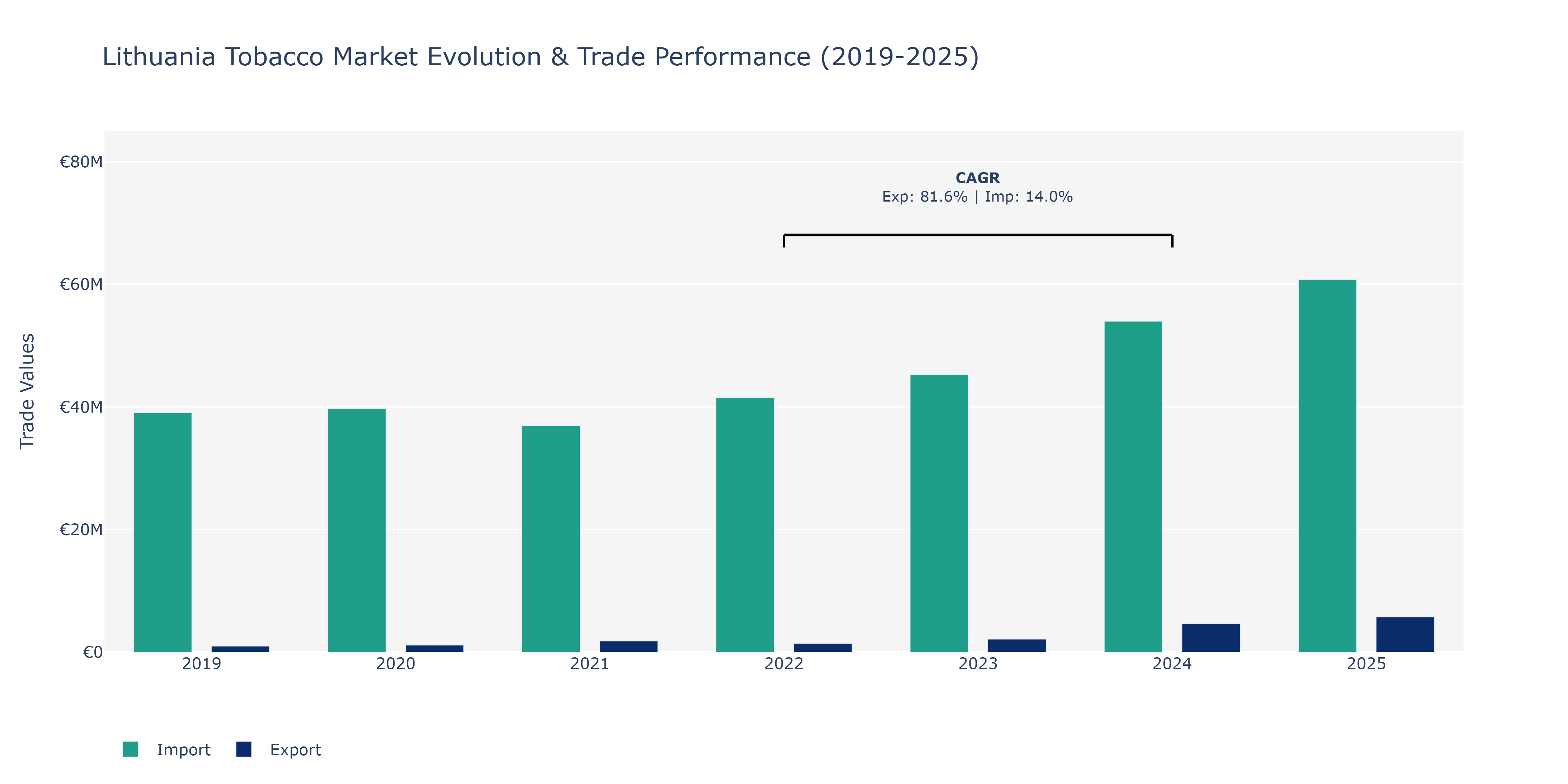
The Lithuania Tobacco Market saw a fluctuating pattern in both Exports and Imports over the years. Exports experienced a notable increase from €955.62 thousand in 2019 to €5.71 million in 2025, showcasing a steady upward trend with significant peaks in 2021 and 2025. This growth can be attributed to an enhanced focus on product quality, competitive pricing strategies, and increased market demand. On the other hand, Imports demonstrated a fluctuating trajectory, reaching €60.78 million in 2025 after a dip in 2021. The peak in Imports in 2025 could be linked to rising consumer preferences for a diverse range of tobacco products not extensively available domestically, leading to increased international trade. The market's growth aligns with the evolving consumer preferences towards premium tobacco products and the market's competitiveness in the global tobacco industry.
Key Highlights of the Report:
- Lithuania Tobacco Market Outlook
- Market Size of Lithuania Tobacco Market, 2025
- Forecast of Lithuania Tobacco Market, 2032
- Historical Data and Forecast of Lithuania Tobacco Revenues & Volume for the Period 2022 - 2032F
- Lithuania Tobacco Market Trend Evolution
- Lithuania Tobacco Market Drivers and Challenges
- Lithuania Tobacco Price Trends
- Lithuania Tobacco Porter`s Five Forces
- Lithuania Tobacco Industry Life Cycle
- Historical Data and Forecast of Lithuania Tobacco Market Revenues & Volume By Product for the Period 2022 - 2032F
- Historical Data and Forecast of Lithuania Tobacco Market Revenues & Volume By Smokeless for the Period 2022 - 2032F
- Historical Data and Forecast of Lithuania Tobacco Market Revenues & Volume By Cigarettes for the Period 2022 - 2032F
- Historical Data and Forecast of Lithuania Tobacco Market Revenues & Volume By Cigar & Cigarillos for the Period 2022 - 2032F
- Historical Data and Forecast of Lithuania Tobacco Market Revenues & Volume By Next Generation Products for the Period 2022 - 2032F
- Historical Data and Forecast of Lithuania Tobacco Market Revenues & Volume By Waterpipes for the Period 2022 - 2032F
- Historical Data and Forecast of Lithuania Tobacco Market Revenues & Volume By Distribution Channel for the Period 2022 - 2032F
- Historical Data and Forecast of Lithuania Tobacco Market Revenues & Volume By Offline for the Period 2022 - 2032F
- Historical Data and Forecast of Lithuania Tobacco Market Revenues & Volume By Online for the Period 2022 - 2032F
- Lithuania Tobacco Import Export Trade Statistics
- Market Opportunity Assessment By Product
- Market Opportunity Assessment By Distribution Channel
- Lithuania Tobacco Top Companies Market Share
- Lithuania Tobacco Competitive Benchmarking By Technical and Operational Parameters
- Lithuania Tobacco Company Profiles
- Lithuania Tobacco Key Strategic Recommendations






































