Lithuania Touchscreen Controller Market Top 5 Importing Countries and Market Competition (HHI) Analysis
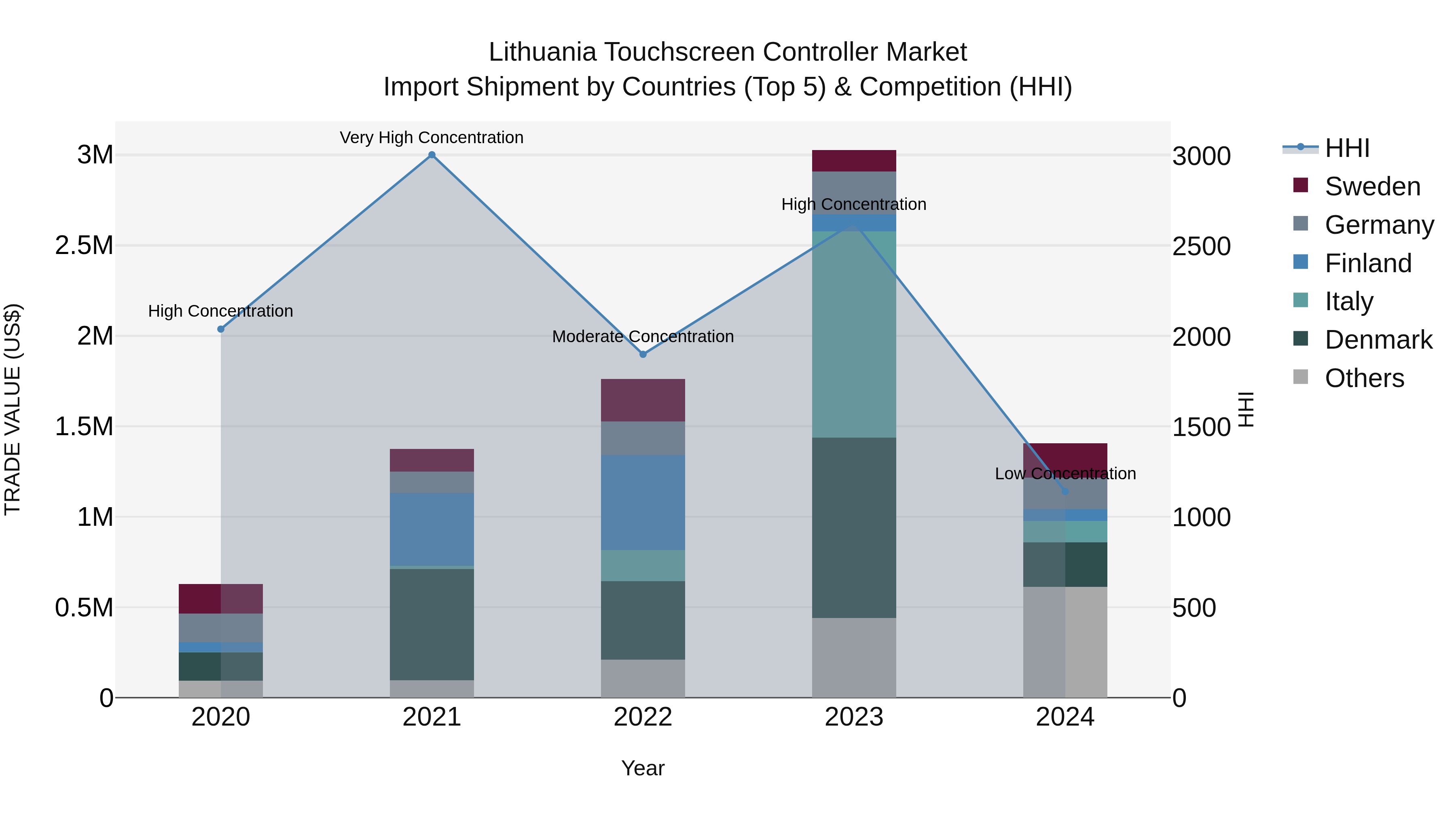
In 2024, Lithuania`s import of touchscreen controllers saw a shift in concentration from high to low, reflecting increased market diversification. Top exporters like Denmark, Latvia, and Sweden remain key players, alongside Romania and Germany. The impressive CAGR of 22.29% from 2020 to 2024 indicates sustained growth, despite a slight decline of -53.53% in the growth rate from 2023 to 2024. This data suggests a dynamic market landscape with opportunities for both established and emerging players in the touchscreen controller industry.
Key Highlights of the Report:
- Lithuania Touchscreen Controller Market Outlook
- Market Size of Lithuania Touchscreen Controller Market, 2025
- Forecast of Lithuania Touchscreen Controller Market, 2032
- Historical Data and Forecast of Lithuania Touchscreen Controller Revenues & Volume for the Period 2022 - 2032F
- Lithuania Touchscreen Controller Market Trend Evolution
- Lithuania Touchscreen Controller Market Drivers and Challenges
- Lithuania Touchscreen Controller Price Trends
- Lithuania Touchscreen Controller Porter`s Five Forces
- Lithuania Touchscreen Controller Industry Life Cycle
- Historical Data and Forecast of Lithuania Touchscreen Controller Market Revenues & Volume By Technology for the Period 2022 - 2032F
- Historical Data and Forecast of Lithuania Touchscreen Controller Market Revenues & Volume By Resistive for the Period 2022 - 2032F
- Historical Data and Forecast of Lithuania Touchscreen Controller Market Revenues & Volume By Capacitive for the Period 2022 - 2032F
- Historical Data and Forecast of Lithuania Touchscreen Controller Market Revenues & Volume By Interface for the Period 2022 - 2032F
- Historical Data and Forecast of Lithuania Touchscreen Controller Market Revenues & Volume By I2C (Inter-Integrated Circuit) for the Period 2022 - 2032F
- Historical Data and Forecast of Lithuania Touchscreen Controller Market Revenues & Volume By Serial Peripheral Interface for the Period 2022 - 2032F
- Historical Data and Forecast of Lithuania Touchscreen Controller Market Revenues & Volume By USB (Universal Serial Bus) for the Period 2022 - 2032F
- Historical Data and Forecast of Lithuania Touchscreen Controller Market Revenues & Volume By UART (Universal Asynchronous Receiver/Transmitter) for the Period 2022 - 2032F
- Historical Data and Forecast of Lithuania Touchscreen Controller Market Revenues & Volume By HID over USB for the Period 2022 - 2032F
- Historical Data and Forecast of Lithuania Touchscreen Controller Market Revenues & Volume By Touchscreen Technology for the Period 2022 - 2032F
- Historical Data and Forecast of Lithuania Touchscreen Controller Market Revenues & Volume By Single-touch Technology for the Period 2022 - 2032F
- Historical Data and Forecast of Lithuania Touchscreen Controller Market Revenues & Volume By Multi-touch Technology for the Period 2022 - 2032F
- Historical Data and Forecast of Lithuania Touchscreen Controller Market Revenues & Volume By Screen Size for the Period 2022 - 2032F
- Historical Data and Forecast of Lithuania Touchscreen Controller Market Revenues & Volume By Small & Medium for the Period 2022 - 2032F
- Historical Data and Forecast of Lithuania Touchscreen Controller Market Revenues & Volume By Large for the Period 2022 - 2032F
- Lithuania Touchscreen Controller Import Export Trade Statistics
- Market Opportunity Assessment By Technology
- Market Opportunity Assessment By Interface
- Market Opportunity Assessment By Touchscreen Technology
- Market Opportunity Assessment By Screen Size
- Lithuania Touchscreen Controller Top Companies Market Share
- Lithuania Touchscreen Controller Competitive Benchmarking By Technical and Operational Parameters
- Lithuania Touchscreen Controller Company Profiles
- Lithuania Touchscreen Controller Key Strategic Recommendations






































