Malaysia 3D Glasses Market Summary
The malaysia 3d glasses market was estimated at USD 221 Million in 2025 and is projected to reach USD 287 Million by 2032, growing at a CAGR of 5.5% from 2026 to 2032.
Malaysia 3D Glasses Market Year-wise Growth Rate and Key Drivers
This graph highlights how the Malaysia 3D Glasses Market has steadily grown over the past five years, supported by major growth factors.
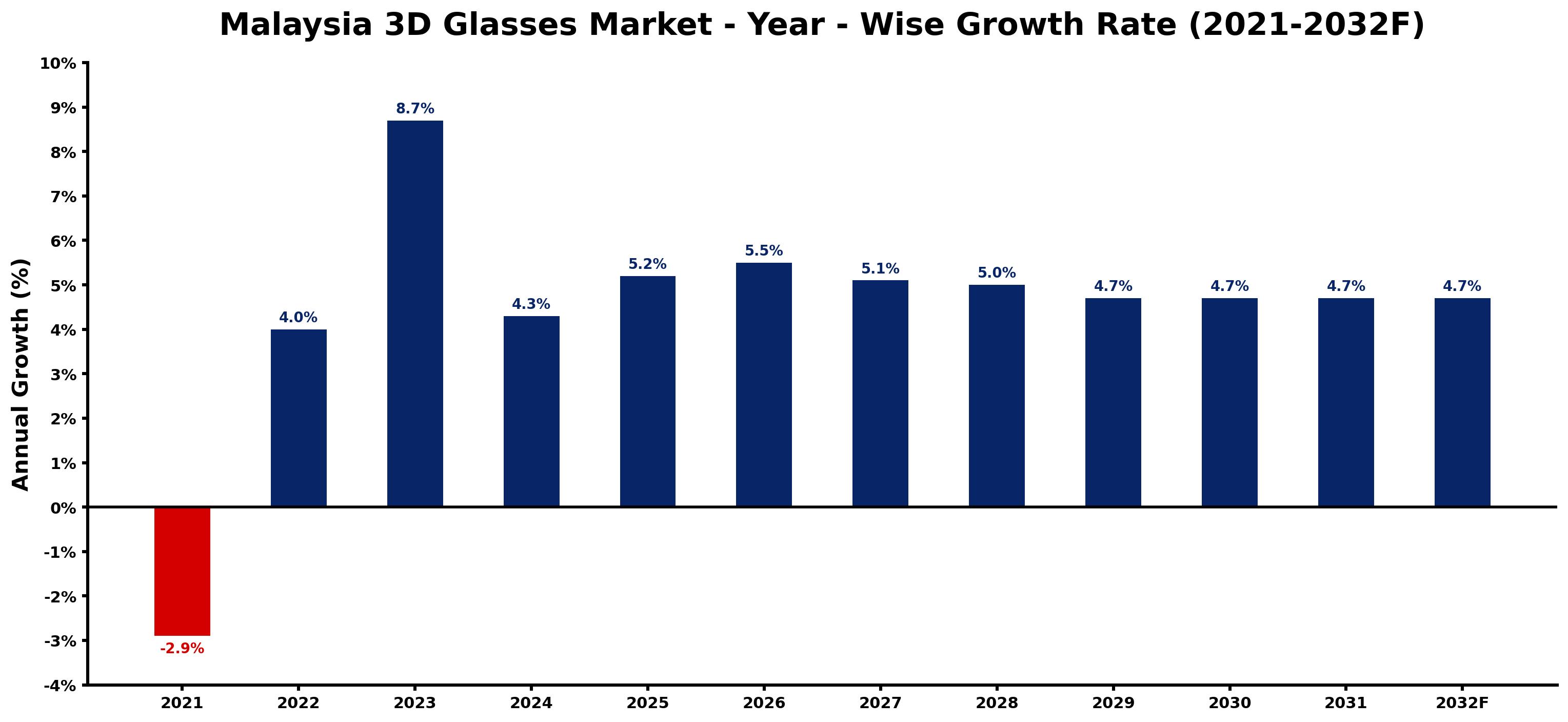
The table below presents the year wise growth rates along with the key drivers influencing the market
| Year | Growth Rate | Major Drivers |
| 2021 | -2.9% | Supply chain disruptions hindered access to essential components, leading to decreased production and sales of 3D glasses. |
| 2022 | 4.0% | Increased local manufacturing capabilities reduce dependency on overseas 3D glasses. |
| 2023 | 8.7% | Consumer electronics trends highlight gaming and virtual reality as market accelerators. |
| 2024 | 4.3% | Collaborations between tech companies stimulate innovation in 3D display technologies. |
| 2025 | 5.2% | E-commerce platforms introduce advanced visualization tools enhancing customer engagement. |
| 2026 | 5.5% | Corporate training programs increasingly adopt 3D glasses for immersive learning experiences. |
| 2027 | 5.1% | Healthcare sector explores 3D glasses for surgical simulations and patient education. |
| 2028 | 5.0% | Cultural institutions invest in augmented reality exhibits utilizing advanced 3D glasses. |
| 2029 | 4.7% | Smartphone integration with augmented reality features drives consumer interest in 3D glasses. |
| 2030 | 4.7% | Urbanization trends fuel demand for virtual reality applications in architecture and design. |
| 2031 | 4.7% | Gaming industry expansion fosters competitive innovations in high-performance 3D glasses. |
| 2032 | 4.7% | Sustainability concerns prompt manufacturers to develop eco-friendly 3D glass technologies. |
Note - Market size estimations and growth projections presented in this report are based on 6Wresearch's advanced forecasting approach, validated with industry datasets as of June 2026.
Malaysia 3D Glasses Market Synopsis
The Malaysia 3D Glasses Market is projected to reach 5.5% and witness significant growth during the forecast period (2026-2032). The market is anticipated to register a compound annual growth rate (CAGR) of 8.9%, fueled by the increasing demand for immersive entertainment experiences. Factors contributing to this growth include rising disposable incomes among consumers and the growing penetration of internet-enabled devices, such as smartphones, tablets, and PCs. Furthermore, digitalization is reshaping everyday life, enriching experiences in communication, education, and entertainment, thereby propelling the adoption of gadgets that offer interactive experiences via augmented reality (AR) and virtual reality (VR).
Malaysia 3D Glasses Market Growth Drivers
The growth trajectory of the Malaysia 3D Glasses Market is influenced by several key drivers:
- Increased consumer interest in immersive and interactive entertainment options, driving demand for advanced 3D glasses.
- Rising disposable incomes enable more consumers to afford high-quality 3D glasses, expanding the target market.
- Widespread adoption of internet-enabled devices enhances user engagement with 3D content, fostering market growth.
- The growing popularity of AR and VR technologies across various sectors, including gaming and education, stimulates demand for compatible 3D glasses.
- Technological advancements and innovation lead to the introduction of smart features in 3D glasses, improving user experiences and expanding product appeal.
Malaysia 3D Glasses Market Challenges and Restraints
Despite the promising growth, the Malaysia 3D Glasses Market faces several challenges:
- The high cost associated with advanced 3D glasses may limit their adoption, particularly among price-sensitive consumers in urban areas.
- A lack of awareness regarding the benefits of 3D technology among populations in rural regions may hinder potential market expansion.
- Technological barriers and compatibility issues with existing devices can restrict the utilization of 3D glasses.
- Consumer skepticism regarding the long-term health effects of prolonged use of 3D glasses may affect adoption rates.
- Economic fluctuations and uncertainties could impact consumer spending habits, influencing the overall market growth.
Malaysia 3D Glasses Market Government Investment and Initiatives
The role of government initiatives in the Malaysia 3D Glasses Market is significant, as authorities seek to foster the development of AR and VR technologies. Initiatives include:
- Public investment in technology infrastructure to facilitate the growth of digital and immersive entertainment experiences.
- Collaboration with educational institutions to promote research and development in 3D technology and its applications.
- Incentives for local startups and companies innovating in AR/VR technologies to enhance market competitiveness.
- Support for trade shows and exhibitions that showcase advancements in 3D glasses and immersive technologies.
- Regulatory frameworks aimed at ensuring safety and promoting consumer confidence in emerging technologies.
Malaysia 3D Glasses Market Latest Developments (May 2025 - June 2026)
Recent developments within the Malaysia 3D Glasses Market highlight the direction of industry advancements:
- Various manufacturers have focused on integrating smart technology features into 3D glasses, enhancing usability and interactivity.
- Consumer awareness campaigns aimed at educating potential users about the advantages of 3D glasses have seen increased participation.
- Investment in research and development has led to more advanced 3D glasses with features tailored for gaming and professional applications.
- Expansion of retail channels to include e-commerce platforms, improving accessibility to consumers across Malaysia.
- Collaborations between tech companies and gaming developers to create exclusive 3D content have gained momentum, driving demand for compatible glasses.
Malaysia 3D Glasses Market - Key Attractiveness of the Report
- 10 Years of Market Numbers
- Historical Data Starting from 2022 to 2025
- Base Year: 2025
- Forecast Data until 2032
- Key Performance Indicators Impacting the Market
- Major Upcoming Developments and Projects
Key Highlights of the Report:
- Malaysia 3D Glasses Market Outlook
- Market Size of Malaysia 3D Glasses Market, 2025
- Forecast of Malaysia 3D Glasses Market, 2032F
- Historical Data and Forecast of Malaysia 3D Glasses Revenues & Volume for the Period 2022-2032F
- Malaysia 3D Glasses Market Trend Evolution
- Malaysia 3D Glasses Market Drivers and Challenges
- Malaysia 3D Glasses Price Trends
- Malaysia 3D Glasses Porter's Five Forces
- Malaysia 3D Glasses Industry Life Cycle
- Historical Data and Forecast of Malaysia 3D Glasses Market Revenues & Volume By Product Type for the Period 2022-2032F
- Historical Data and Forecast of Malaysia 3D Glasses Market Revenues & Volume By Active shutter for the Period 2022-2032F
- Historical Data and Forecast of Malaysia 3D Glasses Market Revenues & Volume By Polarized for the Period 2022-2032F
- Historical Data and Forecast of Malaysia 3D Glasses Market Revenues & Volume By Anaglyph for the Period 2022-2032F
- Historical Data and Forecast of Malaysia 3D Glasses Market Revenues & Volume By Applications for the Period 2022-2032F
- Historical Data and Forecast of Malaysia 3D Glasses Market Revenues & Volume By Media for the Period 2022-2032F
- Historical Data and Forecast of Malaysia 3D Glasses Market Revenues & Volume By Cinemas for the Period 2022-2032F
- Malaysia 3D Glasses Import Export Trade Statistics
- Market Opportunity Assessment By Product Type
- Market Opportunity Assessment By Applications
- Malaysia 3D Glasses Top Companies Market Share
- Malaysia 3D Glasses Competitive Benchmarking By Technical and Operational Parameters
- Malaysia 3D Glasses Company Profiles
- Malaysia 3D Glasses Key Strategic Recommendations






































