Malaysia Acetic Acids Market Size, Share & Growth Rate
The Malaysia Acetic Acids Market was estimated at USD 236 Million in 2025 and is projected to reach USD 306 Million by 2032, growing at a CAGR of 3.8% from 2026 to 2032. This positive trajectory is largely driven by robust demand from various sectors, particularly construction, automotive, and packaging. As these industries ramp up activities, the necessity for acetic acid as a key raw material has surged, fostering significant growth across the market.
Malaysia Acetic Acids Market Year-wise Growth Rate and Key Drivers
This graph highlights how the Malaysia Acetic Acids Market has steadily grown over the years, supported by major growth factors.
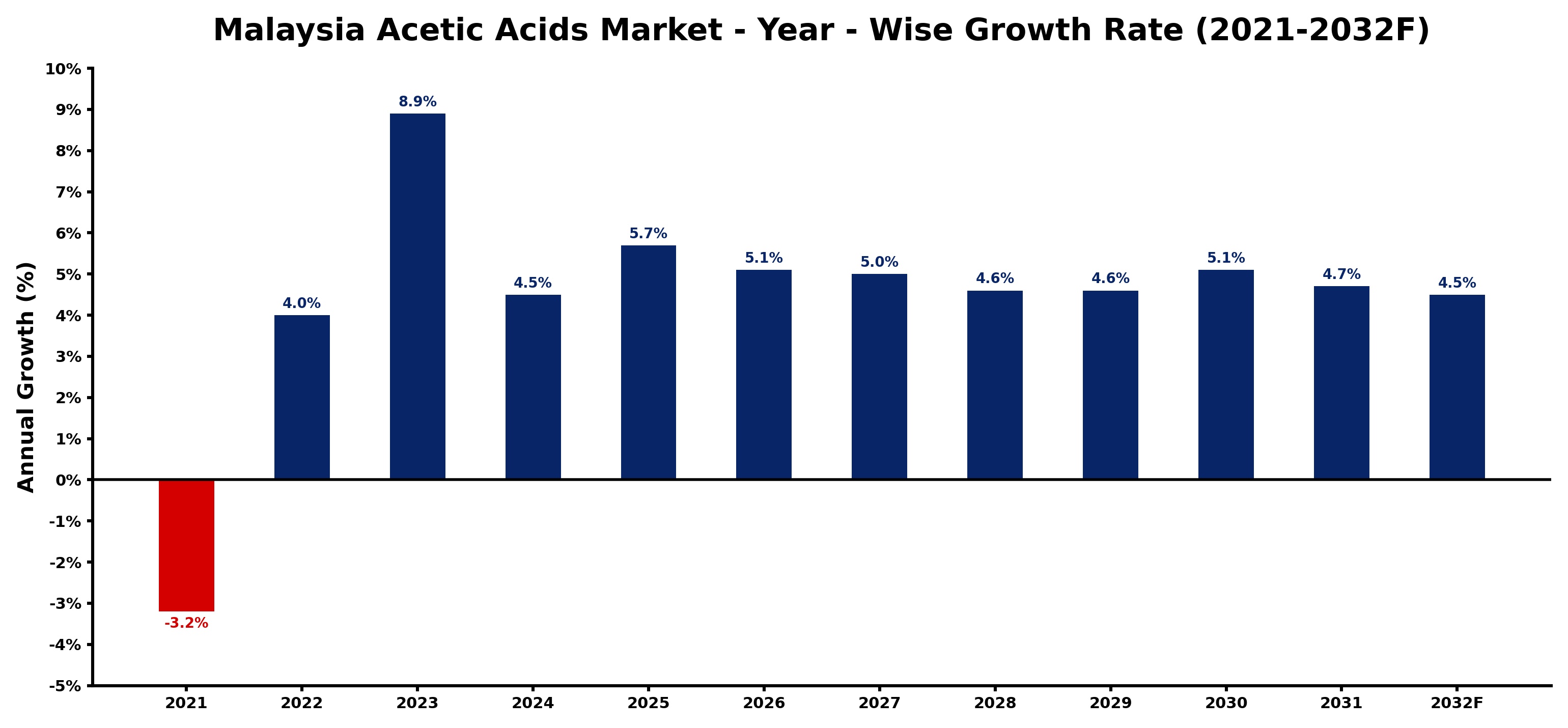
The table below presents the year‑wise growth rates along with the key drivers influencing the market
| Year | Growth Rate | Major Drivers |
| 2021 | -3.2% | Increasing industrial infrastructure investments |
| 2022 | 4.0% | Expansion of manufacturing activities |
| 2023 | 8.9% | Government infrastructure modernization initiatives |
| 2024 | 4.5% | Growing renewable energy integration projects |
| 2025 | 5.7% | Expansion of commercial construction activities |
| 2026 | 5.1% | Government infrastructure modernization initiatives |
| 2027 | 5.0% | Growing renewable energy integration projects |
| 2028 | 4.6% | Growing urbanization and commercial development |
| 2029 | 4.6% | Increasing industrial automation investments |
| 2030 | 5.1% | Expansion of commercial construction activities |
| 2031 | 4.7% | Rising electricity demand across industries |
| 2032 | 4.5% | Expansion of commercial construction activities |
Note - Market size estimations and growth projections presented in this report are based on 6Wresearch's advanced forecasting approach, validated with industry datasets as of June 2026.
Malaysia Acetic Acids Market Synopsis
The strongest force currently shaping the Malaysia acetic acids market is the burgeoning demand stemming from expanding downstream industries. As construction and automotive sectors grow, there is a notable rise in the need for acetic acid in products like adhesives, coatings, and plastics, further solidifying its position in the market.
Additionally, the flourishing food and beverage industry is a pivotal factor in market dynamics. As urbanization accelerates and disposable incomes rise, there is a correlating increase in the consumption of packaged goods, which in turn fuels demand for acetic acid and its derivatives.
Malaysia Acetic Acids Market Key Takeaways
- The market is projected to grow steadily from USD 236 Million in 2025 to USD 306 Million by 2032.
- Key growth sectors include construction, automotive, and packaging industries.
- The rising urban population and increased disposable income are strong demand drivers.
- Investment in downstream industries like paints, coatings, and adhesives is on the rise.
- Volatility in raw material prices presents a potential challenge to sustained growth.
Evaluation of Restraints in Malaysia Acetic Acids Market
Despite the promising outlook, several restraints could hinder the growth of the Malaysia acetic acids market. Chief among these is the volatility in the prices of raw materials required for acetic acid production. Fluctuations in supply costs can lead to unpredictability in pricing strategies, affecting profit margins for manufacturers. Furthermore, dependence on specific industries may pose risks, particularly if market demands shift or if those sectors experience downturns.
Malaysia Acetic Acids Market Trends
Current trends indicate a significant shift towards sustainable practices and the development of bio-based acetic acids as manufacturers seek to reduce environmental impact. Additionally, there is a growing inclination towards advanced manufacturing technologies that improve efficiency and reduce production costs. The integration of digitalization within supply chains is another emerging trend, enhancing operational capabilities and response times to market fluctuations.
Malaysia Acetic Acids Market Opportunities
The Malaysia acetic acids market presents numerous opportunities for growth and investment. Expanding sectors such as biofuels and bioplastics offer potential avenues for acetic acid applications, particularly as the nation seeks to enhance its sustainability credentials. Moreover, the increasing demand for environmentally friendly products can catalyze innovation, paving the way for new product development and niche markets that leverage acetic acid's versatility.
Government Initiatives in the Malaysia Acetic Acids Market
Government initiatives aimed at bolstering the chemical sector are crucial for the growth of the acetic acids market in Malaysia. Policies encouraging foreign investment, as well as public spending in infrastructure projects, serve to strengthen demand for acetic acid. Additionally, environmental regulations that promote sustainable practices can lead to increased funding for research and development in bio-based alternatives, further enhancing market potential.
Future Insights of the Malaysia Acetic Acids Market
Looking forward to the period from 2026 to 2032, the Malaysia acetic acids market is expected to witness a transition towards greater sustainability, with an emphasis on eco-friendly products and processes. The growth in consumer demand for packaged goods will likely continue to spur market expansion, while advancements in production technology will enhance operational efficiencies. Overall, a combination of growing industries and shifting consumer preferences signals a promising future for acetic acid in Malaysia.
Malaysia Acetic Acids Market Latest Developments (May 2025 - June 2026)
Recent developments indicate that the Malaysia acetic acids market is poised for transformative growth driven by innovation and increased investments. Industry stakeholders are actively exploring collaborations to enhance supply chain efficiencies and reduce production costs. Moreover, there is a marked shift towards integrating more sustainable practices and technologies within the production processes, reflecting broader global trends towards environmental responsibility.
Malaysia Acetic Acids Market - Key Attractiveness of the Report
- 10 Years of Market Numbers
- Historical Data Starting from 2022 to 2025
- Base Year: 2025
- Forecast Data until 2032
- Key Performance Indicators Impacting the Market
- Major Upcoming Developments and Projects
Key Highlights of the Report:
- Malaysia Acetic Acids Market Outlook
- Market Size of Malaysia Acetic Acids Market, 2025
- Forecast of Malaysia Acetic Acids Market, 2032F
- Historical Data and Forecast of Malaysia Acetic Acids Revenues & Volume for the Period 2022-2032F
- Malaysia Acetic Acids Market Trend Evolution
- Malaysia Acetic Acids Market Drivers and Challenges
- Malaysia Acetic Acids Price Trends
- Malaysia Acetic Acids Porter's Five Forces
- Malaysia Acetic Acids Industry Life Cycle
- Historical Data and Forecast of Malaysia Acetic Acids Market Revenues & Volume By Application for the Period 2022-2032F
- Historical Data and Forecast of Malaysia Acetic Acids Market Revenues & Volume By Vinyl Acetate Monomer (VAM) for the Period 2022-2032F
- Historical Data and Forecast of Malaysia Acetic Acids Market Revenues & Volume By Purified Terephthalic Acid (PTA) for the Period 2022-2032F
- Historical Data and Forecast of Malaysia Acetic Acids Market Revenues & Volume By Acetate Esters for the Period 2022-2032F
- Historical Data and Forecast of Malaysia Acetic Acids Market Revenues & Volume By Acetic Anhydride for the Period 2022-2032F
- Historical Data and Forecast of Malaysia Acetic Acids Market Revenues & Volume By Other Applications for the Period 2022-2032F
- Historical Data and Forecast of Malaysia Acetic Acids Market Revenues & Volume By End-Users for the Period 2022-2032F
- Historical Data and Forecast of Malaysia Acetic Acids Market Revenues & Volume By Plastics and Polymers for the Period 2022-2032F
- Historical Data and Forecast of Malaysia Acetic Acids Market Revenues & Volume By Food and Beverage for the Period 2022-2032F
- Historical Data and Forecast of Malaysia Acetic Acids Market Revenues & Volume By Inks, Paints, and Coatings for the Period 2022-2032F
- Historical Data and Forecast of Malaysia Acetic Acids Market Revenues & Volume By Chemicals for the Period 2022-2032F
- Historical Data and Forecast of Malaysia Acetic Acids Market Revenues & Volume By Other End-user Industries for the Period 2022-2032F
- Malaysia Acetic Acids Import Export Trade Statistics
- Market Opportunity Assessment By Application
- Market Opportunity Assessment By End-Users
- Malaysia Acetic Acids Top Companies Market Share
- Malaysia Acetic Acids Competitive Benchmarking By Technical and Operational Parameters
- Malaysia Acetic Acids Company Profiles
- Malaysia Acetic Acids Key Strategic Recommendations






































