Malaysia AI in Education Market Size & Growth Rate (2026-2032)
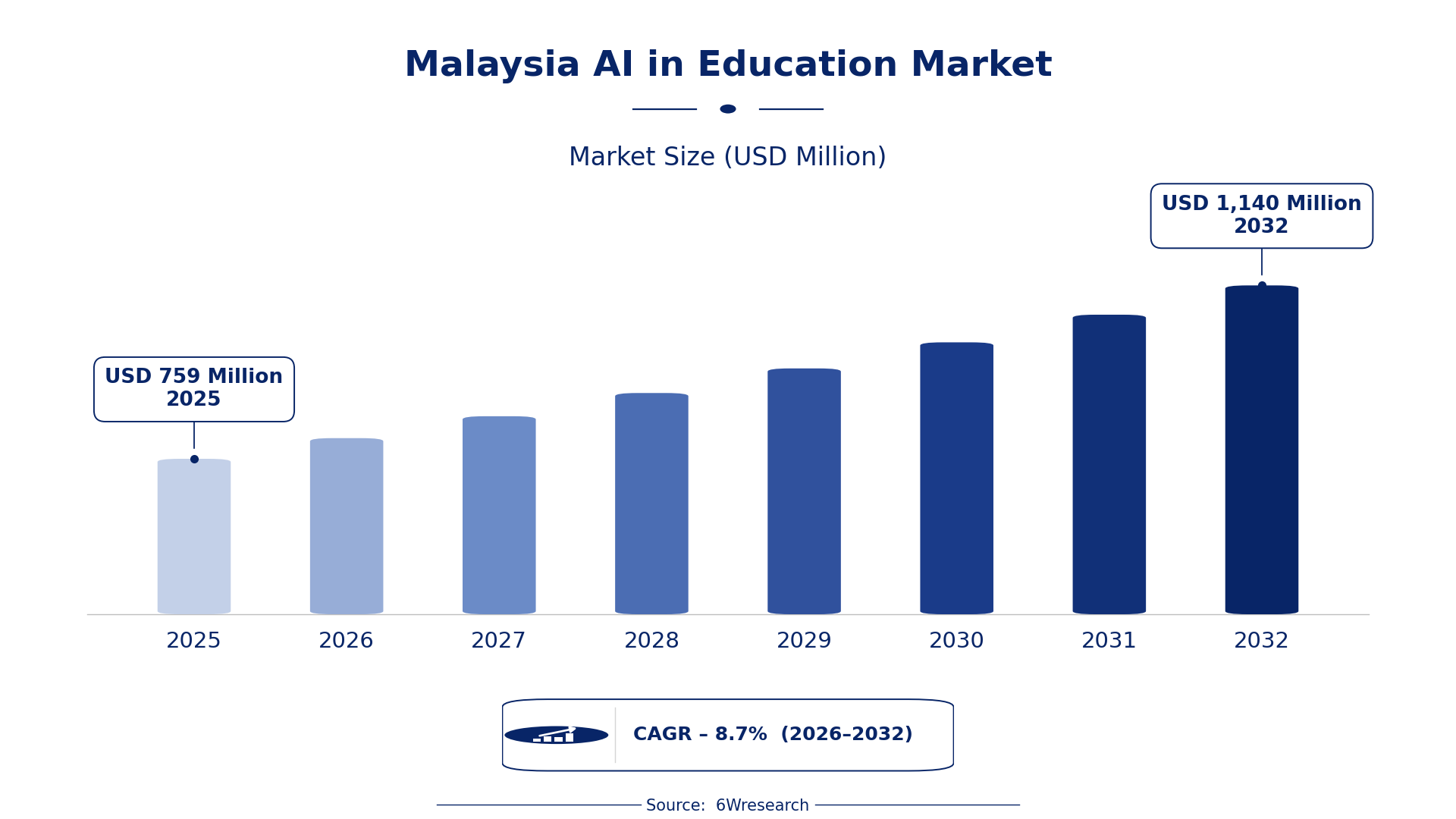
The Malaysia AI in Education Market was estimated at USD 759 Million in 2025 and is projected to reach USD 1140 Million by 2032, growing at a CAGR of 8.7% from 2026 to 2032.
Malaysia AI in Education Market Synopsis
As educational institutions in Malaysia increasingly seek methods to enhance student engagement, AI technology is becoming a vital tool. Adaptive learning systems are on the rise, offering personalized experiences that cater to individual student needs.
The adoption of AI in education is not just a trend; it's a response to the growing demand for interactive learning environments. Schools and universities are leveraging AI for automating administrative tasks, allowing educators to focus more on teaching rather than paperwork.
Malaysia AI in Education Market Year-wise Growth Rate and Key Drivers
This graph illustrates the annual growth rates of the Malaysia AI in Education Market from 2021 to 2032, highlighting a steady upward trajectory and projected expansion over the forecast period.
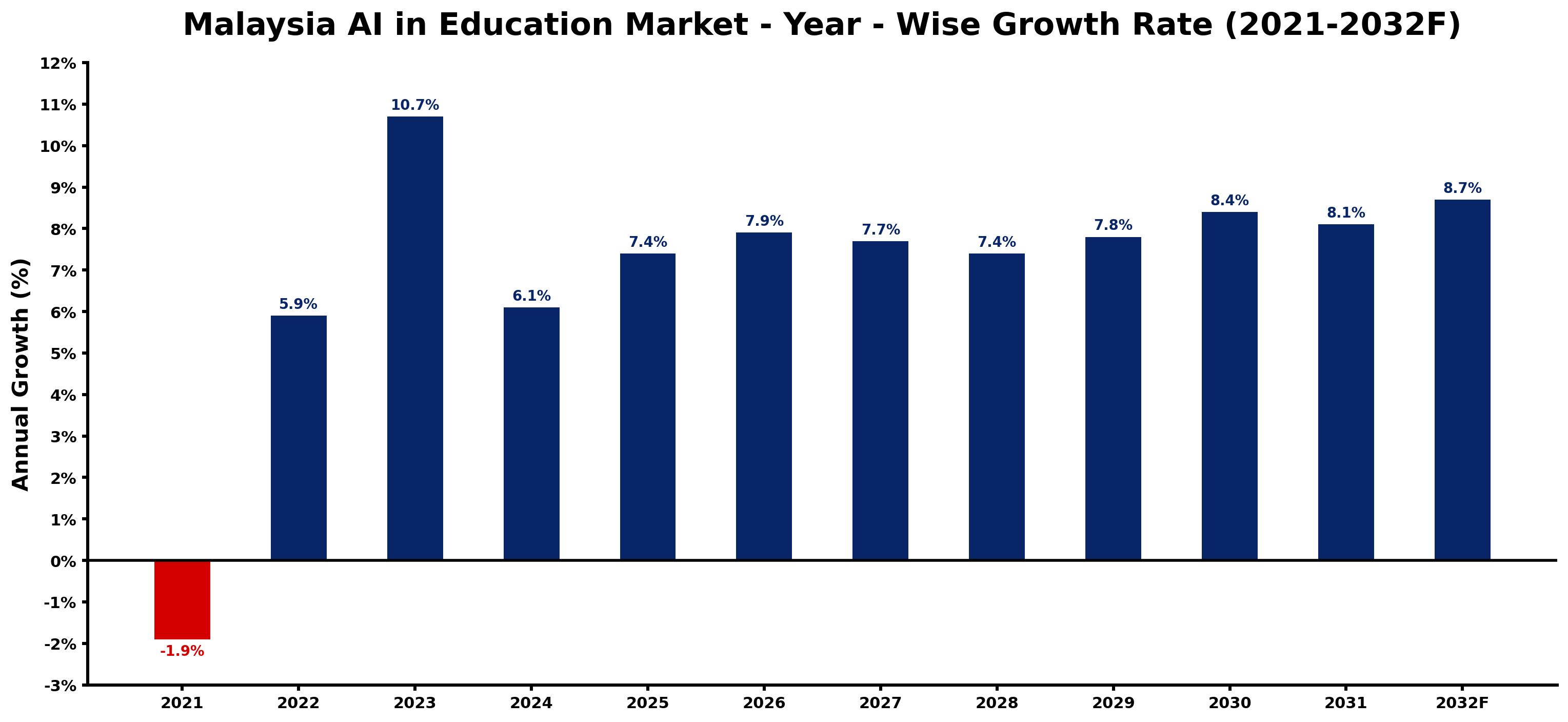
The table below presents the year‑wise growth rates along with the key drivers influencing the market
| Year | Growth Rate | Major Drivers |
| 2021 | -1.9% | National education budget cuts by Ministry of Education |
| 2022 | 5.9% | Ministry of Education's AI curriculum initiative launch. |
| 2023 | 10.7% | Government funding for AI-driven educational tools. |
| 2024 | 6.1% | Increased enrollment in online courses using AI technologies. |
| 2025 | 7.4% | Growing need for personalized learning solutions in schools. |
| 2026 | 7.9% | Implementation of AI assessment systems in public universities. |
| 2027 | 7.7% | Rising interest in innovative pedagogical methods leveraging AI. |
| 2028 | 7.4% | Substantial investments in EdTech by local venture capital. |
| 2029 | 7.8% | Collaborations between universities and tech companies for AI research. |
| 2030 | 8.4% | National digital literacy program fostering AI awareness. |
| 2031 | 8.1% | Emphasis on AI skills training in vocational schools. |
| 2032 | 8.7% | Local demand for AI tutors in remote education settings. |
Note: Market size estimations and growth projections presented in this report are based on 6Wresearch's proprietary forecasting methodology, utilizing the latest available industry data, government publications, and primary research inputs.
Malaysia AI in Education Market Key Takeaways
Below are some of the specific key takeaways from the market, including:
- AI technologies are tailored for personalized learning experiences that adapt to student needs.
- Institutions are increasingly using AI to analyze student performance and enhance educational outcomes.
- There is a growing emphasis on culturally relevant content and methodologies in AI applications.
- The pandemic accelerated the shift towards digital learning solutions that utilize AI tools.
- Data privacy and security concerns are critical considerations as AI adoption expands.
Evaluation of Restraints in Malaysia AI in Education Market
The market faces challenges that hinder its potential. One of the primary restraints is the necessity for educational content that resonates culturally with Malaysia's diverse population. The educational system's structure, comprising various languages and curricula, complicates the implementation of standardized AI solutions. on top of that, concerns about data security and privacy add layers of complexity, as institutions must ensure compliance with regulations while integrating AI technologies.
Malaysia AI in Education Market Trends
Several trends are shaping the direction of AI in education within Malaysia. There's a marked shift towards personalized learning, where AI systems analyze student data to customize educational experiences. Additionally, AI-driven platforms are gaining traction for their ability to assess learning outcomes efficiently.
The demand for remote learning solutions continues to grow, propelled by the experiences of the COVID-19 pandemic. This has led institutions to explore AI tools that enhance online education quality, fostering engagement and interactivity in virtual classrooms.
Malaysia AI in Education Market Opportunities
The future holds numerous opportunities for growth in this market. There is an increasing need for AI solutions that cater to different learning styles and backgrounds, which presents a chance for companies to innovate. Investing in AI technologies that offer administrative efficiencies can also help institutions reduce costs and improve service delivery. on top of that, the rising trend of hybrid learning environments opens avenues for AI applications to enhance both in-person and online education.
Government Initiatives in the Malaysia AI in Education Market
Government policy is significantly influencing the trajectory of the AI in education market in Malaysia. The focus on enhancing digital learning capabilities and integrating AI into educational frameworks has become a priority for policymakers. Initiatives aimed at improving educational access and quality through technology underline the importance of a supportive regulatory environment.
- A national digital infrastructure upgrade programme has been launched, aiming to enhance connectivity in schools across the country.
- Currently underway is a pilot project aimed at integrating AI tools into the curriculum of selected educational institutions, focusing on personalized learning experiences.
- A public-private partnership initiative is planned for 2026, designed to develop AI training programs for educators to better utilize technology in classrooms.
- The Ministry of Education has recently introduced guidelines for data privacy in educational institutions utilizing AI technologies.
- A new regulatory framework is anticipated by 2027, focusing on ethical AI use in education, ensuring fairness and transparency.
Future Insights of the Malaysia AI in Education Market
Looking ahead, the Malaysia AI in Education market is expected to continue its upward trajectory through 2032. As educational institutions prioritize enhancing student engagement and outcomes, AI will play a more central role in the curriculum. The push for more localized content and culturally relevant learning tools will drive innovation. on top of that, the increasing emphasis on data analytics will empower educators to make informed decisions, ultimately leading to improved educational standards across the nation.
Malaysia AI in Education Market Latest Developments
Recent activity in the Malaysia AI in Education market reflects a strong commitment to integrating technology into the learning process. Educational institutions are increasingly recognizing the value of AI solutions in enhancing both teaching and administrative functions.
- A leading regional operator has initiated a project to implement AI-driven assessment tools in schools, with a rollout expected to start in early 2026.
- A major technology vendor launched an AI-powered tutoring platform in late 2025 that tailors learning experiences to individual student needs.
- In mid-2025, a collaborative initiative between universities and tech companies commenced, focusing on developing AI applications for educational content delivery.
- Upcoming in 2026 is a state-sponsored program aimed at training teachers in AI technologies, enhancing their ability to facilitate digital learning.
- An initiative started in Q1 2025 to upgrade the digital infrastructure in rural schools is ongoing, aimed at increasing access to AI educational tools.
Malaysia AI in Education Market - Key Attractiveness of the Report
- 10 Years of Market Numbers
- Historical Data Starting from 2022 to 2025
- Base Year: 2025
- Forecast Data until 2032
- Key Performance Indicators Impacting the Market
- Major Upcoming Developments and Projects
Key Highlights of the Report:
- Malaysia AI in Education Market Outlook
- Market Size of Malaysia AI in Education Market, 2025
- Forecast of Malaysia AI in Education Market, 2032
- Historical Data and Forecast of Malaysia AI in Education Revenues & Volume for the Period 2022-2032F
- Malaysia AI in Education Market Trend Evolution
- Malaysia AI in Education Market Drivers and Challenges
- Malaysia AI in Education Price Trends
- Malaysia AI in Education Porter's Five Forces
- Malaysia AI in Education Industry Life Cycle
- Historical Data and Forecast of Malaysia AI in Education Market Revenues & Volume By Technology for the Period 2022-2032F
- Historical Data and Forecast of Malaysia AI in Education Market Revenues & Volume By Deep Learning and Machine Learning for the Period 2022-2032F
- Historical Data and Forecast of Malaysia AI in Education Market Revenues & Volume By Natural Language Processing (NLP) for the Period 2022-2032F
- Historical Data and Forecast of Malaysia AI in Education Market Revenues & Volume By Component for the Period 2022-2032F
- Historical Data and Forecast of Malaysia AI in Education Market Revenues & Volume By Solutions for the Period 2022-2032F
- Historical Data and Forecast of Malaysia AI in Education Market Revenues & Volume By Services for the Period 2022-2032F
- Historical Data and Forecast of Malaysia AI in Education Market Revenues & Volume By Application for the Period 2022-2032F
- Historical Data and Forecast of Malaysia AI in Education Market Revenues & Volume By Virtual Facilitators and Learning Environments for the Period 2022-2032F
- Historical Data and Forecast of Malaysia AI in Education Market Revenues & Volume By Intelligent Tutoring Systems (ITS) for the Period 2022-2032F
- Historical Data and Forecast of Malaysia AI in Education Market Revenues & Volume By Content Delivery Systems for the Period 2022-2032F
- Historical Data and Forecast of Malaysia AI in Education Market Revenues & Volume By Fraud and Risk Management for the Period 2022-2032F
- Historical Data and Forecast of Malaysia AI in Education Market Revenues & Volume By Student-initiated learning for the Period 2022-2032F
- Historical Data and Forecast of Malaysia AI in Education Market Revenues & Volume By Others for the Period 2022-2032F
- Historical Data and Forecast of Malaysia AI in Education Market Revenues & Volume By Deployment for the Period 2022-2032F
- Historical Data and Forecast of Malaysia AI in Education Market Revenues & Volume By Cloud for the Period 2022-2032F
- Historical Data and Forecast of Malaysia AI in Education Market Revenues & Volume By On-premises for the Period 2022-2032F
- Historical Data and Forecast of Malaysia AI in Education Market Revenues & Volume By End for the Period 2022-2032F
- Historical Data and Forecast of Malaysia AI in Education Market Revenues & Volume By Educational Institutes for the Period 2022-2032F
- Historical Data and Forecast of Malaysia AI in Education Market Revenues & Volume By Educational Publishers for the Period 2022-2032F
- Historical Data and Forecast of Malaysia AI in Education Market Revenues & Volume By Others for the Period 2022-2032F
- Malaysia AI in Education Import Export Trade Statistics
- Market Opportunity Assessment By Technology
- Market Opportunity Assessment By Component
- Market Opportunity Assessment By Application
- Market Opportunity Assessment By Deployment
- Market Opportunity Assessment By End
- Malaysia AI in Education Top Companies Market Share
- Malaysia AI in Education Competitive Benchmarking By Technical and Operational Parameters
- Malaysia AI in Education Company Profiles
- Malaysia AI in Education Key Strategic Recommendations






































