Malaysia AI in IoT Market Size & Growth Rate (2026-2032)
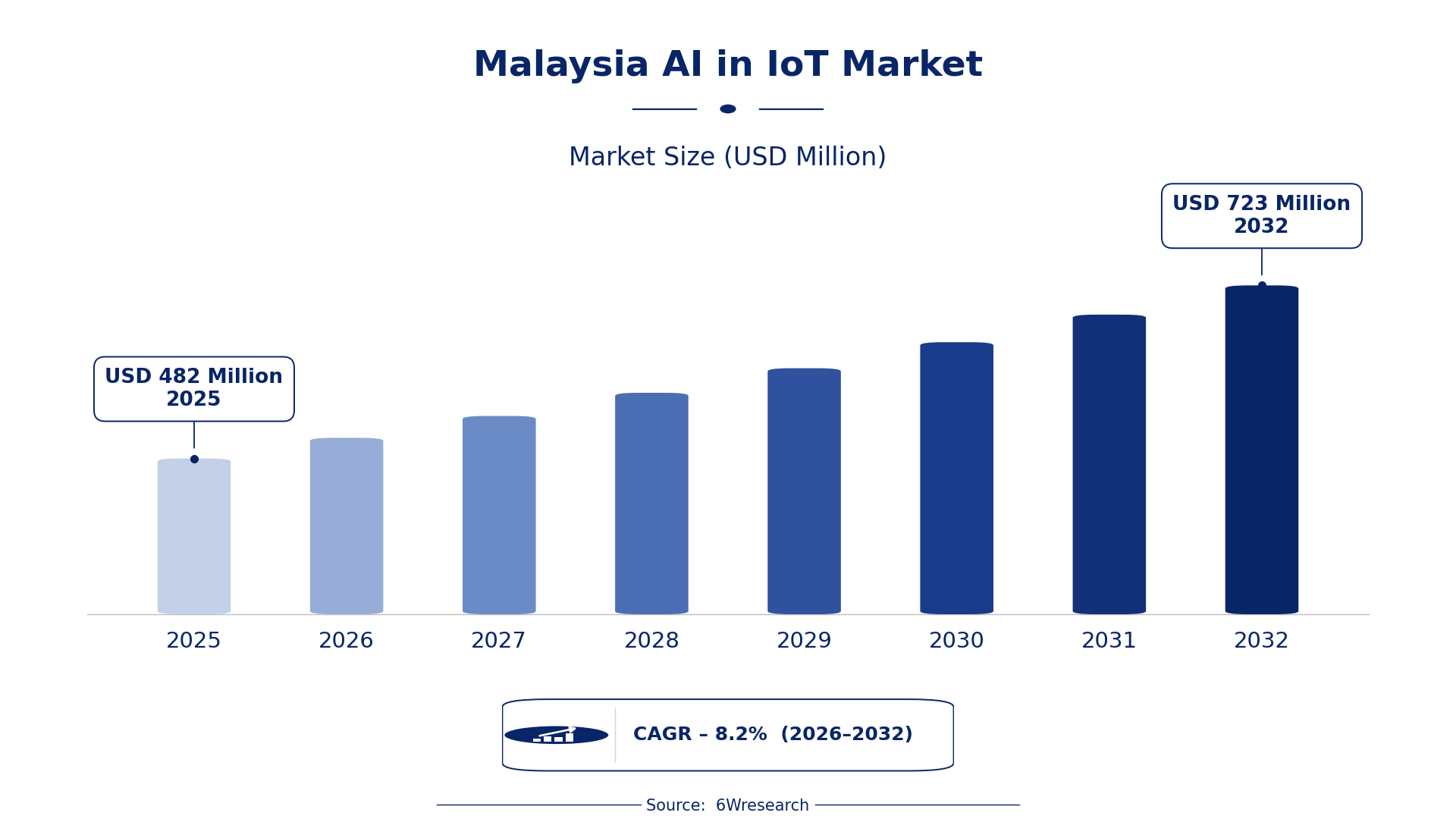
The Malaysia AI in IoT Market was estimated at USD 482 Million in 2025 and is projected to reach USD 723 Million by 2032, growing at a CAGR of 8.2% from 2026 to 2032.
Malaysia AI in IoT Market Synopsis
The integration of AI with IoT technologies is rapidly transforming the Malaysian tech scene. Companies across various sectors are increasingly adopting AI-driven insights to enhance their operations, improve efficiency, and elevate customer satisfaction.
Applications spanning smart cities, industrial automation, and healthcare demonstrate the versatility of AI in IoT. This convergence not only facilitates data-driven decision-making but also opens new avenues for innovation across industries.
Malaysia AI in IoT Market Year-wise Growth Rate and Key Drivers
This graph illustrates the annual growth rates of the Malaysia AI in IoT Market from 2021 to 2032, highlighting a steady upward trajectory and projected expansion over the forecast period.
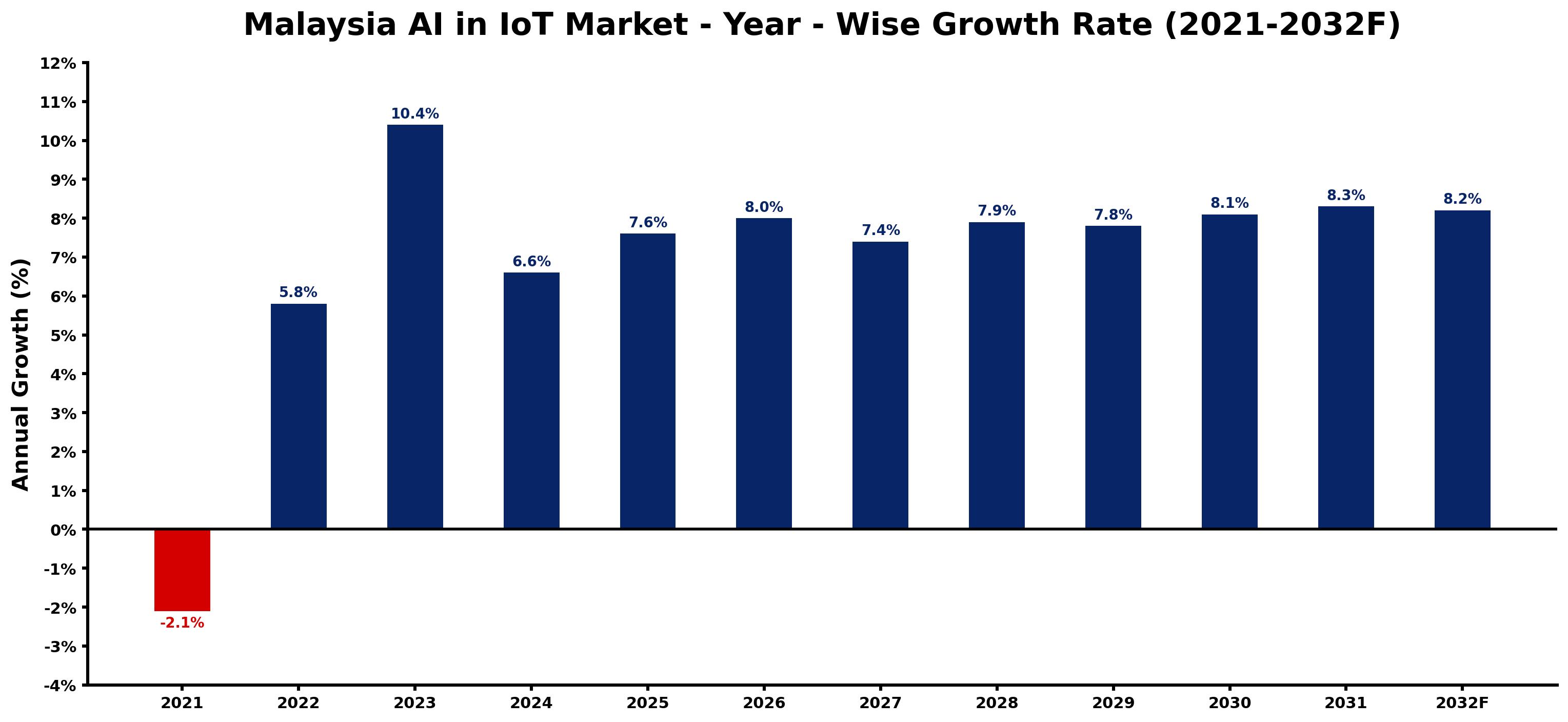
The table below presents the year‑wise growth rates along with the key drivers influencing the market
| Year | Growth Rate | Major Drivers |
| 2021 | -2.1% | Malaysian government cuts AI funding for startups. |
| 2022 | 5.8% | Malaysia's National IoT Roadmap enhancing AI integration. |
| 2023 | 10.4% | Launch of Malaysia Smart Cities Framework drives innovation. |
| 2024 | 6.6% | Government incentives for green technology adoption increase. |
| 2025 | 7.6% | Rising consumer demand for smart home devices. |
| 2026 | 8.0% | Malaysia’s Digital Economy Blueprint prioritizes AI development. |
| 2027 | 7.4% | Increased investment in local tech startups accelerates growth. |
| 2028 | 7.9% | Boost in industrial IoT applications within manufacturing sector. |
| 2029 | 7.8% | Enhanced data privacy regulations fostering trust in AI. |
| 2030 | 8.1% | Public sector embracing smart solutions for urban management. |
| 2031 | 8.3% | Partnerships between universities and tech firms stimulate research. |
| 2032 | 8.2% | Growing interest in AI-driven healthcare IoT solutions. |
Note: Market size estimations and growth projections presented in this report are based on 6Wresearch's proprietary forecasting methodology, utilizing the latest available industry data, government publications, and primary research inputs.
Malaysia AI in IoT Market Key Takeaways
Below are some of the specific key takeaways from the market, including:
- The synergy between AI and IoT is creating transformative solutions across various sectors.
- Malaysia's market is witnessing substantial investment in smart city initiatives and industrial automation.
- Data security and privacy concerns are critical challenges that organizations must address.
- Government initiatives are playing a key role in shaping the regulatory environment for AI in IoT.
- Businesses are increasingly prioritizing immediate, tangible benefits from AI-driven IoT applications.
Evaluation of Restraints in Malaysia AI in IoT Market
Despite the promising outlook, several factors are limiting the growth of the Malaysia AI in IoT market. The complexity of integrating AI into existing IoT frameworks is significant, often requiring specialized expertise and substantial resources. Data security remains a top concern, as the proliferation of IoT devices increases the risk of breaches. on top of that, the lack of standardization across platforms can complicate the deployment of AI solutions, making seamless integration a formidable challenge for many organizations.
Malaysia AI in IoT Market Trends
A notable trend is the increasing emphasis on predictive maintenance models enabled by AI, particularly within industrial sectors. Companies are leveraging AI to analyze data from IoT devices, allowing for proactive interventions that minimize downtime and reduce costs. Additionally, smart city projects are pushing the boundaries of innovation, integrating AI solutions to enhance urban living and optimize resource management. These trends highlight a clear shift toward more intelligent, data-driven operations.
Malaysia AI in IoT Market Opportunities
Investment opportunities abound in sectors such as healthcare, where AI can improve patient care through advanced monitoring systems and data analytics. The demand for smart city technologies also presents significant growth potential, with municipalities seeking innovative solutions to enhance infrastructure and service delivery. As businesses continue to realize the benefits of AI-driven IoT applications, the market is likely to expand further, presenting lucrative opportunities for technology providers and investors alike.
Government Initiatives in the Malaysia AI in IoT Market
The Malaysian government is actively fostering the growth of AI in the IoT sector through various initiatives. With a focus on enhancing the digital economy, policies are being developed to encourage innovation and investment in AI technologies. This proactive approach is critical for creating a conducive environment for businesses and ensuring that Malaysia remains competitive in the global tech arena.
- A national digital infrastructure upgrade programme recently completed aims to bolster connectivity for IoT devices across urban areas.
- Current initiatives include partnerships with tech firms to develop AI-driven solutions for public services, enhancing efficiency and responsiveness.
- Future plans involve a regulatory framework expected to launch by 2027, aimed at standardizing AI applications in IoT devices.
- The government is currently promoting a public-private initiative to expand access to IoT technologies in rural regions.
- Ongoing efforts include funding programs for startups focused on AI innovations in IoT, with applications open until late 2025.
Future Insights of the Malaysia AI in IoT Market
Looking ahead to 2026-2032, the Malaysia AI in IoT market is set to witness a significant uptick in adoption across various sectors. As businesses increasingly recognize the value of data-driven insights, demand for innovative solutions will surge. This trend will be supported by government initiatives aimed at enhancing digital infrastructure and promoting research and development. The convergence of AI and IoT is expected to redefine operational efficiencies, paving the way for a more integrated and intelligent approach to business.
Malaysia AI in IoT Market Latest Developments
Over the past year, the Malaysia AI in IoT market has seen a flurry of activity, with companies ramping up their investments in technology and innovation. This has led to a variety of developments that reflect the growing importance of AI in enhancing IoT capabilities.
- A major technology vendor launched a new AI analytics platform in Q1 2025, designed to optimize data from IoT devices for various industries.
- In early 2025, a collaborative project between several regional operators was initiated to create an IoT ecosystem that integrates AI solutions for smart cities.
- Ongoing partnerships between local startups and government agencies focus on developing AI-driven applications for healthcare monitoring, currently in the pilot phase.
- A planned rollout of AI-enhanced IoT solutions for energy management is expected to begin in mid-2026, targeting industrial users.
- Recently, a pilot program was completed, showcasing the effectiveness of AI in enhancing predictive maintenance across manufacturing facilities.
Malaysia AI in IoT Market - Key Attractiveness of the Report
- 10 Years of Market Numbers
- Historical Data Starting from 2022 to 2025
- Base Year: 2025
- Forecast Data until 2032
- Key Performance Indicators Impacting the Market
- Major Upcoming Developments and Projects
Key Highlights of the Report:
- Malaysia AI in IoT Market Outlook
- Market Size of Malaysia AI in IoT Market, 2025
- Forecast of Malaysia AI in IoT Market, 2032
- Historical Data and Forecast of Malaysia AI in IoT Revenues & Volume for the Period 2022-2032F
- Malaysia AI in IoT Market Trend Evolution
- Malaysia AI in IoT Market Drivers and Challenges
- Malaysia AI in IoT Price Trends
- Malaysia AI in IoT Porter's Five Forces
- Malaysia AI in IoT Industry Life Cycle
- Historical Data and Forecast of Malaysia AI in IoT Market Revenues & Volume By Component for the Period 2022-2032F
- Historical Data and Forecast of Malaysia AI in IoT Market Revenues & Volume By Platforms for the Period 2022-2032F
- Historical Data and Forecast of Malaysia AI in IoT Market Revenues & Volume By Software Solutions for the Period 2022-2032F
- Historical Data and Forecast of Malaysia AI in IoT Market Revenues & Volume By Services for the Period 2022-2032F
- Historical Data and Forecast of Malaysia AI in IoT Market Revenues & Volume By Vertical for the Period 2022-2032F
- Historical Data and Forecast of Malaysia AI in IoT Market Revenues & Volume By Manufacturing for the Period 2022-2032F
- Historical Data and Forecast of Malaysia AI in IoT Market Revenues & Volume By Energy and Utilities for the Period 2022-2032F
- Historical Data and Forecast of Malaysia AI in IoT Market Revenues & Volume By Transportation and Mobility for the Period 2022-2032F
- Historical Data and Forecast of Malaysia AI in IoT Market Revenues & Volume By BFSI for the Period 2022-2032F
- Historical Data and Forecast of Malaysia AI in IoT Market Revenues & Volume By Government and Defense for the Period 2022-2032F
- Historical Data and Forecast of Malaysia AI in IoT Market Revenues & Volume By Retail for the Period 2022-2032F
- Historical Data and Forecast of Malaysia AI in IoT Market Revenues & Volume By Healthcare and Life Sciences for the Period 2022-2032F
- Historical Data and Forecast of Malaysia AI in IoT Market Revenues & Volume By Telecom for the Period 2022-2032F
- Historical Data and Forecast of Malaysia AI in IoT Market Revenues & Volume By Technology for the Period 2022-2032F
- Historical Data and Forecast of Malaysia AI in IoT Market Revenues & Volume By ML and Deep Learning for the Period 2022-2032F
- Historical Data and Forecast of Malaysia AI in IoT Market Revenues & Volume By NLP for the Period 2022-2032F
- Malaysia AI in IoT Import Export Trade Statistics
- Market Opportunity Assessment By Component
- Market Opportunity Assessment By Vertical
- Market Opportunity Assessment By Technology
- Malaysia AI in IoT Top Companies Market Share
- Malaysia AI in IoT Competitive Benchmarking By Technical and Operational Parameters
- Malaysia AI in IoT Company Profiles
- Malaysia AI in IoT Key Strategic Recommendations






































