Malaysia Air Traffic Control (ATC) Equipment Market Size, Share & Growth Rate
The Malaysia Air Traffic Control (ATC) Equipment Market was estimated at USD 714 Million in 2025 and is projected to reach USD 1070 Million by 2032, growing at a CAGR of 5.9% from 2026 to 2032. This growth trajectory is propelled by an increase in air travel frequency, which compels upgrades to aging infrastructure and a push towards modernization. Additionally, the integration of advanced technologies like automation and data analytics is essential for enhancing operational efficiency and safety in air traffic management.
Malaysia Air Traffic Control (ATC) Equipment Market Year-wise Growth Rate and Key Drivers
This graph highlights how the Malaysia Air Traffic Control (ATC) Equipment Market has steadily grown over the years, supported by major growth factors.
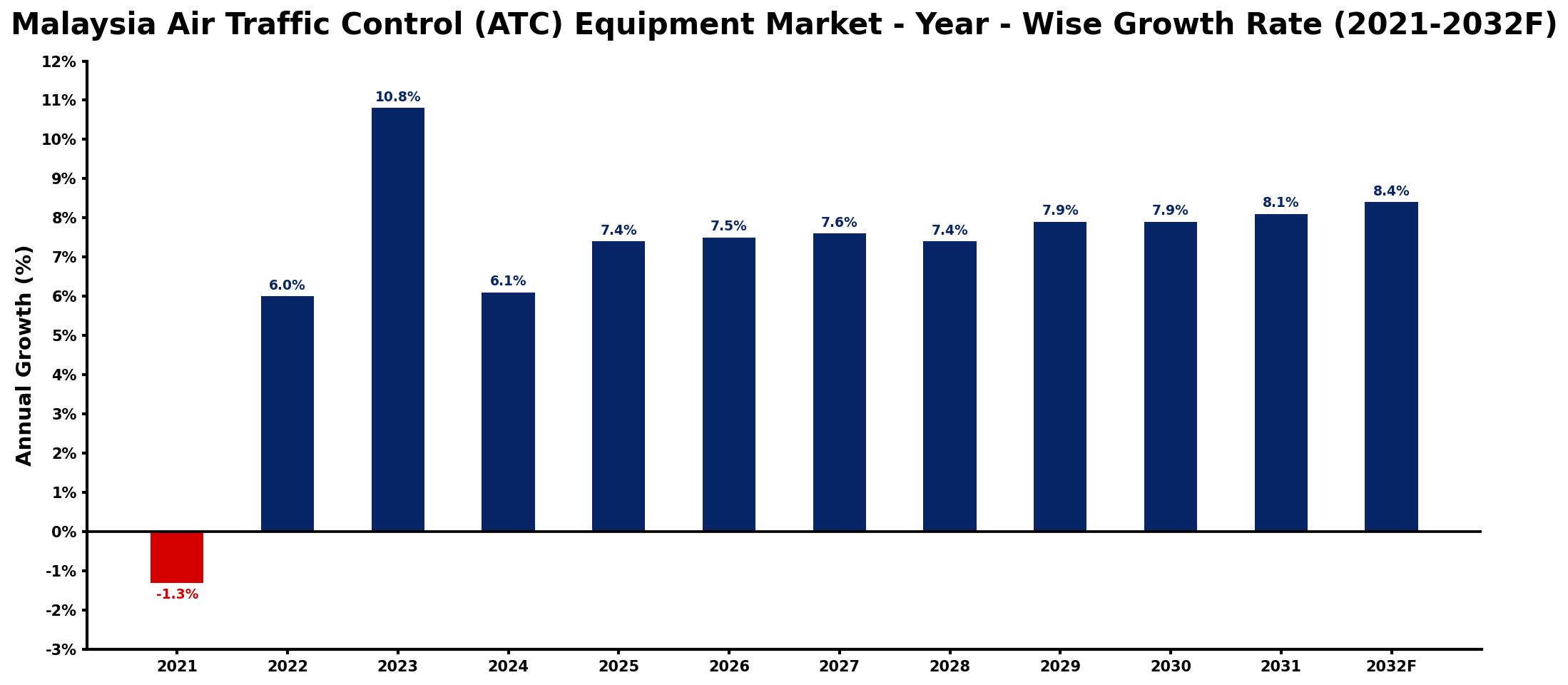
The table below presents the year‑wise growth rates along with the key drivers influencing the market
| Year | Growth Rate | Major Drivers |
| 2021 | -1.3% | decreased investments in infrastructure |
| 2022 | 6.0% | growing demand for modernization solutions |
| 2023 | 10.8% | increased passenger travel recovery |
| 2024 | 6.1% | expansion of regional flight routes |
| 2025 | 7.4% | rising government funding initiatives |
| 2026 | 7.5% | advancements in technology integration |
| 2027 | 7.6% | enhanced safety regulations implementation |
| 2028 | 7.4% | growing private sector partnerships |
| 2029 | 7.9% | increased international collaboration efforts |
| 2030 | 7.9% | rising environmental sustainability focus |
| 2031 | 8.1% | expanding urban development projects |
| 2032 | 8.4% | increased regional tourism initiatives |
Note: Market size estimations and growth projections presented in this report are based on 6Wresearch's proprietary forecasting methodology, utilizing the latest available industry data, government publications, and primary research inputs.
Malaysia Air Traffic Control (ATC) Equipment Market Synopsis
In recent years, the Malaysia ATC equipment market has gained significant momentum, driven by a surge in air travel demand and government investments in aviation infrastructure. However, the horizon presents a dynamic shift as the sector transitions towards more sophisticated ATC technologies that prioritize efficiency and security.
As the aviation industry evolves, Malaysia's commitment to upgrading its air traffic control systems is expected to foster substantial growth in this market. The ongoing developments in technology and rising concerns about safety and cybersecurity are shaping a robust framework for future investments in ATC equipment.
Malaysia Air Traffic Control (ATC) Equipment Market Key Takeaways
- The market is poised for considerable growth, fueled by rising air traffic and modernization efforts.
- Investment in automation and advanced surveillance systems is critical for enhancing efficiency and safety.
- Cybersecurity measures are becoming increasingly vital to protect sensitive aviation data.
- Government initiatives play a significant role in driving infrastructure improvements.
- The market outlook remains positive despite short-term fluctuations caused by global events like the pandemic.
Evaluation of Restraints in Malaysia Air Traffic Control (ATC) Equipment Market
While the Malaysia ATC equipment market is on an upward trajectory, several constraints persist. Ensuring safety amidst increasing air traffic remains a challenge, as does the need to continually adopt cutting-edge technologies that align with international standards. Additionally, the risk of cybersecurity threats poses a significant hurdle, necessitating ongoing investment in protective measures. Balancing these factors with the demand for modernized infrastructure will be crucial as the market evolves.
Malaysia Air Traffic Control (ATC) Equipment Market Trends
Automation is a primary trend shaping the future of the Malaysia ATC equipment market. As aviation authorities seek to optimize air traffic management, the integration of AI and machine learning technologies is becoming increasingly prevalent. Furthermore, the emphasis on data analytics will enhance decision-making processes for air traffic controllers. Additionally, the growing focus on cybersecurity measures underscores the necessity of protecting aviation data from emerging threats, ensuring that the infrastructure can withstand potential attacks.
Malaysia Air Traffic Control (ATC) Equipment Market Opportunities
The expansion of Malaysia's air travel sector presents substantial opportunities for investment in ATC equipment. Infrastructure upgrades, including the establishment of new airports and the renovation of existing facilities, will create demand for state-of-the-art ATC systems. Moreover, collaborations with technology firms specializing in cybersecurity and data analytics will enable the development of robust and innovative solutions tailored to meet the evolving needs of the aviation industry.
Government Initiatives in the Malaysia Air Traffic Control (ATC) Equipment Market
The Malaysian government has recognized the importance of a modern air traffic control system in enhancing national airspace safety. Initiatives include increased public spending on airport infrastructure and comprehensive policies aimed at facilitating technological advancements in ATC equipment. Programs supporting the adoption of automated and intelligent systems indicate a long-term commitment to improving operational efficiency and ensuring that Malaysia remains competitive in the global aviation market.
Future Insights of the Malaysia Air Traffic Control (ATC) Equipment Market
Looking ahead to 2026-2032, the Malaysia ATC equipment market is expected to adapt and evolve significantly. With the anticipated recovery in air travel following the pandemic, demand for advanced ATC systems will escalate. Investment in technological innovations will not only support the growing air traffic but will also prioritize safety and efficiency in operations. This forward momentum will be pivotal in shaping a resilient aviation sector, capable of tackling the complexities of modern airspace management.
Malaysia Air Traffic Control (ATC) Equipment Market Latest Developments (2025 - 2026)
Recent developments in the Malaysia ATC equipment market indicate a strong shift towards integrating cutting-edge technology. There is a noticeable trend toward the deployment of automated systems and enhanced surveillance technologies, driven by the need for operational efficiency. Additionally, increased emphasis on cybersecurity measures highlights the sector's proactive approach to safeguarding aviation data and ensuring the resilience of ATC systems against potential threats.
Malaysia Air Traffic Control (ATC) Equipment Market - Key Attractiveness of the Report
- 10 Years of Market Numbers
- Historical Data Starting from 2022 to 2025
- Base Year: 2025
- Forecast Data until 2032
- Key Performance Indicators Impacting the Market
- Major Upcoming Developments and Projects
Key Highlights of the Report:
- Malaysia Air Traffic Control (ATC) Equipment Market Outlook
- Market Size of Malaysia Air Traffic Control (ATC) Equipment Market, 2025
- Forecast of Malaysia Air Traffic Control (ATC) Equipment Market, 2032
- Historical Data and Forecast of Malaysia Air Traffic Control (ATC) Equipment Revenues & Volume for the Period 2022-2032F
- Malaysia Air Traffic Control (ATC) Equipment Market Trend Evolution
- Malaysia Air Traffic Control (ATC) Equipment Market Drivers and Challenges
- Malaysia Air Traffic Control (ATC) Equipment Price Trends
- Malaysia Air Traffic Control (ATC) Equipment Porter's Five Forces
- Malaysia Air Traffic Control (ATC) Equipment Industry Life Cycle
- Historical Data and Forecast of Malaysia Air Traffic Control (ATC) Equipment Market Revenues & Volume By Product for the Period 2022-2032F
- Historical Data and Forecast of Malaysia Air Traffic Control (ATC) Equipment Market Revenues & Volume By Communications Equipment for the Period 2022-2032F
- Historical Data and Forecast of Malaysia Air Traffic Control (ATC) Equipment Market Revenues & Volume By Navigation Equipment for the Period 2022-2032F
- Historical Data and Forecast of Malaysia Air Traffic Control (ATC) Equipment Market Revenues & Volume By Surveillance Equipment for the Period 2022-2032F
- Historical Data and Forecast of Malaysia Air Traffic Control (ATC) Equipment Market Revenues & Volume By Air Traffic Control Equipment Application Outlook (USD Million, 2023-2032) for the Period 2022-2032F
- Historical Data and Forecast of Malaysia Air Traffic Control (ATC) Equipment Market Revenues & Volume By Commercial Aircraft for the Period 2022-2032F
- Historical Data and Forecast of Malaysia Air Traffic Control (ATC) Equipment Market Revenues & Volume By Private Aircraft for the Period 2022-2032F
- Historical Data and Forecast of Malaysia Air Traffic Control (ATC) Equipment Market Revenues & Volume By Military Aircraft for the Period 2022-2032F
- Malaysia Air Traffic Control (ATC) Equipment Import Export Trade Statistics
- Market Opportunity Assessment By Product
- Malaysia Air Traffic Control (ATC) Equipment Top Companies Market Share
- Malaysia Air Traffic Control (ATC) Equipment Competitive Benchmarking By Technical and Operational Parameters
- Malaysia Air Traffic Control (ATC) Equipment Company Profiles
- Malaysia Air Traffic Control (ATC) Equipment Key Strategic Recommendations






































