Malaysia Aircraft Cabin Interior Market Size, Share & Growth Rate
The Malaysia Aircraft Cabin Interior Market was estimated at USD 1104 Million in 2025 and is projected to reach USD 1663 Million by 2032, growing at a CAGR of 6.0% from 2026 to 2032. This growth trajectory is driven by a booming aviation industry and an increasing emphasis on enhancing passenger experiences. As airlines focus on upgrading cabin interiors to attract discerning travelers, the market is poised for significant expansion over the coming years.
Malaysia Aircraft Cabin Interior Market Year-wise Growth Rate and Key Drivers
This graph highlights how the Malaysia Aircraft Cabin Interior Market has steadily grown over the years, supported by major growth factors.
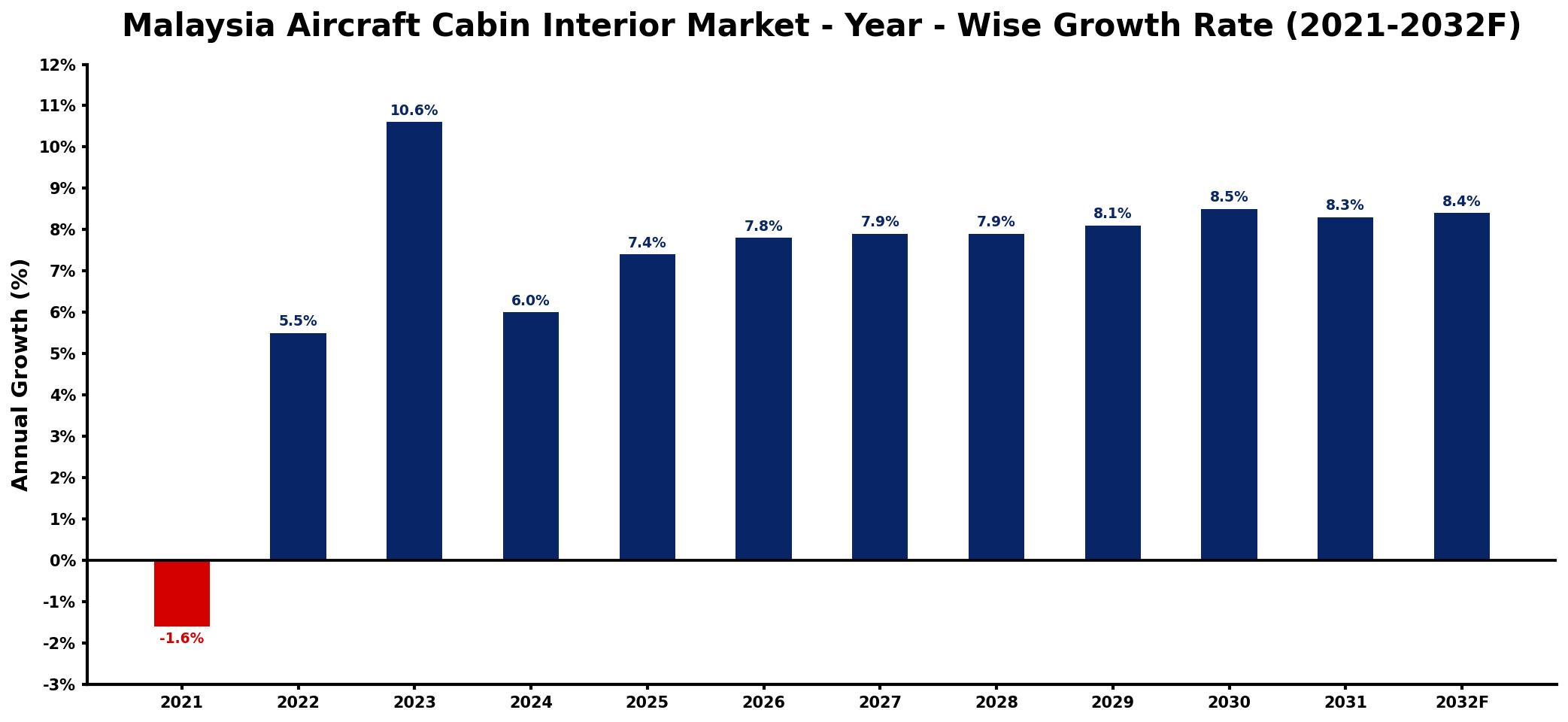
The table below presents the year‑wise growth rates along with the key drivers influencing the market
| Year | Growth Rate | Major Drivers |
| 2021 | -1.6% | decreased consumer travel preferences |
| 2022 | 5.5% | rising investments in aviation sector |
| 2023 | 10.6% | increased focus on passenger comfort |
| 2024 | 6.0% | growing demand for eco-friendly solutions |
| 2025 | 7.4% | expansion of low-cost carriers |
| 2026 | 7.8% | enhanced technology integration in design |
| 2027 | 7.9% | increased airline fleet modernization |
| 2028 | 7.9% | emerging trends in luxury travel |
| 2029 | 8.1% | growing emphasis on safety standards |
| 2030 | 8.5% | rising demand for customization options |
| 2031 | 8.3% | increased partnerships with manufacturers |
| 2032 | 8.4% | enhanced product quality standards |
Note: Market size estimations and growth projections presented in this report are based on 6Wresearch's proprietary forecasting methodology, utilizing the latest available industry data, government publications, and primary research inputs.
Malaysia Aircraft Cabin Interior Market Synopsis
The prevailing force shaping the Malaysia Aircraft Cabin Interior Market is the growing demand for improved passenger comfort and experience. As Malaysia positions itself as a key regional transportation hub, airlines are making substantial investments in cabin upgrades that feature innovative designs and state-of-the-art materials.
These enhancements are not merely cosmetic; they are strategic moves to differentiate services in a highly competitive market. Airlines are increasingly exploring advanced technologies to cater to evolving passenger expectations, making the cabin interior segment a focal point of investment and innovation.
Malaysia Aircraft Cabin Interior Market Key Takeaways
- The market is set for robust growth, fueled by the increasing demand for enhanced passenger comfort and innovative cabin designs.
- Airlines are focusing on retrofitting existing fleets, particularly in response to the evolving landscape post-COVID-19.
- Technological advancements in materials and in-flight entertainment systems are key drivers of innovation.
- Investment opportunities are emerging for suppliers who can adapt to changing passenger needs and preferences.
- Compliance with stringent aviation regulations poses both challenges and opportunities for market players.
Evaluation of Restraints in Malaysia Aircraft Cabin Interior Market
The Malaysia Aircraft Cabin Interior Market faces significant constraints stemming from fluctuating passenger expectations and broader economic conditions. Adapting to the diverse demands for comfort, entertainment, and convenience within the confines of aircraft interiors presents a consistent challenge for airlines. Coupled with the necessity of maintaining cost efficiency, this dynamic complicates investment and decision-making processes. Additionally, the rapid pace of technological change in materials and systems requires ongoing adaptability, often stretching the resources of manufacturers who must comply with rigorous safety and regulatory standards.
Malaysia Aircraft Cabin Interior Market Trends
Current trends in the Malaysia Aircraft Cabin Interior Market reflect a marked shift towards sustainability and passenger-centered designs. The integration of lightweight materials is becoming increasingly prevalent, as airlines seek to improve fuel efficiency without sacrificing comfort. Moreover, the demand for personalized in-flight experiences is growing, with features such as customizable lighting and advanced entertainment options taking center stage. The rise of health-conscious travel post-pandemic is also driving interest in antimicrobial materials and touchless technologies, further shaping the market landscape.
Malaysia Aircraft Cabin Interior Market Opportunities
Genuine growth opportunities abound in the Malaysia Aircraft Cabin Interior Market, particularly for suppliers who specialize in innovative materials and solutions that enhance passenger experience. As airlines retrofit older models to meet new standards, there exists an expanding market for modernized cabin components, including modular seating and flexible configurations. Additionally, the focus on eco-friendly materials and technologies opens avenues for companies committed to sustainability, allowing them to forge strong partnerships with airlines prioritizing greener operations.
Government Initiatives in the Malaysia Aircraft Cabin Interior Market
The Malaysian government has implemented several initiatives aimed at fostering the growth of the aviation sector, with specific emphasis on improving air travel infrastructure and safety standards. Public spending in airport upgrades and incentives for airlines to modernize their fleets is encouraging significant investment in cabin interior enhancements. Moreover, policies promoting technological innovation within the aviation industry support market players looking to adapt to emerging trends and improve overall passenger experience.
Future Insights of the Malaysia Aircraft Cabin Interior Market
Looking ahead to 2026-2032, the Malaysia Aircraft Cabin Interior Market is expected to evolve significantly as airlines prioritize passenger satisfaction in an increasingly competitive landscape. With a focus on adopting next-generation technologies, we can anticipate more widespread use of augmented reality for cabin designs and enhanced personalization options for travelers. The trend towards sustainability will likely continue to shape supplier partnerships, driving innovations in both materials and manufacturing processes. Overall, the market is poised for robust growth as it adapts to the future needs of the aviation sector.
Malaysia Aircraft Cabin Interior Market Latest Developments (2025 - 2026)
In recent months, the industry has witnessed a pivot towards incorporating advanced health and safety features in aircraft interiors, driven by the lingering impacts of the COVID-19 pandemic. Airlines are actively retrofitting aircraft with improved air filtration systems and antimicrobial surfaces to enhance passenger safety. Additionally, several key manufacturers are exploring collaborations focused on the development of sustainable materials and innovative designs to meet the evolving demands of travelers, signaling a proactive response to market changes.
Malaysia Aircraft Cabin Interior Market - Key Attractiveness of the Report
- 10 Years of Market Numbers
- Historical Data Starting from 2022 to 2025
- Base Year: 2025
- Forecast Data until 2032
- Key Performance Indicators Impacting the Market
- Major Upcoming Developments and Projects
Key Highlights of the Report:
- Malaysia Aircraft Cabin Interior Market Outlook
- Market Size of Malaysia Aircraft Cabin Interior Market, 2025
- Forecast of Malaysia Aircraft Cabin Interior Market, 2032
- Historical Data and Forecast of Malaysia Aircraft Cabin Interior Revenues & Volume for the Period 2022-2032F
- Malaysia Aircraft Cabin Interior Market Trend Evolution
- Malaysia Aircraft Cabin Interior Market Drivers and Challenges
- Malaysia Aircraft Cabin Interior Price Trends
- Malaysia Aircraft Cabin Interior Porter's Five Forces
- Malaysia Aircraft Cabin Interior Industry Life Cycle
- Historical Data and Forecast of Malaysia Aircraft Cabin Interior Market Revenues & Volume By Type for the Period 2022-2032F
- Historical Data and Forecast of Malaysia Aircraft Cabin Interior Market Revenues & Volume By Seats for the Period 2022-2032F
- Historical Data and Forecast of Malaysia Aircraft Cabin Interior Market Revenues & Volume By Cabin Lightening for the Period 2022-2032F
- Historical Data and Forecast of Malaysia Aircraft Cabin Interior Market Revenues & Volume By Windows and Windshields for the Period 2022-2032F
- Historical Data and Forecast of Malaysia Aircraft Cabin Interior Market Revenues & Volume By Galley and Lavatory for the Period 2022-2032F
- Historical Data and Forecast of Malaysia Aircraft Cabin Interior Market Revenues & Volume By In-Flight Entertainment & Connectivity for the Period 2022-2032F
- Historical Data and Forecast of Malaysia Aircraft Cabin Interior Market Revenues & Volume By Others for the Period 2022-2032F
- Historical Data and Forecast of Malaysia Aircraft Cabin Interior Market Revenues & Volume By Class for the Period 2022-2032F
- Historical Data and Forecast of Malaysia Aircraft Cabin Interior Market Revenues & Volume By First Class for the Period 2022-2032F
- Historical Data and Forecast of Malaysia Aircraft Cabin Interior Market Revenues & Volume By Business Class for the Period 2022-2032F
- Historical Data and Forecast of Malaysia Aircraft Cabin Interior Market Revenues & Volume By Premium Economy Class for the Period 2022-2032F
- Historical Data and Forecast of Malaysia Aircraft Cabin Interior Market Revenues & Volume By Economy Class for the Period 2022-2032F
- Historical Data and Forecast of Malaysia Aircraft Cabin Interior Market Revenues & Volume By Aircraft Type for the Period 2022-2032F
- Historical Data and Forecast of Malaysia Aircraft Cabin Interior Market Revenues & Volume By Narrow Body Aircraft for the Period 2022-2032F
- Historical Data and Forecast of Malaysia Aircraft Cabin Interior Market Revenues & Volume By Wide-Body Aircraft for the Period 2022-2032F
- Historical Data and Forecast of Malaysia Aircraft Cabin Interior Market Revenues & Volume By Business Jets for the Period 2022-2032F
- Historical Data and Forecast of Malaysia Aircraft Cabin Interior Market Revenues & Volume By Regional Transport Aircraft for the Period 2022-2032F
- Historical Data and Forecast of Malaysia Aircraft Cabin Interior Market Revenues & Volume By End User for the Period 2022-2032F
- Historical Data and Forecast of Malaysia Aircraft Cabin Interior Market Revenues & Volume By OEM for the Period 2022-2032F
- Historical Data and Forecast of Malaysia Aircraft Cabin Interior Market Revenues & Volume By Aftermarket for the Period 2022-2032F
- Malaysia Aircraft Cabin Interior Import Export Trade Statistics
- Market Opportunity Assessment By Type
- Market Opportunity Assessment By Class
- Market Opportunity Assessment By Aircraft Type
- Market Opportunity Assessment By End User
- Malaysia Aircraft Cabin Interior Top Companies Market Share
- Malaysia Aircraft Cabin Interior Competitive Benchmarking By Technical and Operational Parameters
- Malaysia Aircraft Cabin Interior Company Profiles
- Malaysia Aircraft Cabin Interior Key Strategic Recommendations






































