Malaysia Alcoholic Spirits Market Summary
The malaysia alcoholic spirits market was estimated at USD 481 Million in 2025 and is projected to reach USD 626 Million by 2032, growing at a CAGR of 5.7% from 2026 to 2032.
Malaysia Alcoholic Spirits Market Year-wise Growth Rate and Key Drivers
This graph highlights how the Malaysia Alcoholic Spirits Market has steadily grown over the past five years, supported by major growth factors.
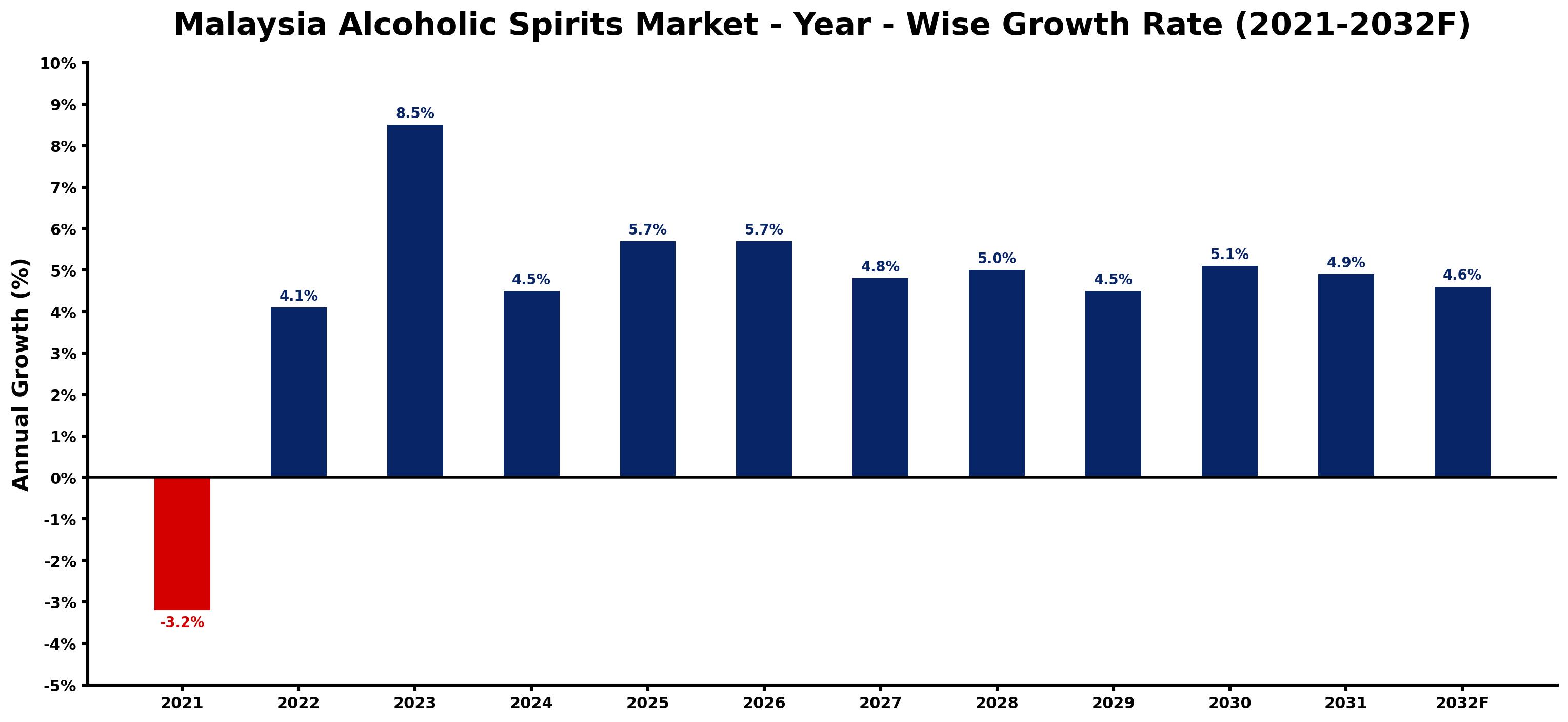
The table below presents the year wise growth rates along with the key drivers influencing the market
| Year | Growth Rate | Major Drivers |
| 2021 | -3.2% | Increased health consciousness and government restrictions led to reduced demand for alcoholic beverages among consumers. |
| 2022 | 4.1% | Changing demographics reflect a youthful population increasingly interested in premium spirits. |
| 2023 | 8.5% | Emerging cocktail culture highlights the importance of innovative product offerings. |
| 2024 | 4.5% | E-commerce platforms expand consumer access to a wider range of spirits. |
| 2025 | 5.7% | Local distilleries enhance market diversity through unique Malaysian flavors and ingredients. |
| 2026 | 5.7% | Sustainability trends encourage brands to adopt eco-friendly production practices. |
| 2027 | 4.8% | Tourism recovery boosts on-trade sales across bars and restaurants nationwide. |
| 2028 | 5.0% | Health-conscious consumers influence brands to develop lower-alcohol and no-alcohol options. |
| 2029 | 4.5% | Social media marketing reshapes brand engagement, attracting younger demographics effectively. |
| 2030 | 5.1% | Collaborations between local artists and brands create culturally resonant marketing campaigns. |
| 2031 | 4.9% | Increased investment in hospitality infrastructure supports market expansion in urban areas. |
| 2032 | 4.6% | Cultural shifts drive interest in artisanal products, fostering niche market growth. |
Note - Market size estimations and growth projections presented in this report are based on 6Wresearch's advanced forecasting approach, validated with industry datasets as of June 2026.
Malaysia Alcoholic Spirits Market Synopsis
The Malaysia Alcoholic Spirits Market is projected to reach 5.7% and witness significant growth during the forecast period (2026-2032). This growth is anticipated to be driven by various factors including an increase in disposable income levels, changing consumer preferences, and a rise in alcohol consumption among younger demographics. Furthermore, the supportive regulatory framework governing alcohol production and distribution in Malaysia is expected to bolster market performance. As new product lines emerge, the overall demand for alcoholic beverages is set to undergo a noteworthy evolution, catering to an increasingly diverse consumer base.
Malaysia Alcoholic Spirits Market Growth Drivers
The expansion of the Malaysia Alcoholic Spirits Market is influenced by several key growth drivers:
- Increasing disposable incomes among Malaysian consumers have created a more favorable environment for spending on premium alcoholic beverages.
- There is a notable rise in consumption among younger consumers, particularly millennials and Generation Z, who are more open to exploring various alcoholic beverage options and trends.
- Government regulations promoting responsible alcohol production and consumption have provided a stable framework that supports industry growth while ensuring public safety.
- Innovation in product offerings, including craft spirits and flavored options, has attracted a wider audience, contributing to increased market demand.
- The growth of the hospitality and tourism sectors in Malaysia has further stimulated demand for alcoholic beverages, especially in urban areas.
Malaysia Alcoholic Spirits Market Trends and Opportunities
The Malaysia Alcoholic Spirits Market is currently witnessing several trends that highlight its dynamic nature:
- There is an increasing trend towards healthier options, with consumers showing an interest in low-calorie and organic alcoholic beverages, reflecting a shift in lifestyle choices.
- Sustainable practices in production and packaging are gaining traction, as consumers are becoming more environmentally conscious, compelling manufacturers to adapt accordingly.
- The rise of e-commerce platforms has transformed the retail landscape, allowing consumers greater access to a variety of alcoholic spirits, facilitating convenient purchasing.
- Cultural shifts towards more casual drinking occasions, such as gatherings and social events, are influencing consumer behavior and encouraging experimentation with new products.
- Brand collaborations and marketing strategies leveraging social media influencers are effectively enhancing brand visibility and consumer engagement.
Malaysia Alcoholic Spirits Market Challenges and Restraints
Despite the promising growth prospects, the Malaysia Alcoholic Spirits Market faces certain challenges:
- Regulatory hurdles can pose challenges, as stringent policies surrounding alcohol sales and marketing may restrict promotional activities and product availability.
- Cultural and societal attitudes towards alcohol consumption can impact market dynamics, especially in regions with conservative views on drinking.
- The potential for economic fluctuations could affect consumer spending power, inadvertently influencing overall alcohol consumption rates.
- Increased competition from alternative beverages, such as non-alcoholic drinks and low-alcohol options, could challenge traditional spirits' market share.
- Supply chain disruptions, which can arise from global events or local conditions, could impact product availability and pricing strategies.
Malaysia Alcoholic Spirits Market Government Investment and Initiatives
The government of Malaysia plays a significant role in shaping the alcoholic spirits market through various initiatives and investments:
- Policies supporting the responsible production and distribution of alcoholic beverages aim to ensure public health and safety, thereby contributing to a stable market environment.
- Investment in local production facilities has been encouraged to reduce import reliance and boost domestic industry growth.
- Public awareness campaigns regarding responsible drinking are reinforced to ensure a balanced consumption culture among citizens.
- The government is also exploring partnerships with educational institutions to promote research and innovation in the alcoholic beverage sector.
- Fiscal policies, including taxation on alcoholic products, are periodically reviewed to balance revenue generation while ensuring market viability.
Malaysia Alcoholic Spirits Market Latest Developments (May 2025 - June 2026)
The Malaysia Alcoholic Spirits Market has experienced various developments between May 2025 and June 2026. These include:
- A surge in craft distilleries has emerged, reflecting consumer interest in unique and artisanal products, contributing to market diversity.
- Companies have intensified their efforts in sustainability initiatives, focusing on eco-friendly packaging and production processes to meet growing consumer demands.
- Digital marketing strategies have become prevalent, particularly on social media platforms, enhancing brand engagement and reaching younger audiences effectively.
- Increased participation in international trade shows and exhibitions has aided local brands in gaining exposure to global trends and innovations.
- Changes in local regulations have prompted refinements in distribution strategies, encouraging the formalization of sales channels and compliance with laws.
Malaysia Alcoholic Spirits Market - Key Attractiveness of the Report
- 10 Years of Market Numbers
- Historical Data Starting from 2022 to 2025
- Base Year: 2025
- Forecast Data until 2032
- Key Performance Indicators Impacting the Market
- Major Upcoming Developments and Projects
Key Highlights of the Report:
- Malaysia Alcoholic Spirits Market Outlook
- Market Size of Malaysia Alcoholic Spirits Market, 2025
- Forecast of Malaysia Alcoholic Spirits Market, 2032
- Historical Data and Forecast of Malaysia Alcoholic Spirits Revenues & Volume for the Period 2022-2032F
- Malaysia Alcoholic Spirits Market Trend Evolution
- Malaysia Alcoholic Spirits Market Drivers and Challenges
- Malaysia Alcoholic Spirits Price Trends
- Malaysia Alcoholic Spirits Porter's Five Forces
- Malaysia Alcoholic Spirits Industry Life Cycle
- Historical Data and Forecast of Malaysia Alcoholic Spirits Market Revenues & Volume By ?Product Type for the Period 2022-2032F
- Historical Data and Forecast of Malaysia Alcoholic Spirits Market Revenues & Volume By Brandy & Cognac for the Period 2022-2032F
- Historical Data and Forecast of Malaysia Alcoholic Spirits Market Revenues & Volume By Rum for the Period 2022-2032F
- Historical Data and Forecast of Malaysia Alcoholic Spirits Market Revenues & Volume By Tequila for the Period 2022-2032F
- Historical Data and Forecast of Malaysia Alcoholic Spirits Market Revenues & Volume By White Spirits for the Period 2022-2032F
- Historical Data and Forecast of Malaysia Alcoholic Spirits Market Revenues & Volume By Whiskey for the Period 2022-2032F
- Historical Data and Forecast of Malaysia Alcoholic Spirits Market Revenues & Volume By Liqueurs for the Period 2022-2032F
- Historical Data and Forecast of Malaysia Alcoholic Spirits Market Revenues & Volume By Others for the Period 2022-2032F
- Historical Data and Forecast of Malaysia Alcoholic Spirits Market Revenues & Volume By Distribution Channels for the Period 2022-2032F
- Historical Data and Forecast of Malaysia Alcoholic Spirits Market Revenues & Volume By Supermarkets & Hypermarkets for the Period 2022-2032F
- Historical Data and Forecast of Malaysia Alcoholic Spirits Market Revenues & Volume By Liquor Specialist Stores for the Period 2022-2032F
- Historical Data and Forecast of Malaysia Alcoholic Spirits Market Revenues & Volume By Grocery Retailers for the Period 2022-2032F
- Historical Data and Forecast of Malaysia Alcoholic Spirits Market Revenues & Volume By Online Retailing for the Period 2022-2032F
- Historical Data and Forecast of Malaysia Alcoholic Spirits Market Revenues & Volume By Other for the Period 2022-2032F
- Malaysia Alcoholic Spirits Import Export Trade Statistics
- Market Opportunity Assessment By ?Product Type
- Market Opportunity Assessment By Distribution Channels
- Malaysia Alcoholic Spirits Top Companies Market Share
- Malaysia Alcoholic Spirits Competitive Benchmarking By Technical and Operational Parameters
- Malaysia Alcoholic Spirits Company Profiles
- Malaysia Alcoholic Spirits Key Strategic Recommendations






































