Malaysia Algorithmic Trading Market Size & Growth Rate (2026-2032)
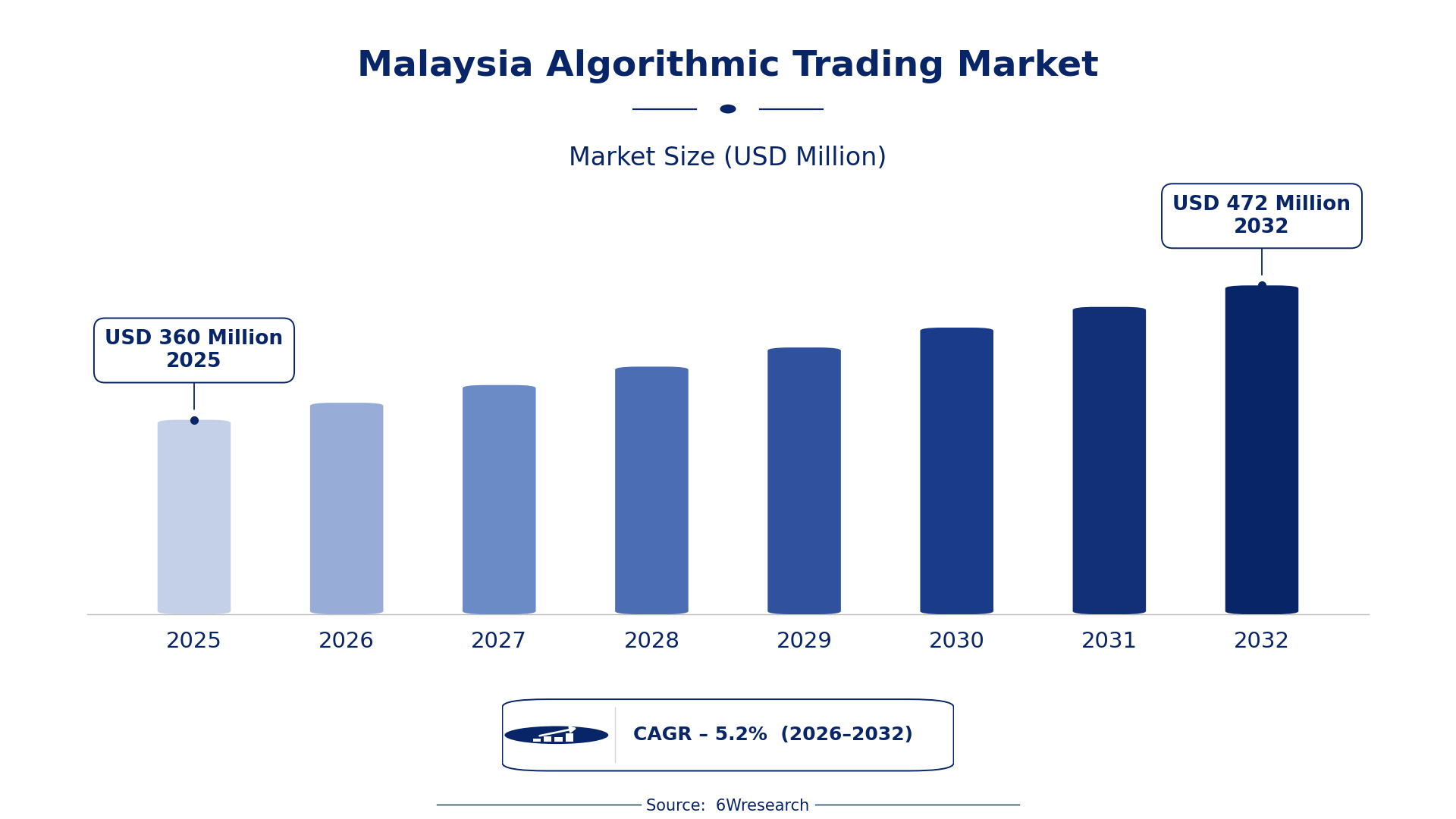
The Malaysia Algorithmic Trading Market was estimated at USD 360 Million in 2025 and is projected to reach USD 472 Million by 2032, growing at a CAGR of 5.2% from 2026 to 2032.
Malaysia Algorithmic Trading Market Synopsis
The escalating sophistication of financial markets is the primary force driving the Malaysia Algorithmic Trading Market. As institutions increasingly adopt automated trading strategies, the demand for algorithmic solutions is surging. This is not merely a trend; it's a fundamental shift in how trading is executed.
Investment firms are increasingly recognizing the importance of data-driven trading strategies. The integration of advanced technologies such as artificial intelligence and machine learning is enabling the development of algorithms that analyze data in real-time, providing traders with a competitive edge that is hard to overlook.
Malaysia Algorithmic Trading Market Year-wise Growth Rate and Key Drivers
This graph illustrates the annual growth rates of the Malaysia Algorithmic Trading Market from 2021 to 2032, highlighting a steady upward trajectory and projected expansion over the forecast period.
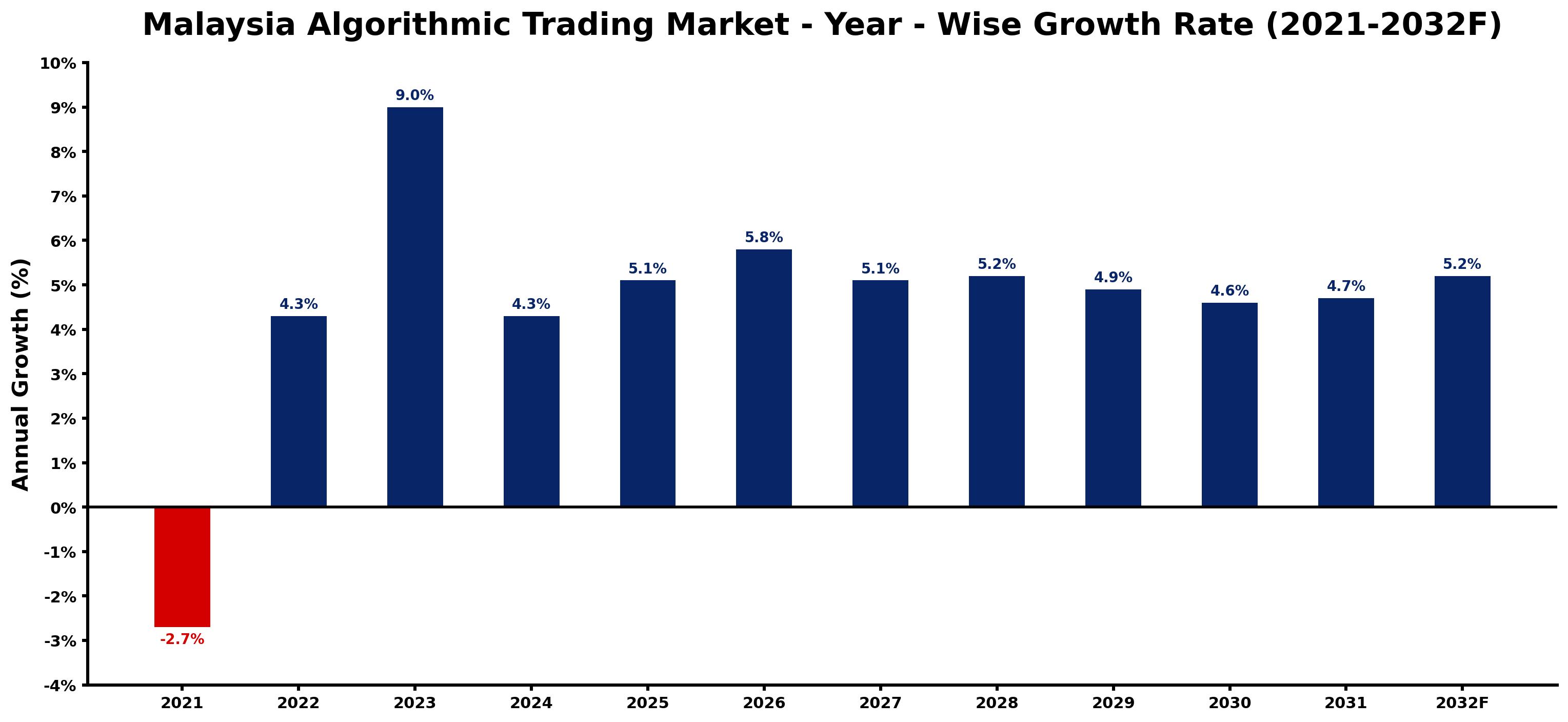
The table below presents the year‑wise growth rates along with the key drivers influencing the market
| Year | Growth Rate | Major Drivers |
| 2021 | -2.7% | Securities Commission Malaysia delayed fintech regulatory approvals. |
| 2022 | 4.3% | Bursa Malaysia's enhanced trading technology integration |
| 2023 | 9.0% | Regulatory encouragement for fintech innovations by Securities Commission |
| 2024 | 4.3% | Increased retail investor participation in stock markets |
| 2025 | 5.1% | Growth in local demand for high-frequency trading platforms |
| 2026 | 5.8% | Emergence of AI-driven investment strategies in Malaysia |
| 2027 | 5.1% | Collaboration between banks and algorithmic trading firms |
| 2028 | 5.2% | Rising awareness of algorithmic trading benefits in investments |
| 2029 | 4.9% | Support from Malaysian government for digital finance initiatives |
| 2030 | 4.6% | Regulatory clarity enhancing trust in algorithmic trade execution |
| 2031 | 4.7% | Increased university programs focused on quantitative finance |
| 2032 | 5.2% | Financial literacy campaigns boosting algorithmic trading adoption |
Note: Market size estimations and growth projections presented in this report are based on 6Wresearch's proprietary forecasting methodology, utilizing the latest available industry data, government publications, and primary research inputs.
Malaysia Algorithmic Trading Market Key Takeaways
Below are some of the specific key takeaways from the market, including:
- The market is witnessing significant growth driven by technological advancements and rising adoption of digital trading platforms.
- Algorithmic trading systems are evolving to incorporate machine learning, allowing for more sophisticated trading strategies.
- The shift towards automation is helping firms reduce transaction costs while enhancing trading efficiencies.
- Regulatory compliance remains a critical challenge, impacting market entry and operational strategies for firms.
- Market volatility and unexpected global events are forcing traders to adapt quickly, highlighting the need for robust algorithms.
Evaluation of Restraints in Malaysia Algorithmic Trading Market
The Malaysia Algorithmic Trading Market faces notable restraints that can hinder its progress. A primary concern is the complexity of regulatory compliance, which demands that firms navigate stringent rules to ensure fair market practices. This often leads to delays in implementing algorithmic solutions.
Additionally, the rapid pace of technological change means that firms must continually invest in advanced infrastructure to maintain competitiveness. This financial burden can be particularly challenging for smaller institutions. Market volatility presents another significant obstacle, as unexpected fluctuations can disrupt algorithmic trading strategies, necessitating constant recalibration and adjustment.
Malaysia Algorithmic Trading Market Trends
Several trends are currently shaping the Malaysia Algorithmic Trading Market. The adoption of artificial intelligence is on the rise, with firms utilizing it to enhance predictive analytics for trading decisions. This trend is driving demand for more sophisticated algorithms capable of processing vast datasets efficiently.
on top of that, a growing interest in environmental, social, and governance (ESG) criteria is influencing trading strategies, pushing firms to integrate ethical considerations into their algorithms. This trend reflects a broader shift towards responsible investing, which is gaining traction among Malaysian investors.
Malaysia Algorithmic Trading Market Opportunities
The future of the Malaysia Algorithmic Trading Market is ripe with opportunities. The ongoing digital transformation within financial services presents a clear opening for firms to innovate. Investing in cloud-based solutions can enhance operational agility and reduce costs, making it easier for firms to scale their algorithmic trading capabilities.
Additionally, partnerships with technology providers can facilitate access to cutting-edge trading tools and systems, allowing firms to improve their trading strategies further. Emerging markets also represent a significant opportunity, as traders seek to capitalize on less saturated regions with high growth potential.
Government Initiatives in the Malaysia Algorithmic Trading Market
Government policies are pivotal in shaping the Malaysia Algorithmic Trading Market. Regulatory frameworks are being developed to foster innovation while ensuring market integrity. This focus on creating a conducive environment for algorithmic trading is essential for attracting both local and international investors.
- A regulatory framework introduced in 2025 aims to streamline compliance processes for algorithmic trading firms, making it easier to operate.
- Currently ongoing is a national initiative to upgrade digital infrastructure, which is critical for supporting advanced trading technologies.
- There are plans for a public-private partnership expected to enhance cybersecurity measures in trading systems by 2027.
- The government is actively promoting financial literacy programs that include training on algorithmic trading for market participants.
- A new policy initiative launched in early 2025 focuses on developing a framework to encourage ethical trading practices within algorithmic trading.
Future Insights of the Malaysia Algorithmic Trading Market
Looking ahead to 2026-2032, the Malaysia Algorithmic Trading Market is set for continued growth. The increasing sophistication of algorithms will likely be paralleled by greater regulatory scrutiny, necessitating a balance between innovation and compliance. As firms invest in more advanced technologies, the emphasis on data security and risk management will only intensify, shaping the competitive landscape.
on top of that, the integration of ESG factors into trading algorithms is expected to become more pronounced. This will not only appeal to ethically-minded investors but also drive market participants to innovate in how they develop and deploy trading strategies.
Malaysia Algorithmic Trading Market Latest Developments
In the past 12-14 months, the Malaysia Algorithmic Trading Market has experienced notable developments. Firms are increasingly implementing AI-driven trading algorithms to enhance execution speed and accuracy. This push towards automation reflects the broader trend of digital transformation within the financial sector.
- A major technology vendor launched an innovative trading platform in Q1 2025, aimed at improving the user experience for algorithmic traders.
- In mid-2025, a leading investment bank initiated a project to integrate machine learning capabilities into its trading operations, enhancing predictive analytics.
- A partnership between two financial institutions is currently underway, focusing on developing a shared algorithmic trading infrastructure that began in early 2025.
- Looking ahead, a rollout of an enhanced compliance monitoring system is planned for late 2026 to support firms in navigating regulatory challenges.
Malaysia Algorithmic Trading Market - Key Attractiveness of the Report
- 10 Years of Market Numbers
- Historical Data Starting from 2022 to 2025
- Base Year: 2025
- Forecast Data until 2032
- Key Performance Indicators Impacting the Market
- Major Upcoming Developments and Projects
Key Highlights of the Report:
- Malaysia Algorithmic Trading Market Outlook
- Market Size of Malaysia Algorithmic Trading Market, 2025
- Forecast of Malaysia Algorithmic Trading Market, 2032
- Historical Data and Forecast of Malaysia Algorithmic Trading Revenues & Volume for the Period 2022-2032F
- Malaysia Algorithmic Trading Market Trend Evolution
- Malaysia Algorithmic Trading Market Drivers and Challenges
- Malaysia Algorithmic Trading Price Trends
- Malaysia Algorithmic Trading Porter's Five Forces
- Malaysia Algorithmic Trading Industry Life Cycle
- Historical Data and Forecast of Malaysia Algorithmic Trading Market Revenues & Volume By Trading Type for the Period 2022-2032F
- Historical Data and Forecast of Malaysia Algorithmic Trading Market Revenues & Volume By Foreign Exchange (FOREX) for the Period 2022-2032F
- Historical Data and Forecast of Malaysia Algorithmic Trading Market Revenues & Volume By Stock Markets for the Period 2022-2032F
- Historical Data and Forecast of Malaysia Algorithmic Trading Market Revenues & Volume By Exchange-Traded Fund (ETF) for the Period 2022-2032F
- Historical Data and Forecast of Malaysia Algorithmic Trading Market Revenues & Volume By Bonds for the Period 2022-2032F
- Historical Data and Forecast of Malaysia Algorithmic Trading Market Revenues & Volume By Cryptocurrencies for the Period 2022-2032F
- Historical Data and Forecast of Malaysia Algorithmic Trading Market Revenues & Volume By Others for the Period 2022-2032F
- Historical Data and Forecast of Malaysia Algorithmic Trading Market Revenues & Volume By Deployment Mode for the Period 2022-2032F
- Historical Data and Forecast of Malaysia Algorithmic Trading Market Revenues & Volume By Cloud for the Period 2022-2032F
- Historical Data and Forecast of Malaysia Algorithmic Trading Market Revenues & Volume By On-premises for the Period 2022-2032F
- Historical Data and Forecast of Malaysia Algorithmic Trading Market Revenues & Volume By Component for the Period 2022-2032F
- Historical Data and Forecast of Malaysia Algorithmic Trading Market Revenues & Volume By Solutions for the Period 2022-2032F
- Historical Data and Forecast of Malaysia Algorithmic Trading Market Revenues & Volume By Services for the Period 2022-2032F
- Historical Data and Forecast of Malaysia Algorithmic Trading Market Revenues & Volume By Enterprise Size for the Period 2022-2032F
- Historical Data and Forecast of Malaysia Algorithmic Trading Market Revenues & Volume By Small and Medium-sized Enterprises (SMEs) for the Period 2022-2032F
- Historical Data and Forecast of Malaysia Algorithmic Trading Market Revenues & Volume By Large Enterprises for the Period 2022-2032F
- Malaysia Algorithmic Trading Import Export Trade Statistics
- Market Opportunity Assessment By Trading Type
- Market Opportunity Assessment By Deployment Mode
- Market Opportunity Assessment By Component
- Market Opportunity Assessment By Enterprise Size
- Malaysia Algorithmic Trading Top Companies Market Share
- Malaysia Algorithmic Trading Competitive Benchmarking By Technical and Operational Parameters
- Malaysia Algorithmic Trading Company Profiles
- Malaysia Algorithmic Trading Key Strategic Recommendations






































